Vegetable Tanning vs Chrome Tanning: 7 Powerful Facts?

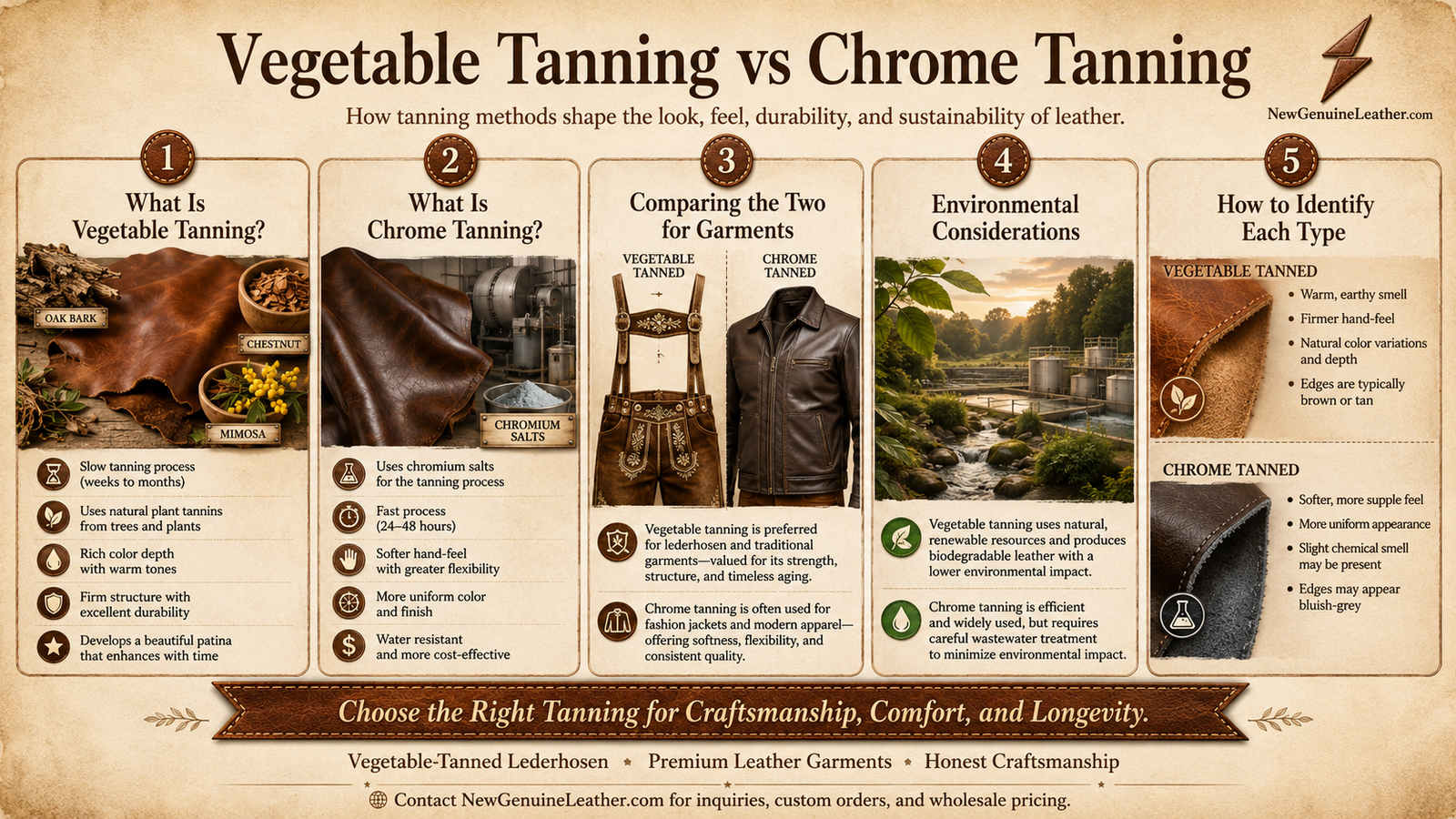
Vegetable Tanning vs Chrome Tanning is an important comparison for anyone buying leather jackets, skirts, gloves, bags, belts, footwear, or traditional lederhosen. Both methods transform animal hide into usable leather, but they create noticeable differences in softness, structure, colour, ageing, cost, and performance.
At New Genuine Leather (NGL), we believe wholesale and private-label buyers should understand these differences before approving leather samples. There is no universal winner. The right tanning method depends on the product, desired appearance, comfort requirements, target price, and intended use.
What Does Leather Tanning Do?
Untreated animal hide would naturally decompose. Tanning stabilises the collagen structure inside the hide, converting it into a durable material that can withstand regular handling and long-term use.
After tanning, leather can be retanned, dyed, softened, milled, embossed, polished, or coated to achieve a specific appearance and performance.
The Leather Working Group’s guide to modern leather production explains that chrome tanning uses chromium salts, while vegetable tanning relies on tannins extracted from plant sources such as bark, wood, leaves, and fruit.
Vegetable Tanning vs Chrome Tanning: The Main Difference
Vegetable tanning is the older and more traditional method. Plant-based tannins penetrate the hide and generally create firm, structured leather with warm natural tones and strong shape retention.
Chrome tanning normally uses chromium(III) salts. It is faster and commonly creates leather that is softer, lighter, more flexible, and suitable for a wider range of colours and finishes.
Chrome tanning is currently the dominant commercial method, while vegetable tanning remains especially important for premium craft products, structured accessories, belts, soles, and traditional leather goods.
1. Different Tanning Materials
Vegetable-tanned leather is produced using natural tannins obtained from trees and plants. Common sources include chestnut, mimosa, quebracho, and tara.
These tannins often give the finished material a full, substantial feel. They also make the leather suitable for carving, stamping, embossing, shaping, and moulding.
Chrome-tanned leather uses mineral tanning salts based mainly on chromium(III). The tanning chemicals penetrate the hide efficiently and produce consistent results within a shorter manufacturing cycle.
Chromium(VI) is not the tanning chemical normally intended for this process. However, it may form under unsuitable processing, chemical, ageing, or storage conditions. Responsible manufacturers reduce this risk through controlled production and laboratory testing.
2. Production Speed and Colour Consistency
Vegetable tanning normally requires more processing time. It may also produce greater natural variation from one hide to another.
This variation is desirable in heritage wallets, handcrafted belts, saddlery, structured bags, watch straps, and traditional leather accessories. Each item can develop an individual appearance.
However, greater variation can create challenges when a wholesale customer needs hundreds or thousands of products in an almost identical shade.
Chrome tanning supports faster and more repeatable production. Chrome-tanned leather accepts dyes and finishing treatments effectively, helping manufacturers create consistent black, brown, red, blue, white, and fashion colours.
For OEM and private-label buyers, this consistency can simplify sample approval, bulk production, and future repeat orders.
3. Appearance and Natural Patina
Vegetable-tanned leather commonly begins with tan, honey, beige, or warm brown undertones. It may also be dyed in darker colours.
As the material is handled and exposed to light, conditioning, and regular wear, it develops a richer patina. Small scratches, folds, and gradual colour changes can become part of the product’s natural personality.
Chrome-tanned leather usually maintains its original shade more consistently. Its final look depends heavily on the finishing process.
It can be produced with smooth, pebbled, corrected-grain, aniline, semi-aniline, nubuck, suede, printed, or protected surfaces.
When comparing Vegetable Tanning vs Chrome Tanning for appearance, vegetable tanning is suitable for natural character and visible ageing. Chrome tanning is usually better for broad colour choice, softer drape, and greater consistency.
4. Softness, Structure, and Comfort
Vegetable-tanned leather is generally firmer when new. It holds its shape well, making it suitable for products that need structure.
Typical applications include:
- Belts and watch straps
- Card holders and wallets
- Structured handbags
- Leather soles
- Saddlery and craft products
- Moulded leather accessories
The material normally softens with use, but it retains more body than most garment leather.
Chrome-tanned leather is usually softer and more flexible from the beginning. This makes it suitable for products that must move, bend, or sit comfortably against the body.
It is commonly selected for leather jackets, leather skirts, trousers, gloves, footwear uppers, upholstery, and soft handbags.
The tanning method is not the only factor affecting softness. Animal type, thickness, grain quality, retanning, fatliquoring, milling, and finishing also influence the final feel.
For this reason, New Genuine Leather recommends approving a physical sample before placing a bulk order.
5. Water, Heat, and Everyday Performance
Vegetable-tanned leather is relatively porous and can darken after contact with water. Without a suitable protective finish, rain and liquid spills may leave visible marks.
Repeated soaking followed by rapid drying may also make the material stiff or distorted. Vegetable-tanned products should therefore be dried naturally and kept away from radiators, hair dryers, and intense direct heat.
Chrome-tanned leather generally offers better resistance to moisture and heat. It often performs well in garments and accessories exposed to movement, perspiration, changing weather, or frequent handling.
However, chrome-tanned leather is not automatically waterproof. Surface finish, stitching, lining, seam construction, and aftercare still affect the performance of the finished product. The Leather Working Group describes chrome-tanned leather as supple, versatile, durable, and comparatively water-resistant.
6. Environmental and Sustainability Considerations
The environmental comparison is more complicated than saying vegetable tanning is always sustainable and chrome tanning is always harmful.
Vegetable tanning uses plant-derived tannins, but the production process still requires water, energy, chemicals, wastewater treatment, and responsible sourcing.
Chrome tanning is efficient and produces highly versatile leather. However, chromium recovery, wastewater treatment, chemical storage, employee protection, and restricted-substance control must be managed correctly.
The European Commission’s best available techniques for hide and skin tanning focus on efficient chemical use, water management, waste reduction, emission control, and responsible processing rather than judging sustainability from the tanning agent alone.
A well-managed chrome tannery may perform more responsibly than a poorly controlled vegetable tannery, and the reverse may also be true.
Wholesale buyers should evaluate:
- Tannery audit status
- Hide traceability
- Wastewater treatment
- Chemical-management procedures
- Restricted-substance reports
- Water and energy management
- Expected product durability
The Leather Working Group supplier directory can also help buyers identify audited leather manufacturers and tanneries.
7. Best Product Applications
Vegetable-tanned leather works particularly well for products requiring structure, moulding, carving, or visible patina.
Common uses include:
- Premium belts
- Structured handbags
- Wallets and card holders
- Watch straps
- Saddlery
- Leather soles
- Craft and heritage goods
- Traditional accessories
Chrome-tanned leather is normally preferred when softness, flexibility, comfort, and colour consistency are priorities.
It is widely used for:
- Leather jackets
- Leather skirts and trousers
- Gloves
- Shoe uppers
- Upholstery
- Soft handbags
- Fashion accessories
- Flexible embroidered products
Some manufacturers use combination tanning or retanning to balance firmness, softness, colour response, and performance. Buyers should therefore request a complete leather specification rather than relying only on a general label.
Which Tanning Method Is Better for Your Product?
For a heritage wallet, firm belt, structured satchel, or handcrafted accessory, vegetable-tanned leather may offer the desired shape and natural character.
For a fitted jacket, leather skirt, glove, soft bag, or flexible fashion garment, chrome-tanned leather will often provide better drape and immediate comfort.
For custom lederhosen, firmer leather can support traditional shape and detailed embroidery. Softer leather may provide greater freedom of movement for festivals, events, and repeated seasonal use.
New Genuine Leather can develop samples according to your required leather thickness, colour, finish, embroidery, hardware, branding, and size range.
Questions Wholesale Buyers Should Ask
Before placing a production order, ask the manufacturer to confirm:
- Animal type and country of origin
- Leather grade and grain type
- Vegetable, chrome, or combination tanning
- Thickness and thickness tolerance
- Colour and finish standard
- Tannery source
- Testing requirements
- Minimum order quantity
- Sample and production lead times
Always request a physical sample. Examine the grain, softness, edge, smell, colour consistency, stitching response, and behaviour when the material is folded.
Private-label buyers should also request compliance and restricted-substance reports appropriate for their destination market.
For additional technical background, the Leather Naturally tanning-method overview provides a helpful industry reference.
Care Differences
Vegetable-tanned leather needs gentle cleaning, controlled conditioning, and protection from prolonged moisture and sunlight.
Gradual darkening and patina should be expected. These changes are usually considered part of the material’s appeal rather than a manufacturing defect.
Chrome-tanned leather can be easier to maintain, but its care routine must match the surface finish. A product with suede, nubuck, aniline, or protected leather may require different cleaning products.
Avoid household detergents, cooking oils, soaking, and direct heat on both leather types. Test every cleaner or conditioner on a hidden section first.
Frequently Asked Questions
Is vegetable-tanned leather real leather?
Yes. It is real animal hide stabilised using tannins obtained mainly from plant sources.
Is chrome-tanned leather genuine leather?
Yes. Chrome tanning is a processing method. It does not mean that the finished material is artificial or synthetic.
Which tanning method lasts longer?
Both methods can produce long-lasting leather when the hide quality, construction, use, and care are appropriate.
Vegetable-tanned leather is valued for structure and patina. Chrome-tanned leather is valued for flexibility, comfort, and everyday performance.
Which type is more expensive?
Vegetable-tanned leather is often more expensive because of its slower manufacturing process, lower production volumes, and use in premium craft goods.
The final price still depends on the animal type, hide quality, thickness, finish, labour, order quantity, and product construction.
Final Thoughts
Vegetable Tanning vs Chrome Tanning does not have one correct answer for every leather product.
Vegetable tanning provides traditional character, firmness, shape retention, tooling ability, and distinctive patina. Chrome tanning provides softness, production efficiency, colour flexibility, consistency, and broad product performance.
The right choice should match the product design, target customer, comfort requirements, care expectations, intended use, and price point.
New Genuine Leather manufactures custom leather garments and accessories for wholesale, OEM, and private-label buyers worldwide. We can develop leather jackets, skirts, gloves, bags, lederhosen, and other custom products according to your specifications.
Follow Us
Instagram: https://www.instagram.com/newgenuineleather/
WhatsApp: https://wa.me/+923008758207
