

History of Lederhosen: 7 Fascinating Milestones

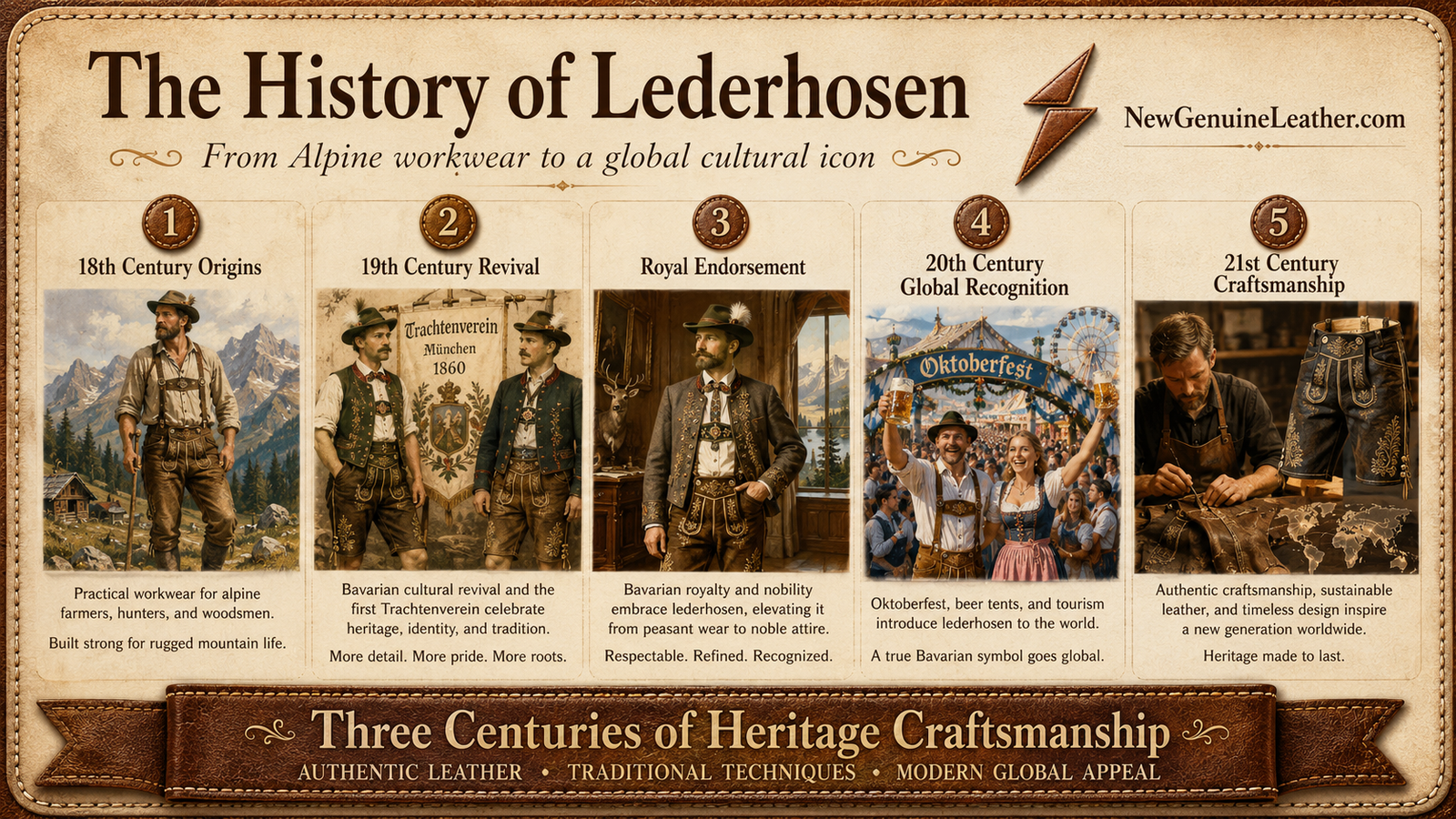
The history of Lederhosen is a story of practical workwear, skilled leather craftsmanship, regional pride, and cultural revival. Today, Lederhosen are immediately associated with Bavaria, Austria, Alpine festivals, and Oktoberfest. However, they were not originally designed as festival costumes or tourist clothing.
Early Lederhosen were made for people who needed strong, flexible trousers capable of surviving physical work in demanding rural environments. Farmers, hunters, horse riders, craftsmen, and mountain workers valued leather because it resisted tearing and lasted longer than many ordinary woven fabrics.
Over time, these practical trousers developed into an important part of Alpine identity. Decorative embroidery, regional cuts, traditional buttons, suspenders, and better-quality hides transformed simple work clothing into garments worn at celebrations, weddings, cultural gatherings, and public festivals.
This guide explores seven important stages in the development of Lederhosen and explains why the garment continues to influence traditional clothing and modern leather fashion.
What Does the Word Lederhosen Mean?
“Lederhosen” comes from two German words: Leder, meaning leather, and Hosen, meaning trousers. In standard German usage, Lederhose is singular, while Lederhosen is plural.
English speakers commonly use “Lederhosen” to describe the traditional short or knee-length leather trousers associated with southern Germany and Austria. Longer styles extending below the knee may also be described as Bundhosen.
Lederhosen are part of a broader clothing tradition known as Tracht. Tracht refers to traditional regional dress rather than one single German national costume. Different areas developed their own colors, embroidery patterns, hats, shirts, waistcoats, footwear, and trouser cuts.
This distinction matters because Lederhosen are strongly connected with Bavaria and Alpine regions, but they should not be treated as the historic everyday clothing of every part of Germany. Bavaria’s museum network also highlights how traditional clothing once made regional origins and local customs visibly recognizable.
1. The History of Lederhosen Began with Practical Workwear
The earliest chapter in the history of Lederhosen is based on function rather than fashion. Leather breeches were worn in different parts of Europe because leather provided protection during riding, hunting, farming, and outdoor labor.
In Alpine areas, workers needed clothing that could tolerate contact with rocks, branches, animals, tools, and changing weather. Leather was useful because it was durable and could become more flexible with repeated wear.
Unlike delicate formal trousers, leather garments did not need to remain perfectly smooth. Marks, fading, and surface variation became part of their appearance. A well-used pair could reflect the wearer’s work and daily life.
The shorter cut also supported movement when walking across steep ground. Knee-length and longer variations offered additional protection, while shorter versions made climbing and physical work easier.
This practical origin explains why high-quality Lederhosen are still judged by their leather strength, seam reinforcement, comfort, and freedom of movement—not only by their decoration.
2. European Breeches Developed a Distinctive Bavarian Character
Leather trousers were not exclusive to Bavaria in their earliest forms. Similar breeches were used by riders, hunters, agricultural workers, and outdoor laborers in several European regions.
What changed was the way Alpine communities adapted them. Bavarian and Austrian makers developed recognizable cuts, front flaps, side closures, embroidery, suspenders, and regional decorative details. The drop-front construction became particularly associated with Bavarian styling.
By the eighteenth and nineteenth centuries, these details helped distinguish Alpine Lederhosen from more general European leather breeches. Clothing became a way to express local identity as well as occupation.
The materials also varied according to availability and the buyer’s budget. Cowhide could provide strength and accessibility, while deer or goatskin could produce softer, lighter, and more prestigious garments.
Today, traditional specialists still produce Lederhosen from deer and cow leather, often combining regional tanning practices with hand-finished embroidery. An Associated Press feature on a traditional German leather tailor shows how these methods continue in modern workshops.
3. Lederhosen Became Part of Regional Tracht
As Lederhosen became more established, they developed beyond simple protective trousers. Communities began adding features connected with their local customs and social identity.
Embroidery could include flowers, leaves, vines, animals, hunting imagery, or geometric patterns. The style and placement of these motifs varied among regions and makers.
Buttons were also important. Traditional-looking horn, bone, wood, or metal buttons gave the garment a distinctive finish. Decorative stitching around the bib, pockets, legs, and side seams demonstrated the maker’s skill.
Suspenders were not merely accessories. They helped secure the trousers during work and movement. Embroidered H-shaped chest pieces later became among the most recognizable features of Bavarian Lederhosen.
Because regional Tracht was never entirely uniform, historical Lederhosen appeared in different lengths and colors. Brown and black remained common, but shade, cut, embroidery, and hardware could indicate a specific area or tradition.
4. Industrialization Threatened Traditional Clothing
The nineteenth century brought major economic and social changes to Europe. Industrial textile production made factory-manufactured clothing easier to obtain, while urban fashion increasingly influenced rural communities.
Traditional handmade clothing required time, specialist skills, and costly materials. As inexpensive fabric trousers became more widely available, Lederhosen lost some of their earlier role as ordinary workwear outside the Alpine heartland.
Modernization also changed how people viewed regional dress. Some considered traditional garments old-fashioned, rural, or unsuitable for expanding towns and professional workplaces.
This decline could have caused many local designs to disappear. However, the changing social environment also encouraged cultural organizations to document and preserve traditional clothing.
The survival of Lederhosen was therefore not automatic. It depended partly on leather workers, local communities, cultural associations, and supporters who believed that regional dress deserved protection.
5. The Great Nineteenth-Century Lederhosen Revival
One of the most important moments in the history of Lederhosen occurred during the nineteenth-century revival of Alpine traditions.
Cultural preservation societies began promoting regional clothing, music, dance, and customs. These organizations are commonly known as Trachtenvereine, or traditional costume associations.
The associations helped establish guidance about appropriate materials, embroidery, colors, and complete outfits. They also encouraged people to wear traditional dress during festivals, processions, performances, and community gatherings.
Royal and aristocratic interest gave the movement greater visibility. Members of the Bavarian and Austrian upper classes wore Alpine clothing while hunting or visiting rural regions. This helped transform Lederhosen from purely working-class clothing into a respected symbol of regional pride.
The revival also created a stronger public connection between Lederhosen and Bavaria. What had begun as practical clothing was becoming cultural heritage.
6. The Connection Between Lederhosen and Oktoberfest
Lederhosen are now strongly associated with Oktoberfest, but the relationship developed gradually.
Munich’s Oktoberfest began in 1810 as a celebration connected with the marriage of Crown Prince Ludwig and Princess Therese. Traditional clothing appeared during nineteenth-century festival events and cultural processions, but Lederhosen were not always the standard outfit for every visitor.
For much of Oktoberfest’s history, attendees also wore ordinary contemporary clothing. The modern expectation that visitors should arrive in Lederhosen or dirndls became especially widespread much later.
According to Munich’s official Oktoberfest clothing guide, the relationship between traditional Tracht and the festival reaches back to its nineteenth-century history.
Today, Lederhosen are worn at Oktoberfest celebrations throughout Germany and internationally. They are also popular at weddings, folk-dance events, harvest festivals, themed restaurants, tourism events, and Bavarian cultural gatherings.
This international exposure has made Oktoberfest one of the strongest drivers of modern Lederhosen demand.
7. The History of Lederhosen Enters the Modern Fashion Era
Modern Lederhosen balance tradition with commercial fashion. Authentic garments may still feature natural leather, reinforced seams, hand or machine embroidery, traditional bibs, decorative buttons, and structured suspenders.
However, contemporary collections offer far more variety. Buyers can choose short, knee-length, or long cuts; light tan, antique brown, dark brown, gray, or black finishes; minimal embroidery or heavily decorated designs; and traditional or modern fits.
Women’s Lederhosen have also become increasingly visible in modern festival fashion. While they are not identical to every historic male garment, they represent the continuing evolution of Alpine-inspired clothing.
High-quality bespoke Lederhosen remain valuable because of the labor required for selecting leather, cutting panels, fitting the garment, completing the embroidery, and attaching hardware. Traditional specialists may create separate everyday and ceremonial pairs for their customers.
The garment has therefore moved through several roles: workwear, regional clothing, heritage dress, festival outfit, fashion product, and international retail category.
How Traditional Lederhosen Were Made
Traditional production started with suitable animal hide. The tanning process preserved the hide and changed it into material that could be cut, stitched, softened, dyed, and worn.
The maker selected sections of leather based on thickness, flexibility, surface quality, and the intended style. Main panels required strength, while areas around the waistband, pockets, and suspenders needed reinforcement.
After the pattern was cut, the pieces were stitched together and decorative elements were added. Embroidery required careful placement so that both sides of the garment remained balanced.
Buttons, buckles, straps, piping, pocket flaps, and the front bib completed the design. A premium pair could take considerable time to finish, especially when adjusted to an individual customer’s measurements.
Modern manufacturing has made production faster, but the same quality principles remain important: suitable leather, consistent cutting, reinforced seams, accurate sizing, secure hardware, and clean embroidery.
Why Genuine Leather Became So Important
Leather was central to the history of Lederhosen because it offered a combination of strength, flexibility, and character.
A natural hide is not completely uniform. It may contain differences in grain, tone, texture, and surface markings. These variations give each garment an individual appearance.
Leather also develops a patina through handling, movement, light, and age. Instead of looking exactly the same after years of use, a well-maintained pair may become softer and visually richer.
Synthetic materials can recreate the general appearance at a lower price, but they do not always provide the same aging behavior, repairability, or long-term feel.
For wholesale buyers, leather selection is therefore one of the most important discussions to have with a manufacturer before approving production.
The Cultural Meaning of Lederhosen Today
Modern Lederhosen communicate more than festival participation. For many wearers, they represent family traditions, regional belonging, craftsmanship, and respect for Alpine culture.
A pair may be purchased for a wedding, inherited from a relative, worn by a folk-dance group, or reserved for annual celebrations. Others purchase Lederhosen simply because they appreciate the design and durability.
The Bavarian Museum Landscape offers useful context on how regional clothing and customs historically helped distinguish different areas of Bavaria.
International buyers should therefore treat Lederhosen as a garment with genuine cultural roots rather than only as a costume. Thoughtful materials, appropriate decoration, and accurate construction help maintain that connection.
History of Lederhosen and Modern Wholesale Demand
The international popularity of Oktoberfest has created reliable demand among retailers, event suppliers, costume businesses, rental companies, hospitality brands, and private-label buyers.
Wholesale customers typically require consistent leather shades, dependable measurements, secure embroidery, reinforced stress points, and accurate repeat production. These requirements connect directly to the garment’s practical origins.
OEM production also allows buyers to select leather type, length, color, embroidery, suspenders, buttons, labels, packaging, and size ranges.
At New Genuine Leather (NGL), we manufacture custom Lederhosen for wholesale, OEM, and private-label customers. Our goal is to preserve the recognizable character of Bavarian-inspired leather clothing while meeting the sizing, branding, and production requirements of modern international markets.
Explore our custom leather manufacturing services or follow New Genuine Leather on Instagram for product designs, leather craftsmanship, and production updates.
Frequently Asked Questions
Where did Lederhosen originate?
Lederhosen are most strongly associated with Bavaria, Austria, and the Alpine regions of Central Europe. Their development was influenced by practical European leather breeches worn for riding, hunting, farming, and outdoor work.
Were Lederhosen originally worn at Oktoberfest?
They were originally practical working garments. Their close association with Oktoberfest developed through cultural revival, festival processions, tourism, and modern Tracht fashion.
What were traditional Lederhosen made from?
Traditional versions were produced from animal hides such as deer, goat, or cow leather. The material depended on regional availability, desired softness, durability, and price.
Why do Lederhosen have embroidery?
Embroidery adds decoration and can reflect Alpine plants, animals, hunting culture, local styles, or the maker’s craftsmanship. Modern buyers can also request customized embroidery.
Are Lederhosen still worn in Bavaria?
Yes. They are worn at weddings, festivals, cultural gatherings, hunting events, family celebrations, and Oktoberfest. Some people own both everyday and special-occasion pairs.
Final Thoughts
The history of Lederhosen shows how a practical garment can become an enduring cultural symbol. Leather trousers first valued for strength and freedom of movement gradually acquired regional cuts, embroidery, suspenders, and decorative craftsmanship.
Although industrialization reduced their everyday use, cultural preservation movements helped protect the tradition. Oktoberfest and international Bavarian celebrations later introduced Lederhosen to audiences around the world.
Today, they remain a connection between historic Alpine workwear and modern fashion. Whether produced for cultural events, retail collections, rental businesses, or private labels, well-made Lederhosen continue to represent durability, craftsmanship, and distinctive Bavarian-inspired style.
Looking for authentic Lederhosen for wholesale or private-label production?
New Genuine Leather (NGL) manufactures custom leather Lederhosen with selectable colors, embroidery, suspenders, sizing, branding, and packaging.
Website: New Genuine Leather
Follow Us
Instagram: https://www.instagram.com/newgenuineleather/
WhatsApp: https://wa.me/+923008758207
