

Lederhosen Size Guide: 7 Essential Steps to Perfect Fit

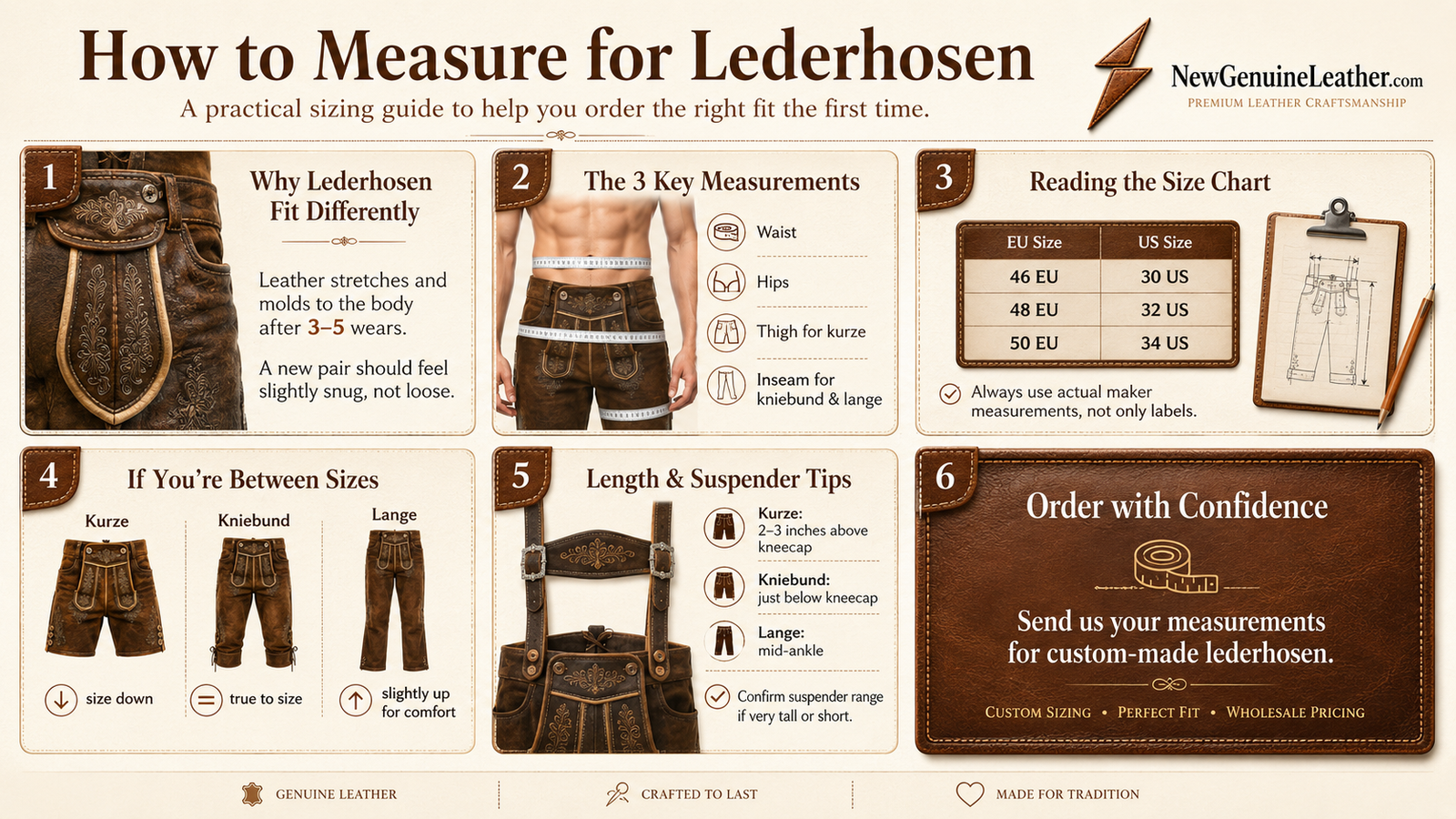
A reliable Lederhosen size guide is essential because traditional leather trousers fit differently from ordinary jeans, shorts, or costume pants. Lederhosen are shaped from genuine leather, include structured waistbands, and are often worn with suspenders. Choosing the wrong size can result in uncomfortable pressure, excessive looseness, or an incorrect traditional silhouette.
Whether you are buying one pair for Oktoberfest or sourcing hundreds of pieces for a wholesale collection, accurate body measurements should always come before selecting a size. This guide explains how to measure correctly, interpret common European sizing, and communicate sizing requirements to your manufacturer.
At New Genuine Leather (NGL), we manufacture custom lederhosen for international wholesalers, retailers, rental businesses, costume suppliers, and private-label brands. Our goal is to help buyers achieve consistent sizing, comfortable movement, and dependable quality across every production run.
Why a Lederhosen Size Guide Is Important
Lederhosen should feel fitted without restricting walking, sitting, or dancing. Unlike lightweight fabric trousers, genuine leather has more structure and gradually softens according to the wearer’s body shape.
A pair that feels slightly firm during the first fitting may become more comfortable after several wears. However, leather should never feel painfully tight around the waist, crotch, seat, or thighs.
Sizing labels also vary between manufacturers. An EU size 50 from one supplier may not have exactly the same finished garment measurements as an EU size 50 from another supplier. International clothing standards therefore distinguish between body measurements and finished garment measurements. ISO’s clothing-size guidance explains that size designation is based primarily on body dimensions, while designers and manufacturers add allowances according to the garment’s style and intended fit.
That is why this Lederhosen size guide focuses on measuring the person first rather than relying only on an existing trouser label.
Lederhosen Size Guide: Measurements You Need
Use a flexible measuring tape and wear light clothing while measuring. Stand naturally, keep the tape level, and avoid pulling it too tightly.
For the most accurate result, ask another person to take the measurements. Record each measurement in both centimetres and inches when ordering from an international manufacturer.
1. Measure the Wearing Waist
Measure around the position where the lederhosen waistband will sit. Traditional lederhosen may sit slightly higher than modern low-rise jeans, so do not automatically measure at the same point as your everyday trousers.
Keep one finger underneath the measuring tape to allow normal breathing and movement. Do not hold your stomach in or add several unnecessary centimetres.
The waist measurement is normally the most important number in a Lederhosen size guide, but it should always be checked alongside the hip and thigh measurements.
2. Measure the Full Hip or Seat
Wrap the tape around the fullest part of the hips and seat. Make sure the tape remains horizontal across the front and back.
The seat measurement determines whether the lederhosen will have enough room for sitting, bending, and moving comfortably. A correct waist size with an insufficient seat allowance can cause pulling across the front flap, pockets, or back seam.
Retailers should pay particular attention to this measurement when developing extended sizes or serving customers with different body proportions.
3. Measure the Thigh
Measure around the widest part of one upper thigh. Keep your weight balanced evenly across both feet and do not flex the leg.
Traditional leather trousers may have a relatively close thigh fit, but they should not restrict movement. Tightness in this area can place unnecessary stress on the crotch seam, side buttons, embroidery panels, and pocket openings.
For sports events, dance groups, rental businesses, or active Oktoberfest customers, consider requesting a slightly more relaxed thigh allowance.
4. Check the Front and Back Rise
The rise is the distance from the front waistband, through the crotch, to the back waistband. This measurement affects how high the lederhosen sit and how comfortable they feel when the wearer bends or sits.
A rise that is too short may pull at the crotch and waistband. A rise that is too long can create excess material and an untidy appearance.
Rise requirements often vary by market. Some customers prefer an authentic higher-waisted Bavarian fit, while fashion-focused buyers may request a more contemporary cut.
5. Measure the Outseam Length
Measure from the top of the waistband down the outside of the leg to the intended hem position. This is especially important because lederhosen are produced in several lengths.
Short lederhosen normally finish above the knee. Knee-length styles finish around or just below the knee, while longer traditional versions extend farther down the lower leg.
Do not select length based only on the product photograph. Use the measurement to determine where the garment will finish on the actual wearer.
6. Measure the Inseam
The inseam runs from the crotch seam down the inside of the leg to the hem. It helps confirm both the garment length and the correct leg opening position.
For a short style, measure to the desired point above the knee. For knee-length lederhosen, measure to the intended lower edge near the knee.
Providing both inseam and outseam measurements reduces uncertainty when ordering custom designs.
7. Confirm Suspender Length
Suspenders affect how the lederhosen sit at the waist. Measure from the front attachment point, over the shoulder, to the corresponding attachment point at the back.
Adjustable suspenders offer flexibility, but they must still have a suitable basic length. Suspenders that are too short can pull the waistband upward, while excessively long straps may not provide enough support.
For bulk production, request an adjustable range for every garment size rather than using one universal suspender length.
Practical Lederhosen Size Chart
The following Lederhosen size guide chart is a general purchasing reference. It is not a universal standard, because pattern shapes and fit allowances vary between manufacturers.
| EU Size | Approx. Waist | Approx. Waist | Suggested International Size |
|---|---|---|---|
| 44 | 76–80 cm | 30–31.5 in | XS |
| 46 | 80–84 cm | 31.5–33 in | S |
| 48 | 84–88 cm | 33–34.5 in | M |
| 50 | 88–92 cm | 34.5–36 in | M–L |
| 52 | 92–96 cm | 36–38 in | L |
| 54 | 96–100 cm | 38–39.5 in | XL |
| 56 | 100–104 cm | 39.5–41 in | 2XL |
| 58 | 104–108 cm | 41–42.5 in | 3XL |
| 60 | 108–112 cm | 42.5–44 in | 4XL |
Always compare the customer’s hip and thigh measurements with the manufacturer’s finished garment chart. Do not choose a size from waist measurements alone.
The official ISO 8559-1 clothing-size standard provides internationally recognized principles for taking body measurements. The related ISO 8559-2 size designation standard explains the relationship between body dimensions and garment sizing. Add these as normal follow links in WordPress rather than selecting the “nofollow” option.
How Should Lederhosen Fit?
A good fit should be close at the waist and seat without creating sharp pulling lines. The wearer should be able to sit, walk, climb stairs, and bend the knees comfortably.
The waistband should remain secure without requiring the suspenders to carry the garment’s entire weight. The suspenders should support the traditional shape rather than pulling the trousers tightly upward.
The front flap should lie flat, and the side seams should remain straight. Pockets should not spread open, and buttons should close without excessive tension.
Use the Lederhosen size guide as a starting point, but also consider the leather type. Softer suede leather may feel more flexible from the first wear, while thicker leather can require a longer breaking-in period.
What to Do When You Are Between Sizes
When the waist falls between two sizes, check the hip and thigh measurements before making a decision. Choose the larger size when the seat or thighs are close to the maximum measurement shown on the chart.
A slightly loose waistband may be adjusted through suspenders, side adjustments, or minor tailoring. A pair that is too tight across several areas is more difficult to correct.
For custom production, provide the complete measurement set instead of requesting only a standard label. NGL can use waist, seat, thigh, rise, inseam, outseam, and suspender measurements when developing samples.
Lederhosen Size Guide for Wholesale Orders
Wholesale buyers need more than a basic small-to-large range. They need a planned size distribution based on the target market, customer age group, sales history, and intended fit.
A retailer serving Germany or Austria may require a different size ratio from a costume supplier serving the United States or Australia. Rental companies may also need more adjustable designs because garments will be worn by many different customers.
Before confirming production, request the following:
- A finished garment measurement chart for every size
- A physical sample in a central or best-selling size
- Waist, hip, thigh, rise, inseam, and outseam specifications
- Acceptable production tolerances
- Grading rules between consecutive sizes
- Adjustable suspender ranges
- Separate charts for men, women, and children
For private-label orders, the approved size chart should become part of the production specification. This reduces inconsistencies between the approved sample and the final bulk order.
Common Lederhosen Sizing Mistakes
The most common mistake is ordering the same size as ordinary jeans without checking measurements. Jeans labels may use vanity sizing, stretch fabrics, or different waistband positions.
Another mistake is measuring an old pair of trousers instead of measuring the body. Garment measurements can still be useful, but only when the existing garment already fits correctly and the measuring method is clearly defined.
Buyers also sometimes ignore thigh circumference and rise. These measurements strongly influence comfort, especially when the lederhosen have a fitted traditional cut.
Finally, do not assume that leather will stretch enough to correct a significantly undersized garment. Genuine leather can soften and shape with wear, but it cannot compensate for major sizing errors.
Lederhosen Size Guide for Children
Children’s lederhosen should allow more movement and reasonable growth room. Avoid ordering an excessively tight waist or thigh fit, even when the garment is intended for a single event.
Adjustable suspenders and waistband features are particularly useful for children. The hem should also remain clear of the knee so the child can walk, sit, and play comfortably.
For wholesale children’s collections, use height, waist, hip, and age only as combined indicators. Age alone is not a dependable size measurement because children of the same age can have very different proportions.
Frequently Asked Questions
Should lederhosen fit tightly?
They should fit closely but should not feel painful or restrict movement. Slight firmness is normal with new leather, but the wearer must still be able to sit and walk comfortably.
Do genuine leather lederhosen stretch?
Leather generally softens and conforms through wear, although the amount depends on its thickness, tanning, finish, lining, and construction. Do not order a substantially smaller size expecting the leather to solve the problem.
Is EU sizing the same for every brand?
No. EU size labels are useful references, but finished garment measurements and fit allowances vary. Always check the manufacturer’s specific Lederhosen size guide.
Should I size up when wearing a shirt underneath?
The shirt normally tucks inside the waistband, so a small comfort allowance is helpful. Heavy base layers may require additional room, particularly around the waist and seat.
Can NGL produce custom size charts?
Yes. New Genuine Leather can develop custom grading, extended sizes, retailer-specific measurements, adjustable suspenders, private labels, and OEM packaging for wholesale orders.
Order Custom Lederhosen from New Genuine Leather
New Genuine Leather (NGL) manufactures traditional and modern lederhosen for wholesalers, Oktoberfest retailers, rental businesses, costume suppliers, and private-label brands.
We offer genuine leather and suede options, custom embroidery, multiple length styles, adjustable suspenders, branded labels, expanded sizing, and OEM packaging. Buyers can submit their own Lederhosen size guide or work with our team to create a chart for their target customers.
For a quotation, include your required quantity, target market, size range, leather preference, embroidery design, product length, and delivery destination.
Website: New Genuine Leather
Follow Us
Instagram: https://www.instagram.com/newgenuineleather/
WhatsApp: https://wa.me/+923008758207
Final Thoughts
An accurate Lederhosen size guide protects buyers from uncomfortable fits, unnecessary returns, and inconsistent bulk production. Waist size is important, but seat, thigh, rise, inseam, outseam, and suspender length should also be checked.
