
Tanning in Leather: 7 Powerful Steps to Quality

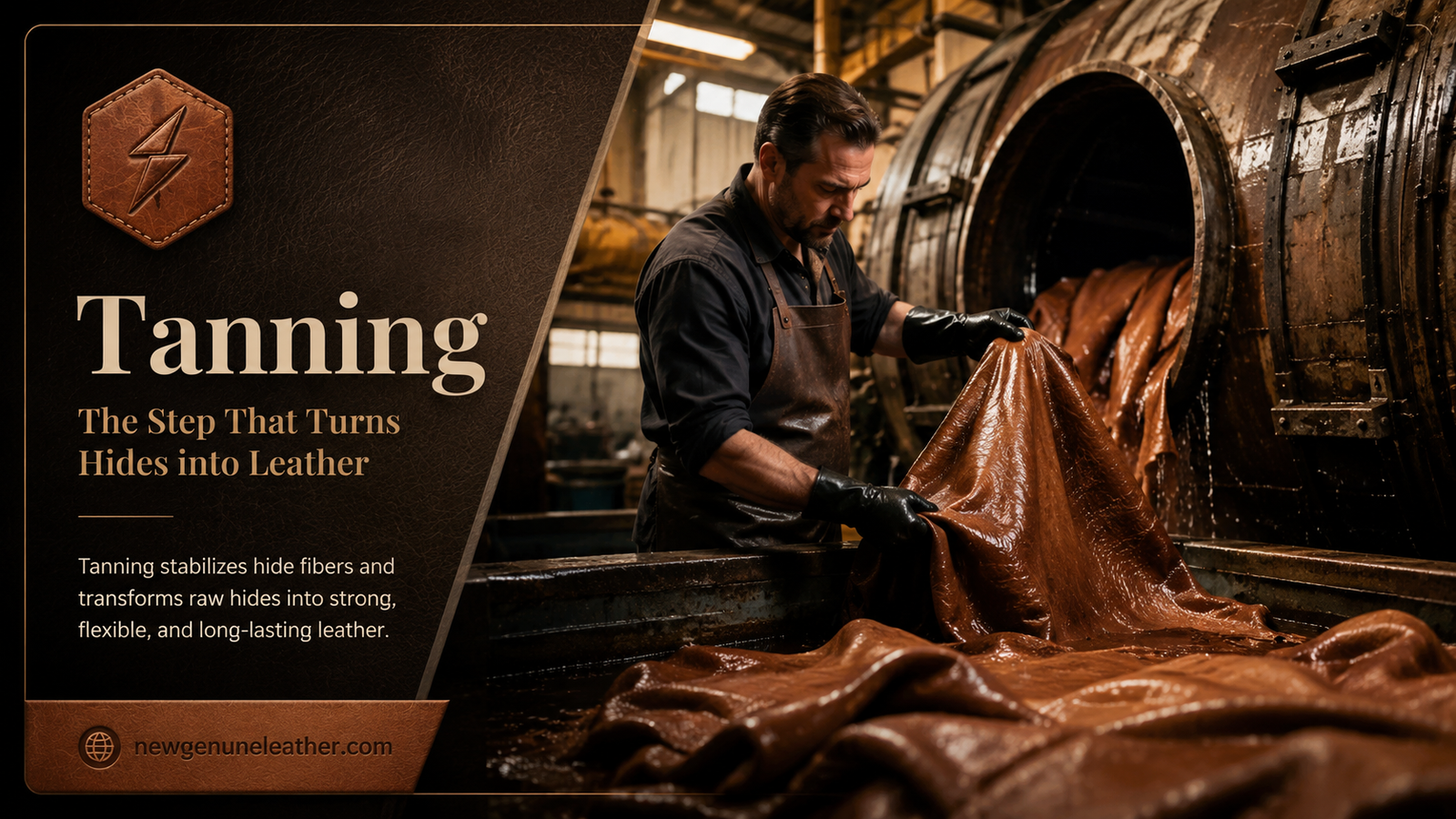
Tanning in leather is the essential manufacturing process that transforms prepared animal hides and skins into durable, flexible, and usable leather. Without tanning, untreated hides would remain vulnerable to decomposition, stiffness, moisture damage, and changes in temperature.
The process influences almost every quality buyers notice in a finished leather product, including softness, color, strength, grain appearance, flexibility, water resistance, and ageing characteristics.
At New Genuine Leather, we understand that good leather products begin long before cutting and stitching. Careful material selection and appropriate tanning are vital when manufacturing leather jackets, gloves, lederhosen, accessories, and private-label leather garments for international wholesale buyers.
Table of Contents
- What Is Tanning in Leather?
- Why Leather Must Be Tanned
- Seven Main Tanning Steps
- Major Leather Tanning Methods
- How Tanning Affects Leather Quality
- Responsible Leather Manufacturing
- What Wholesale Buyers Should Check
- Frequently Asked Questions
What Is Tanning in Leather?
Tanning is a controlled chemical process that stabilizes the collagen structure found inside animal hides and skins. Once stabilized, the material becomes more resistant to heat, moisture, microorganisms, mechanical stress, and natural decomposition.
Leather begins as a hide or skin, most commonly obtained as a by-product of the meat industry. The hide must be preserved, cleaned, prepared, tanned, dyed, dried, softened, and finished before it can be used for manufacturing.
Leather Naturally explains that tanning stabilizes hides so they become durable, flexible, and suitable for long-term use. The organisation’s educational resources provide additional information about how modern leather is made.
Why Is Tanning Necessary?
Fresh animal hide contains water, proteins, fats, minerals, hair, and natural tissues. If it is left untreated, bacteria and environmental conditions will cause it to deteriorate.
The purpose of tanning in leather is not simply to change the hide’s colour. It changes the internal structure of the material so that it can remain stable during manufacturing and everyday use.
Correct tanning helps produce leather that is:
- Resistant to decomposition
- Flexible enough for cutting and stitching
- Strong enough for repeated use
- Suitable for dyeing and finishing
- More stable under changing temperatures
- Capable of maintaining its shape
The selected tanning method also determines whether the finished leather feels firm, soft, lightweight, heavy, stretchy, structured, or naturally aged.
The 7 Main Steps of Tanning in Leather
Although production methods vary according to the tannery, hide type, tanning system, and final application, the process can be understood through seven main stages.
1. Hide Selection and Preservation
The process begins with selecting suitable hides or skins. Cattle hides are widely used for jackets, lederhosen, bags, belts, footwear, and protective gloves. Goat and sheep skins are often chosen for lighter garments and gloves because of their softness and flexibility.
Fresh hides must be preserved soon after removal. Salt curing is commonly used to reduce moisture and limit bacterial activity during storage and transportation.
A hide may be rejected or downgraded because of deep cuts, insect damage, excessive scars, poor preservation, or uneven thickness. These natural characteristics influence the usable cutting area and final leather grade.
2. Soaking and Cleaning
Preserved hides are soaked in water to restore moisture lost during curing. Soaking also helps remove salt, dirt, blood, and other unwanted material.
Cleaning must be controlled carefully. Insufficient soaking may leave the hide uneven, while excessive processing can damage the collagen fibres.
The objective is to return the hide to a clean and workable condition before hair removal and further preparation.
3. Liming, Unhairing and Fleshing
During liming, hides are treated to loosen the hair and epidermal layer. The process also opens the fibre structure, helping prepare the hide for later tanning treatments.
After unhairing, fleshing machinery removes remaining fat and tissue from the underside. This creates a cleaner and more even surface.
The hide may also be split into layers. The upper grain layer is generally used for higher-grade leather, while the lower split layer can be processed for suede, coated split leather, and other applications.
4. Deliming, Bating and Pickling
After liming, the hide must be brought back to the correct chemical condition. Deliming reduces alkalinity, while bating uses controlled enzymatic action to improve cleanliness and softness.
Pickling normally follows when the hide is being prepared for certain mineral tanning systems. Acids and salts adjust the pH and help tanning agents penetrate the hide evenly.
Control is important at this stage because uneven penetration can result in inconsistent colour, firmness, or strength across the leather.
5. The Main Tanning Stage
This is the stage where the prepared hide is converted into stable leather. Tanning agents interact with the collagen structure and improve its resistance to decomposition.
The tanning process usually takes place inside rotating drums. The exact temperature, pH, drum speed, chemical concentration, and processing time depend on the selected method and required leather characteristics.
After chrome tanning, the material is commonly called wet blue because of its pale blue appearance. Chrome-free tanned material may be known as wet white, while vegetable-tanned leather normally develops natural beige, tan, or brown tones.
6. Retanning, Dyeing and Fatliquoring
Initial tanning provides stability, but additional processing is required to create the desired commercial properties.
Retanning can modify the leather’s fullness, firmness, grain tightness, softness, and embossing performance. Different agents may be selected depending on whether the leather will become a jacket, glove, bag, belt, shoe, or piece of Bavarian clothing.
Dyes are introduced to create the required colour. Fatliquoring then distributes selected oils throughout the fibre structure, helping the leather remain soft and flexible after drying.
Colour consistency is particularly important for wholesale buyers. All pieces within a bulk production run should match the approved colour standard as closely as possible.
7. Drying, Softening and Finishing
After wet processing, leather must be dried under controlled conditions. Common operations can include setting out, vacuum drying, toggling, hanging, or other drying systems.
Once dry, the leather may feel firm. Mechanical operations such as staking soften the fibres and improve flexibility.
The surface can then be finished with protective coatings, waxes, oils, pigments, embossing, polishing, buffing, or other treatments. The selected finish determines the final appearance, touch, sheen, colour depth, and resistance to surface wear.
You can also read our genuine leather care guide to understand how correct maintenance helps finished leather retain its flexibility and appearance.
Major Methods Used for Tanning Leather
Different tanning systems produce different results. Manufacturers select a method based on the required performance, appearance, production time, price point, and final product.
Chrome Tanning
Chrome tanning commonly uses chromium compounds in a carefully controlled process. It is valued for its speed, consistent results, softness, flexibility, and ability to produce a wide variety of colours.
Chrome-tanned leather is widely used for garments, gloves, footwear, upholstery, bags, and other products requiring softness and repeated movement.
Modern production should control chemical use, wastewater, pH, and process efficiency. Proper chemistry management is necessary throughout production.
Vegetable Tanning in Leather
Vegetable tanning uses tannins derived from plant materials such as bark, wood, leaves, and fruits. The source of the tannin can influence colour, firmness, fullness, and ageing characteristics.
Vegetable-tanned leather is usually firmer and may develop a distinctive patina over time. It is widely used for belts, structured bags, saddlery, wallets, footwear components, and traditional leather goods.
Learn more in our detailed guide to vegetable tanning.
Chrome-Free Tanning in Leather
Chrome-free systems use alternative tanning agents to produce leather without chrome tanning. Depending on the chemistry, the resulting material may be referred to as wet-white leather.
These systems can be selected to meet particular brand requirements, colour needs, technical specifications, or restricted-substance policies.
The term “chrome-free” does not automatically describe the complete environmental performance of a tannery. Buyers should assess the overall process, including water management, chemical handling, energy use, waste treatment, and traceability.
Combination Tanning in Leather
Combination tanning uses more than one tanning system to achieve selected properties. For example, a manufacturer may combine methods to balance softness, firmness, colour, structure, durability, or ageing behaviour.
The exact combination depends on the product being developed and the buyer’s technical requirements.
How Tanning Influences Finished Leather Tanning in Leather
The quality of tanning in leather directly affects how the final material performs during manufacturing.
Soft garment leather must bend naturally and remain comfortable against the body. Glove leather needs flexibility, touch sensitivity, and resistance at high-stress seams. Lederhosen leather requires strength, substance, embroidery stability, and an authentic traditional appearance.
Tanning also influences:
- Tear and tensile strength
- Colour absorption
- Surface grain
- Thickness and weight
- Stretch and shape retention
- Resistance to moisture
- Suitability for embroidery
- Performance during cutting and stitching
This is why leather should be selected according to its intended product rather than appearance alone.
Responsible Tanning and Environmental Controls Tanning in Leather
Responsible manufacturing requires more than producing attractive leather. Tanneries should manage water consumption, chemicals, energy, wastewater, solid waste, worker safety, traceability, and operating permits.
The Leather Working Group certification programme assesses how leather manufacturing facilities measure, control, and report the impacts of their operations. Its Leather Manufacturer Standard covers multiple operational and environmental areas, including production data and incoming-material traceability.
Wholesale buyers should request relevant information from their suppliers instead of relying only on broad marketing terms such as “eco-friendly” or “natural.”
What Wholesale Buyers Should Check Tanning in Leather
When evaluating leather samples, buyers should ask the manufacturer about the leather type, animal origin, thickness, tanning method, finish, colourfastness, and intended application.
A physical sample is important because photos cannot fully communicate softness, weight, smell, grain, flexibility, or colour variation.
Buyers should confirm:
- Approved leather thickness
- Required colour standard
- Grain and surface finish
- Softness or firmness level
- Testing requirements
- Restricted-substance specifications
- Order-to-order consistency
- Sample approval procedures
For private-label orders, the approved sample should become the production reference for material, embroidery, hardware, stitching, sizing, labels, and packaging.
Tanning in Leather at New Genuine Leather
New Genuine Leather (NGL) is a Sialkot-based manufacturer and exporter of genuine leather garments, leather gloves, motorcycle apparel, lederhosen, and leather accessories.
We work with wholesale retailers, importers, distributors, workwear suppliers, fashion brands, and OEM clients across Europe, North America, Australia, and the Middle East.
Our customization services include leather selection, colour development, embroidery, sizing, private-label branding, hardware selection, packaging, and bulk production. Our standard minimum order quantity is 50 pieces, depending on the design and product category.
Understanding tanning in leather allows our team to select material according to the functional needs of each product rather than choosing leather only by colour or surface appearance.
Frequently Asked Questions
What is the main purpose of leather tanning?
The main purpose is to stabilize the hide’s collagen structure. This turns a perishable raw material into durable leather suitable for manufacturing and long-term use.
Which tanning method is best?
There is no single method suitable for every product. Chrome tanning is widely selected for softness and flexibility, while vegetable tanning is often chosen for firmness, structure, and natural ageing.
Does tanning determine leather quality?
Tanning is an important factor, but final quality also depends on hide selection, preparation, dyeing, fatliquoring, drying, finishing, storage, cutting, and garment construction.
What is wet-blue leather?
Wet blue is leather that has completed chrome tanning but has not yet gone through all retanning, colouring, drying, and finishing stages.
Can buyers request a specific tanning method?
Yes. Wholesale and private-label buyers can specify tanning preferences, restricted-substance requirements, thickness, colour, finish, softness, and performance standards during product development.
Final Thoughts
Tanning in leather is the foundation of genuine leather manufacturing. It transforms prepared hides into stable material and determines how the leather feels, performs, accepts colour, withstands use, and ages over time.
For international buyers, understanding the tanning process makes it easier to compare samples, communicate specifications, assess suppliers, and avoid materials unsuitable for the intended product.
New Genuine Leather combines material knowledge with OEM and private-label manufacturing for buyers seeking custom leather garments, gloves, lederhosen, and accessories.
Looking for a reliable leather manufacturing partner? Contact New Genuine Leather for custom sampling, wholesale pricing, private-label development, and bulk production from Sialkot, Pakistan.
Contact New Genuine Leather
Website: New Genuine Leather
Instagram: Follow New Genuine Leather
WhatsApp: Discuss Your Wholesale Order
