

Pickling in Leather: 7 Powerful Steps for Better Quality

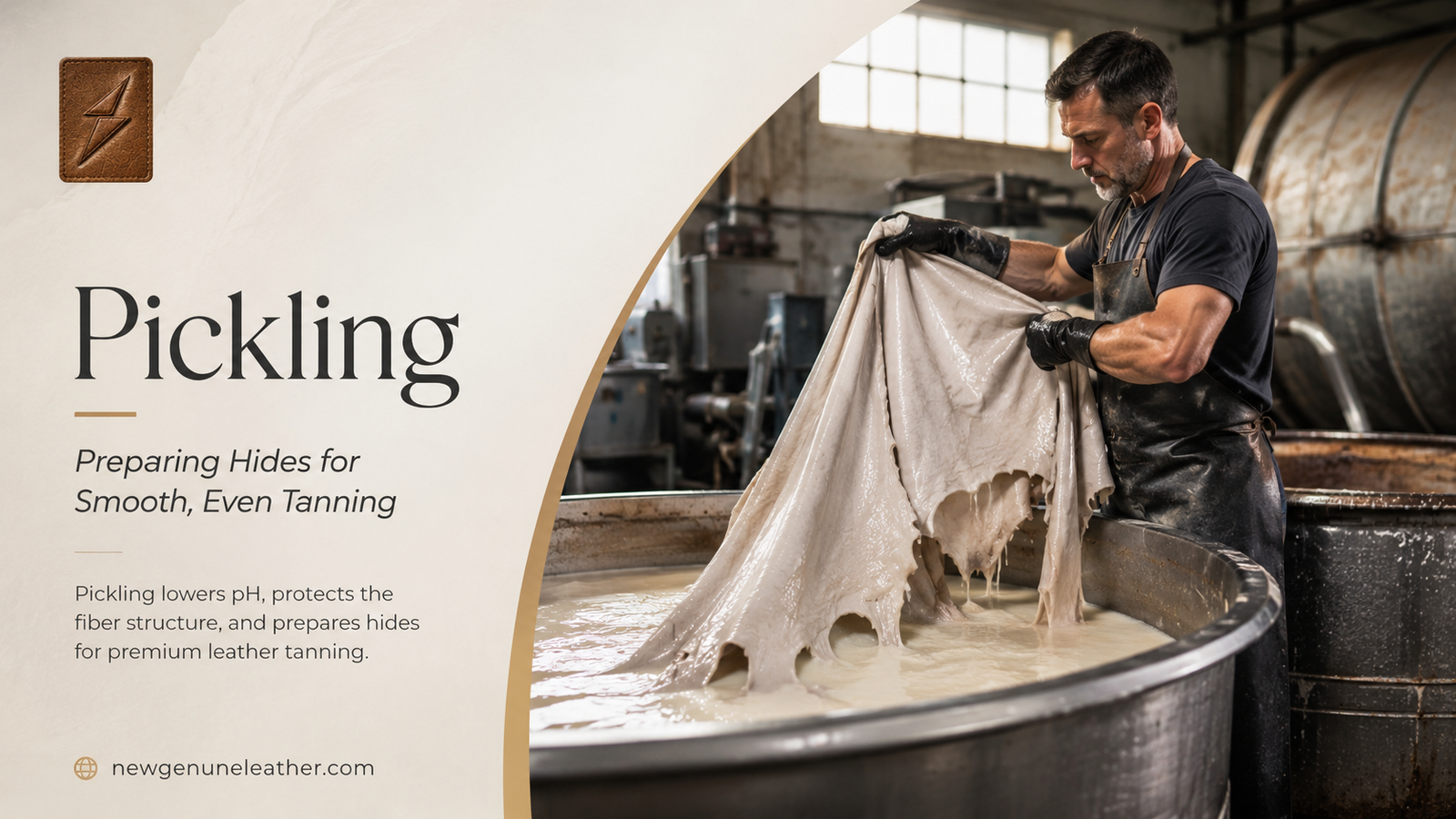
Pickling in Leather is an essential preparation stage between deliming and tanning. Although it is less visible than dyeing or finishing, it strongly affects how evenly tanning materials enter the hide, how stable the collagen structure becomes, and how consistently the finished leather performs.
At New Genuine Leather, we believe wholesale buyers should understand the processes behind dependable leather products. From Sialkot, Pakistan, we manufacture genuine leather garments, gloves, lederhosen, accessories, and custom OEM products for importers, distributors, retailers, private-label brands, and workwear suppliers.
Table of Contents
- What Is Pickling in Leather?
- Why the Pickling Process Matters
- Seven Key Stages of Pickling
- Materials Associated with Pickling
- Its Effect on Finished Leather
- Common Pickling Problems
- Responsible Leather Production
- New Genuine Leather Manufacturing
What Is Pickling in Leather?
Pickling is the controlled acidification of delimed and bated hides or skins before tanning. In a professionally managed tannery, the pelt is processed in a controlled float containing salt and selected acids. The purpose is to reduce its pH while preventing excessive acid swelling.
The Leather Working Group explains that a conventional acid-and-salt pickle often uses formic and sulfuric acids, while common salt helps protect hides from swelling. It also states that this stage controls how tanning agents penetrate the skin structure. The FAO similarly describes pickling as a process that increases hide acidity so chromium tanning materials can enter effectively.
Pickling does not complete the tanning process. Instead, it prepares the collagen fibres so that the selected tanning material can penetrate before strong fixation begins.
Why Pickling in Leather Matters
A hide coming from deliming and bating is not yet in the ideal chemical condition for many tanning systems. If a highly reactive tanning material is introduced too early, it may bind quickly near the surface while the centre remains insufficiently penetrated.
Pickling in Leather creates a more controlled environment. By adjusting acidity before tanning, it reduces the risk of rapid surface fixation and gives the tanning material time to travel more evenly through the hide’s cross-section.
The Leather Working Group notes that pickling controls the chemical reactivity of collagen and influences the rate at which tanning materials combine with the structure. Chrome tanning materials require moderately acidic conditions to penetrate before fixation.
This preparation can influence grain tightness, softness, fullness, colour consistency, physical strength, and the leather’s behaviour during shaving, neutralization, retanning, dyeing, fatliquoring, drying, staking, and finishing.
7 Key Stages of Pickling in Leather
1. Inspecting the Prepared Pelt
Before pickling begins, hides should have completed the necessary beamhouse operations, including liming, fleshing, deliming, and bating.
Technicians examine cleanliness, thickness, grain condition, and batch uniformity. Differences between hides at this stage can affect how quickly and evenly they respond during acidification.
2. Establishing Salt Protection
Salt helps control the behaviour of the hide when acidity increases. Without suitable protection, collagen can absorb excessive water and swell, potentially damaging the grain and weakening the structure.
Both the FAO and Leather Working Group identify salt as an important part of controlling swelling during conventional acid pickling.
The required conditions depend on hide type, thickness, equipment, water quality, and the tanning system that follows. This industrial process requires trained professionals, protective equipment, documented chemical controls, and compliant wastewater treatment.
3. Controlling Acidification
In conventional pickling, acidity is introduced in a controlled manner rather than through a sudden chemical change. Controlled acidification helps the condition of the pelt change more evenly from its surface toward the centre.
Different tanneries use different systems depending on the raw material, desired leather properties, and tanning method. Process conditions should always be determined and monitored by qualified tannery technicians.
4. Maintaining Drum Movement
Mechanical action helps distribute the processing float and chemicals throughout the batch. Drum movement also exposes folded sections and supports even contact across the grain and flesh sides.
Insufficient action may contribute to uneven treatment. Excessive mechanical action, however, may increase the risk of abrasion, tangling, creases, or grain damage, especially when processing delicate skins.
5. Monitoring pH and Penetration
Accurate monitoring is central to Pickling in Leather. Tannery technicians assess both the processing float and the pelt cross-section to determine whether the required acidity has reached the correct depth.
A float reading alone may not fully reveal the condition inside a thick hide. The outside can become acidic before the centre reaches the intended preparation level.
Proper monitoring therefore focuses on uniform penetration rather than simply achieving a quick reading in the processing vessel.
6. Allowing Equalization
The batch requires sufficient processing time for the chemical condition to become reasonably uniform. The objective is not merely to produce a fast surface change but to prepare the complete hide cross-section for tanning.
Uniformity is especially important for leather used in jackets, gloves, footwear, bags, lederhosen, and private-label products. Buyers expect consistent softness, colour, thickness, cutting yield, and physical performance across every production batch.
7. Transitioning to Tanning
Once the pelt reaches the required condition, the selected tanning material can be introduced.
During chrome tanning, controlled acidity allows chromium compounds to penetrate the structure. Later adjustments make the system less acidic and encourage the tanning compounds to bond with the collagen.
Other tanning methods may require different preparation profiles. The Leather Working Group notes that the required acidity varies according to the tanning product and that alternative systems also require an appropriate preparation stage.
Materials Associated with Pickling
Traditional Pickling in Leather commonly involves water, common salt, and selected organic and mineral acids. Modern systems may use buffered products, alternative acids, reduced-salt technologies, or specialized auxiliaries developed for particular tanning methods.
The process must match the intended end use. Soft garment leather may require a different preparation profile from firm belt leather, safety-glove leather, suede, upholstery leather, or heavy footwear leather.
Chemical handling belongs in professionally managed facilities with trained employees, suitable storage, protective systems, controlled processes, and effective effluent treatment.
How Pickling in Leather Affects Finished Quality
Well-controlled Pickling in Leather supports even tanning-material penetration and creates a more uniform foundation for subsequent wet processing.
This can improve cutting consistency, grain appearance, colour development, softness, and the leather’s response to retanning and fatliquoring. The final character of leather is further developed through neutralization, retanning, dyeing, and lubrication processes.
These qualities matter to manufacturers because inconsistent leather can increase cutting waste, sorting time, production delays, colour variation, and rejected components.
For OEM buyers, proper process control also supports repeatability. A distributor ordering several production batches expects similar leather character, shade response, softness, thickness, and performance each time.
Problems Caused by Poor Pickling in Leather
Uneven pickling can lead to incomplete penetration during tanning. The outside may react faster than the centre, producing an inconsistent cross-section.
Excessive acidification may contribute to reduced fullness, fibre damage, loose grain, or lower physical strength. Inadequate protection against swelling can also affect grain quality and structural stability.
Poor drum control may produce creases, surface abrasion, folded sections, or uneven chemical treatment.
Water quality, hide thickness, batch loading, temperature, chemical distribution, and processing time can all influence the result. Professional monitoring is therefore more dependable than relying only on a fixed formula.
Pickling in Leather and Responsible Production
Conventional pickling can generate wastewater containing salts and acidic residues. Responsible tanneries work to reduce unnecessary chemical use, improve process control, monitor chemical uptake, and treat wastewater before discharge.
The leather industry has explored pollution-reduction measures, improved chemical management, alternative processing systems, and more efficient use of water and chemicals.
A new process should not be considered responsible merely because it reduces one chemical. Its effects on leather quality, employee safety, water consumption, energy demand, wastewater treatment, and the following tanning stages must also be evaluated.
For additional technical information, readers can review the following authoritative resources:
Keep these as normal follow links when adding the article to WordPress. Do not select the “nofollow” option.
Pickling in Leather at New Genuine Leather
At New Genuine Leather, we evaluate leather beyond its final surface appearance. Reliable preparation and tanning help produce material that cuts cleanly, stitches consistently, accepts finishing evenly, and performs properly in the finished product.
Our B2B manufacturing capabilities include:
- Genuine leather jackets
- Motorcycle leather jackets
- Leather fashion gloves
- Safety and work gloves
- Lederhosen and Bavarian apparel
- Leather accessories
- Custom OEM and private-label products
We support wholesale buyers with material selection, custom sizing, logo application, custom colours, packaging, export-quality workmanship, and bulk manufacturing.
From Sialkot, Pakistan, we serve importers, retailers, distributors, and private-label businesses across Europe, North America, Australia, and the Middle East.
Our standard MOQ is 50 pieces, depending on the product design, material selection, branding, and customization requirements.
Conclusion
Pickling in Leather is the controlled preparation stage connecting beamhouse operations with tanning. It establishes the chemical environment needed for tanning-material penetration while protecting the collagen structure from excessive swelling and uneven fixation.
When properly managed, pickling supports consistency, strength, grain quality, softness, colour response, and efficient manufacturing. For wholesale buyers, understanding this hidden stage makes it easier to evaluate genuine leather beyond its surface appearance.
New Genuine Leather combines leather-processing knowledge with skilled garment and glove manufacturing to supply export-ready OEM and private-label products.
Contact New Genuine Leather
Website: New Genuine Leather
Instagram: Follow New Genuine Leather
WhatsApp: Discuss Your Wholesale Order
