

Real or Fake Leather: 7 Powerful Tests to Avoid Costly Mistakes

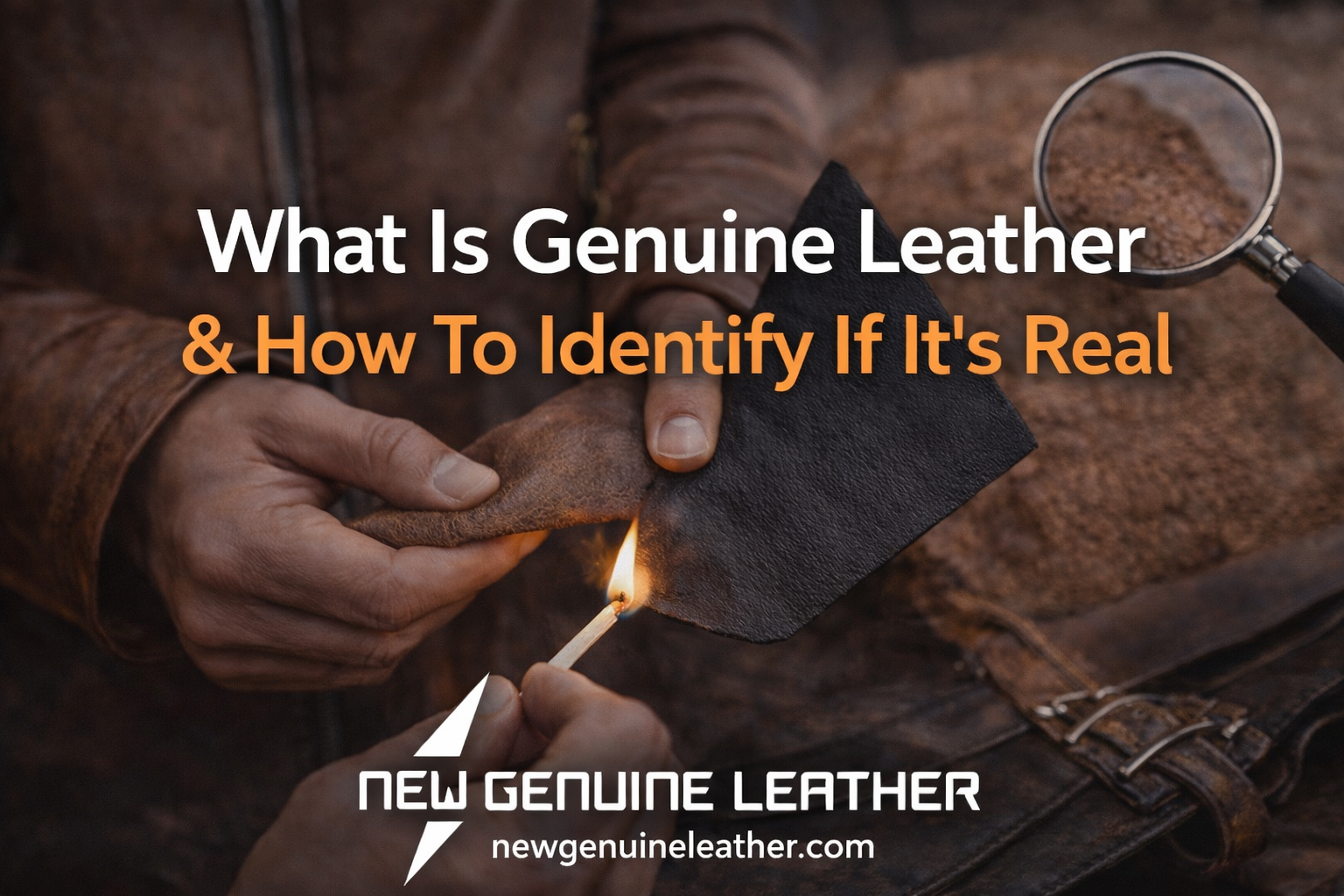
Real or fake leather can appear almost identical when you first examine a jacket, bag, skirt, pair of gloves, or traditional leather garment. Modern synthetic materials can successfully copy the color, grain, softness, and shine of natural hide.
However, the two materials behave very differently during regular use. Their durability, breathability, aging, comfort, care requirements, and long-term value are not the same.
For individual customers, identifying the correct material prevents misleading purchases. For retailers, importers, distributors, and private-label brands, proper material identification is even more important because it affects product descriptions, pricing, customer expectations, and brand reputation.
At New Genuine Leather, we believe every buyer should know exactly which material is being used before approving a sample or placing a bulk order.
What Is Real Leather?
Real leather is a natural material produced from animal hide. The hide undergoes tanning, a controlled process that preserves it and prepares it for use in garments, footwear, bags, furniture, gloves, belts, and accessories.
Leather contains a complex network of natural fibers. This structure gives it flexibility, strength, breathability, and the ability to develop character as it ages.
Different types of real leather include:
- Full-grain leather
- Top-grain leather
- Corrected-grain leather
- Split leather
- Suede
- Nubuck
- Finished genuine leather
Full-grain leather retains the natural outer surface of the hide. It may show pores, wrinkles, scars, shade variations, and other natural characteristics.
Top-grain leather is generally lightly sanded or corrected to create a cleaner and more consistent appearance. Corrected-grain leather receives additional surface treatment and may be embossed with an artificial grain pattern.
The label “genuine leather” means that the material comes from real hide. However, it does not automatically identify the leather as full-grain or the highest available grade. Buyers should still ask about thickness, hide type, surface treatment, and finishing method.
What Is Fake Leather?
Fake leather is a manufactured material designed to imitate natural leather. It normally consists of a plastic coating applied over a woven or nonwoven fabric backing.
The two most common materials are polyurethane and polyvinyl chloride. They are usually marketed as:
- PU leather
- PVC leather
- Faux leather
- Synthetic leather
- Artificial leather
- Leatherette
- Vegan leather
- Leather-look material
Synthetic leather can provide uniform grain, consistent color, easy surface cleaning, and a lower initial price. It may also be selected by customers who prefer animal-free materials.
However, many synthetic materials are less breathable than real hide. With repeated movement and exposure to heat, moisture, or sunlight, the surface coating may become brittle, crack, peel, or separate from the fabric backing.
The term “vegan leather” does not identify one specific material. It may refer to PU, PVC, plant-based composites, recycled materials, or other animal-free constructions. Buyers should always ask for the exact material composition.
Why Identifying Real or Fake Leather Matters
Knowing whether a product contains real or fake leather affects far more than its appearance. It determines how the product should be priced, described, maintained, stored, and marketed.
Natural leather often becomes softer and develops a patina through use. Its color and texture may change gradually, giving every product a unique appearance.
Synthetic material normally remains more uniform during its early life. However, once the outer coating begins to deteriorate, repairing it can be difficult.
For wholesale buyers, incorrect material descriptions can result in returns, complaints, chargebacks, poor reviews, or damaged relationships with retailers. Clear product specifications protect the manufacturer, importer, seller, and final customer.
1. Read the Material Label Real or Fake Leather
The first test is to examine the product label carefully. Real or Fake Leather
Descriptions such as “full-grain leather,” “top-grain leather,” “genuine leather,” “suede,” and “nubuck” normally refer to materials produced from animal hide.
Descriptions such as “PU,” “PVC,” “synthetic upper,” “faux leather,” “leatherette,” and “leather-effect” indicate artificial material.
Do not rely only on the product title. Some sellers place the word “leather” prominently in the title while providing the actual material composition in smaller text.
Wholesale buyers should request a written material declaration on the quotation, specification sheet, proforma invoice, and purchase order. This creates a clear record of the material approved for production.
2. Examine the Grain Pattern Real or Fake Leather
A close examination of the surface can help identify real or fake leather.
Natural leather usually contains irregular pores, creases, wrinkles, and variations. No two areas of a natural hide are completely identical.
Synthetic grain is commonly created using rollers, printing equipment, or molds. Because it is mechanically produced, the same grain pattern may repeat across the surface.
Look at a large area rather than one small section. Jacket backs, leather skirts, handbags, sofa panels, and larger garment pieces make repeated patterns easier to identify.
Some corrected real leather is embossed to create a more uniform grain, while premium artificial leather may have realistic irregularities. Therefore, the grain test should always be combined with other checks.
3. Inspect the Cut Edge Real or Fake Leather
The cut edge is one of the most useful areas for checking material construction.
Real leather normally has a fibrous or suede-like interior. Its edge may appear slightly rough or uneven because it contains interwoven natural fibers.
Fake leather frequently has several visible layers. You may see a smooth plastic surface attached to a woven fabric backing.
Useful places to inspect include:
- Inside pockets
- Unfinished seams
- Strap ends
- Belt holes
- Button openings
- Undersides of decorative flaps
Some products have painted, folded, or sealed edges. In that case, ask the supplier for an unfinished material swatch that clearly shows the cross-section.
4. Perform the Touch and Flexibility Test Real or Fake Leather
Real leather normally feels warm, flexible, and slightly inconsistent. When pressed or folded, it develops fine wrinkles that vary naturally across the surface.
Synthetic material may feel cooler, more uniform, or slightly plastic-like. Lower-quality PU or PVC can feel unusually stiff, sticky, thin, or overly smooth.
Gently bend the material and observe how it reacts. Natural leather should flex without appearing like a plastic sheet. Artificial material may crease in a more mechanical or identical pattern.
Touch cannot provide complete proof because finishes, waxes, pigments, and coatings can significantly change the surface feel. It is most effective when used with the edge and grain tests.
5. Check the Smell Real or Fake Leather
Natural leather often has a recognizable earthy, warm, or tanned smell. Artificial leather may smell like plastic, vinyl, adhesives, or chemicals, particularly when it has recently been unpacked.
However, smell should be used cautiously. Leather treatments, dyes, fragrances, storage conditions, packaging, and adhesives can change or mask the natural odor.
Some synthetic products may even be given a leather-like fragrance. Therefore, smell is a useful initial clue, but it should not be treated as final evidence.
For commercial orders, physical samples and written material specifications are more dependable than smell alone.
6. Try a Small Water-Drop Test Real or Fake Leather
A small water test can sometimes help determine real or fake leather.
Uncoated natural leather is porous. A small drop may absorb slowly and cause temporary darkening.
Most synthetic surfaces are less porous, causing water to remain on top or form a bead.
This test also has limitations. Pigmented, waxed, coated, or waterproof real leather may repel water. Suede and nubuck may absorb water quickly and develop a visible mark.
Always perform the test on a hidden area or, preferably, on a separate sample swatch. Never place water directly on an expensive finished product without the owner’s permission.
7. Compare Price and Documentation
Price can help provide context, but it cannot prove whether a product contains real leather.
Natural hide requires grading, tanning, finishing, cutting, and quality control. It therefore normally has a higher production cost than basic synthetic material.
However, premium synthetic materials can cost more than low-grade real leather. Price must be evaluated alongside the product’s construction, finish, country of manufacture, hardware, lining, stitching, and branding.
When evaluating a supplier, ask:
What type of hide is being used?
The supplier should identify whether it is cowhide, sheepskin, goatskin, buffalo leather, or another material.
What is the leather grade?
Ask whether it is full-grain, top-grain, corrected-grain, split, suede, or nubuck.
What is the thickness?
Different products require different leather thicknesses and performance characteristics.
What finishing method is used?
Request information about pigmentation, aniline finishing, waxing, embossing, distressing, or protective coatings.
Can a sample be provided?
A physical swatch and finished sample should be approved before bulk manufacturing.
Common Myths About Real and Fake Leather
One common myth is that every irregular mark proves that leather is natural. Manufacturers can create random-looking grain patterns on synthetic surfaces.
Another myth is that natural leather always absorbs water. Many genuine leather products receive protective finishes that make them temporarily water-resistant.
Some buyers also believe that all synthetic material is low quality. Advanced artificial materials may perform well for certain applications when they are correctly identified and honestly marketed.
The problem is not simply choosing between the two categories. The main issue is transparency. Customers should receive the exact material stated in the product description.
Which Material Is Better? Real or Fake Leather
The right choice depends on the product, target market, budget, expected lifespan, and customer preference.
Real leather is commonly selected for premium jackets, motorcycle garments, leather skirts, gloves, bags, lederhosen, belts, and accessories intended for long-term use.
It provides natural texture, breathability, flexibility, and aging characteristics that synthetic materials cannot fully reproduce.
Fake leather may be suitable for short fashion cycles, promotional products, uniform-color collections, easy-clean surfaces, or specifically animal-free product lines.
A correctly labeled synthetic product is more trustworthy than an artificial item falsely advertised as genuine hide.
Advice for Wholesale and Private-Label Buyers Real or Fake Leather
Wholesale buyers should never approve a large order based only on online photographs. Images cannot accurately confirm leather composition, thickness, softness, finish, smell, or backing structure.
Request a complete finished sample and inspect:
- Leather grain and thickness
- Cut edges and backing
- Stitching and seam reinforcement Real or Fake Leather
- Color consistency
- Flexibility and surface finish
- Hardware and closures
- Lining and labels
- Packaging information Real or Fake Leather
Buyers can review responsible leather-manufacturing information from the Leather Working Group. Educational information about leather production and care is also available through Leather Naturally.
Keep at least one of these external resources as a normal dofollow link so Rank Math recognizes an outbound link.
New Genuine Leather Manufacturing Services Real or Fake Leather
New Genuine Leather (NGL) is a wholesale, OEM, and private-label leather manufacturer based in Sialkot, Pakistan.
We manufacture leather jackets, motorcycle jackets, leather skirts, trousers, gloves, bags, lederhosen, traditional Bavarian clothing, and customized leather accessories for international buyers.
Our customization services include leather selection, product development, custom sizing, embroidery, color matching, private labels, branded packaging, and bulk-order manufacturing.
Before production begins, buyers can approve the material, finish, measurements, stitching, hardware, branding, and packaging through a physical sample.
Contact New Genuine Leather
Website: New Genuine Leather
Instagram: Follow New Genuine Leather
WhatsApp: Discuss Your Wholesale Order
Frequently Asked Questions Real or Fake Leather
What is the fastest way to identify real or fake leather?
Start by checking the material label. Then inspect the cut edge and look for a fabric backing or natural fibrous structure. Finish by comparing the grain and flexibility.
Does genuine leather mean the highest quality?
No. Genuine leather confirms that the material is real, but it does not identify its exact grade. Ask whether it is full-grain, top-grain, corrected-grain, or split leather.
Can fake leather last for several years?
Some high-quality synthetic materials can last for years. Their performance depends on the coating, fabric backing, climate, storage conditions, and frequency of use.
Can real leather crack or peel?
Real leather can dry and crack when neglected. Heavy surface finishes may also flake, but natural leather does not normally peel away like a plastic film attached to fabric.
Final Thoughts Real or Fake Leather
Distinguishing real or fake leather requires more than one quick trick. The label, grain, cut edge, backing, flexibility, smell, water response, price, and supplier documentation should be considered together.
For customers, these checks reduce the risk of paying natural-leather prices for a synthetic product. For wholesale and private-label buyers, they support accurate specifications, stronger quality control, and more dependable supplier relationships.
New Genuine Leather helps international buyers choose suitable leather grades, finishes, colors, and constructions for their intended markets. Clear material identification, sample approval, and transparent manufacturing should always come before bulk production.
