

Chrome Tanning: 7 Powerful Benefits for Better Leather

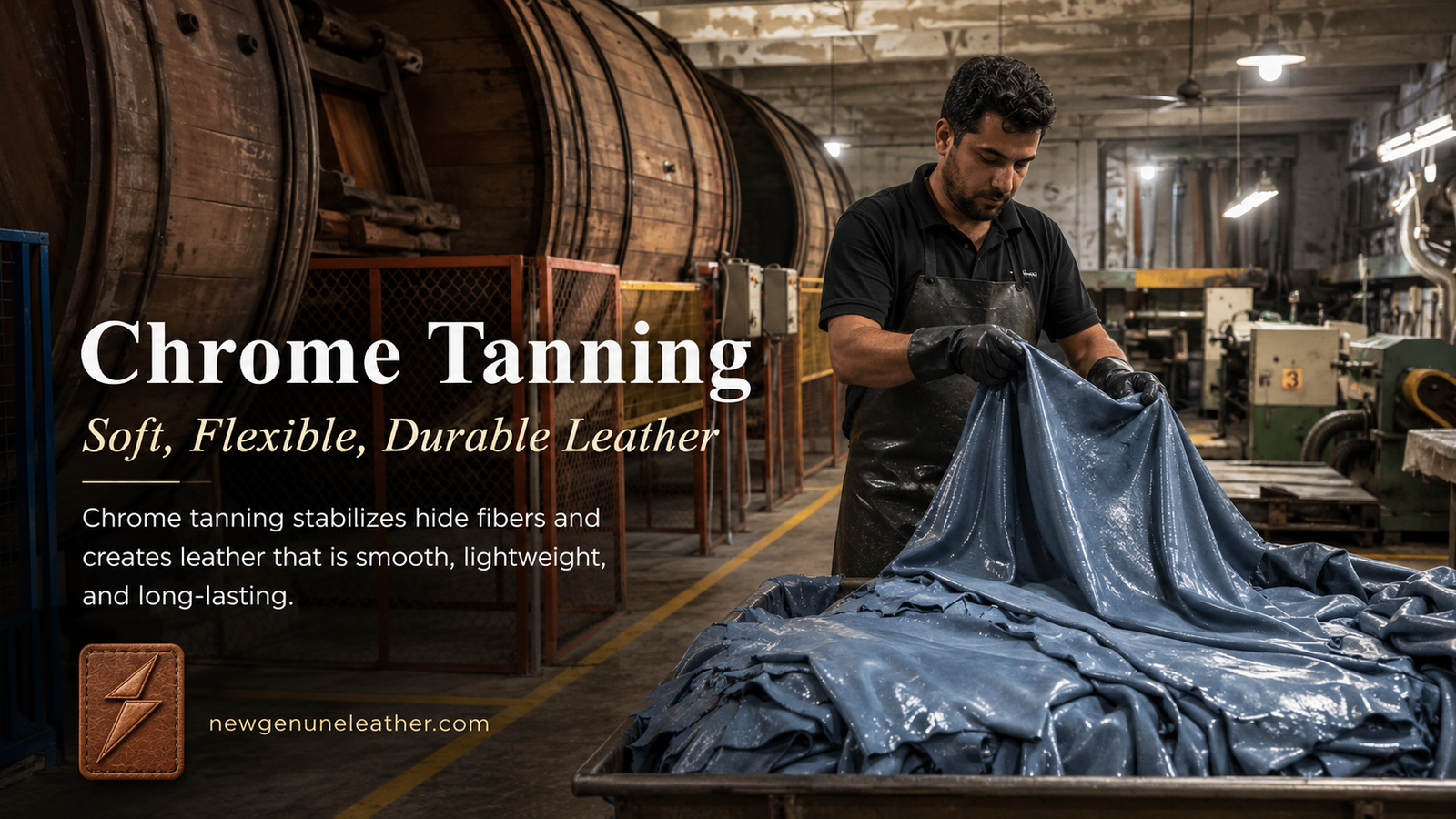
Chrome tanning is one of the most widely used methods for converting raw animal hides into soft, durable, and commercially valuable leather. Manufacturers prefer it because it is efficient, supports consistent coloring, and produces flexible leather suitable for garments, gloves, footwear, bags, and upholstery.
At New Genuine Leather, we manufacture export-quality leather products for wholesalers, importers, distributors, and private-label brands. Based in Sialkot, Pakistan, we combine skilled workmanship with custom development, bulk production, and international B2B service.
What Is Chrome Tanning?
Chrome tanning is a leather-processing method that mainly uses chromium(III) salts to stabilize the collagen fibers inside an animal hide. This treatment prevents the hide from decaying and gives the finished material strength, softness, flexibility, and improved resistance to heat.
Before dyeing and finishing, chrome-tanned leather usually has a pale blue or bluish-grey color. This semi-processed material is commonly called “wet blue.” It can later be retanned, dyed, softened, buffed, coated, and finished according to the required product specifications.
The method is popular because it is faster than many traditional tanning systems. It also helps manufacturers achieve repeatable results across large production batches.
How Does the Chrome Tanning Process Work?
The process begins with hide preparation. Raw hides are soaked, cleaned, fleshed, limed, delimed, and treated to remove hair, dirt, unwanted tissue, and substances that may interfere with tanning.
Pickling
The prepared hides are treated with salt and acid to reduce their pH. Pickling prepares the collagen structure and allows the tanning chemicals to penetrate more evenly.
Chromium Salt Penetration
Chromium(III) salts are added to a rotating tanning drum. As the drum moves, the tanning solution reaches the inner fiber structure of the hide.
Basification
The pH is gradually increased so the chromium compounds bond firmly with the collagen fibers. This fixation stage improves the stability and performance of the leather.
Post-Tanning Operations
The leather may then pass through washing, neutralization, retanning, dyeing, fatliquoring, drying, staking, buffing, and surface finishing.
These stages determine the material’s final color, thickness, softness, grain, shine, texture, and overall feel.
7 Powerful Benefits of Chrome Tanning
1. Faster Leather Production
One of the greatest advantages of chrome tanning is speed. Its main tanning stage can be completed much faster than traditional vegetable tanning.
For wholesale buyers, faster processing can support organized production schedules, repeat orders, seasonal collections, and shorter product-development cycles.
Efficient tanning also helps manufacturers plan material availability before cutting, stitching, branding, and finishing begin.
2. Soft and Flexible Leather
Chrome-tanned leather is generally soft, lightweight, and easy to bend. It moves comfortably, which makes it suitable for garments and fitted accessories.
This flexibility is especially useful for leather jackets, motorcycle clothing, fashion gloves, driving gloves, leather trousers, and selected lederhosen designs.
The required softness can be adjusted through hide selection, fatliquoring, staking, finishing, and other post-tanning treatments.
3. Wide Color Selection
The pale base created by chrome tanning accepts a broad range of dyes. Manufacturers can produce classic black and brown, vintage shades, bright fashion colors, or customized brand tones.
This makes the process useful for OEM buyers who want leather products matched with their logos, linings, packaging, or existing clothing collections.
Color consistency remains especially important for wholesale orders in which multiple garments, gloves, or accessories must match an approved sample.
4. Strength and Durability
Chromium compounds form stable bonds within the collagen structure. This can improve resistance to stretching, wear, and repeated handling.
Final durability also depends on the hide, leather thickness, surface finish, stitching, hardware, and product construction.
For example, a motorcycle jacket normally requires a different leather thickness and construction standard from a lightweight fashion jacket. Good tanning must always be supported by careful manufacturing.
5. Improved Heat Resistance
Chrome-tanned leather generally handles heat better than untreated hide and many traditionally tanned materials. This quality can be useful for products exposed to warmth, friction, or demanding working conditions.
Work gloves, welding gloves, and motorcycle garments must still be designed and tested for their specific intended use.
Leather type, thickness, lining, seams, reinforcement, and product certification should all be considered before selecting material for protective applications.
6. Consistency in Bulk Orders
Wholesale customers need similar color, softness, thickness, and appearance from one production batch to another. Chrome tanning supports controlled and repeatable leather processing.
This consistency benefits retailers, importers, distributors, uniform suppliers, and private-label brands ordering products under approved specifications.
Manufacturers should still inspect every batch because natural hides may contain variations in grain, texture, thickness, and surface markings.
7. Compatibility With Many Products
Chrome tanning can be adapted to different hides, finishes, thicknesses, and product categories.
It is commonly used for:
- Leather jackets and coats
- Motorcycle jackets and trousers
- Fashion, driving, and work gloves
- Lederhosen and Bavarian apparel
- Footwear and leather accessories
- Bags, belts, and wallets
- Furniture and automotive upholstery
Its versatility is one of the main reasons this tanning method remains important in modern leather manufacturing.
Chrome-Tanned Leather vs Vegetable-Tanned Leather
Chrome-tanned and vegetable-tanned leather are both genuine leather, but they have different characteristics.
Vegetable tanning uses natural tannins obtained from plant materials such as bark, leaves, and wood. It often produces firmer leather that develops a distinctive patina.
Vegetable-tanned leather is commonly selected for belts, saddlery, structured bags, cases, wallets, and traditional leather goods.
Chrome tanning usually creates softer, lighter, and more flexible leather. It also supports a broader range of colors, making it practical for jackets, gloves, footwear, soft bags, and upholstery.
Neither method is automatically better for every product. The correct choice depends on the design, desired feel, target market, performance requirements, pricing, and buyer expectations.
Environmental and Safety Considerations
Responsible chrome tanning requires accurate chemical control, trained workers, suitable wastewater treatment, safe handling, and proper waste management.
Chromium(III), which is normally used for tanning, is different from chromium(VI), an undesirable and restricted form. Poor processing, unsuitable chemical control, or improper storage can create quality and compliance risks.
Professional tanneries should carefully manage pH, temperature, chemical dosage, washing, oxidation, and finishing.
Buyers can review responsible leather-production guidance from the Leather Working Group and environmental information from the U.S. Environmental Protection Agency.
Brands supplying regulated markets may request laboratory testing for restricted substances, color fastness, abrasion resistance, tear strength, and other product-specific standards.
These outbound links should remain dofollow when the article is uploaded to WordPress. Do not select the “nofollow” option in the link settings.
Common Uses of Chrome-Tanned Leather
The softness and flexibility of chrome-tanned leather make it suitable for many clothing and accessory applications.
Lambskin, sheepskin, goatskin, cowhide, and buffalo leather can all be selected according to the required product.
A lightweight fashion jacket may use soft lambskin, while a motorcycle jacket may require stronger cowhide. Welding gloves may use split leather, whereas driving gloves may require a softer grain leather.
The tanning method should therefore be matched with the correct hide, thickness, finish, lining, thread, hardware, and construction technique.
Selecting the wrong leather can affect comfort, appearance, durability, pricing, and product performance.
How Buyers Can Check Leather Quality
Buyers should evaluate more than color and appearance. Quality leather should feel consistent across the panel, bend without surface cracking, and match the approved shade and finish.
The grain should be suitable for the agreed product specification. The material should also be checked for excessive chemical odor, uneven coating, loose grain, color variation, or unwanted surface defects.
Before bulk production, buyers should approve:
- Product samples
- Measurement charts
- Leather colors
- Stitching standards
- Branding placement
- Labels and packaging
- Hardware and accessories
- Testing requirements
A dependable manufacturer should clearly explain the leather type, thickness, finish, customization options, production stages, and quality-control procedures.
Chrome Tanning for OEM and Private-Label Products
Chrome tanning provides valuable flexibility for OEM production. Leather can be developed in custom colors, thicknesses, surface effects, and softness levels.
At New Genuine Leather, we manufacture leather jackets, motorcycle wear, fashion gloves, safety gloves, lederhosen, Bavarian apparel, and leather accessories.
Customization options include:
- Logo embossing
- Embroidery
- Private labels
- Custom linings
- Zippers and buttons
- Customized sizing
- Color development
- Export packaging
Our standard MOQ starts from 50 pieces, depending on the product, leather type, color selection, and customization requirements.
Buyers may provide reference images, technical packs, measurement charts, color codes, artwork, or physical samples for product development.
Why Choose New Genuine Leather?
New Genuine Leather serves wholesale retailers, boutiques, importers, distributors, workwear suppliers, and private-label brands in Europe, North America, Australia, and the Middle East.
We focus on clear communication, sample development, controlled production, export-quality finishing, custom branding, and competitive wholesale pricing.
Our Sialkot manufacturing experience allows us to support different leather categories while maintaining attention to material selection, fitting, stitching, branding, and packaging.
Explore our manufacturing capabilities at New Genuine Leather and contact our team to discuss your next custom leather collection.
Final Thoughts
Chrome tanning remains a practical leather-making method because it produces soft, durable, color-friendly, and consistent material.
Its speed and adaptability make it suitable for garments, gloves, footwear, upholstery, motorcycle apparel, and fashion accessories.
However, finished-product quality depends on more than tanning. Responsible processing, suitable hide selection, skilled stitching, strong finishing, and careful quality control are equally important.
For wholesale and private-label buyers, working with an experienced manufacturer can reduce sourcing risks and improve product consistency.
New Genuine Leather supports custom product development, private labeling, OEM manufacturing, and bulk export orders with an MOQ starting from 50 pieces.
Contact New Genuine Leather
Website: New Genuine Leather
Instagram: Follow New Genuine Leather
WhatsApp: Discuss Your Wholesale Order
