Vegetable Tanning: 7 Powerful Benefits for Leather

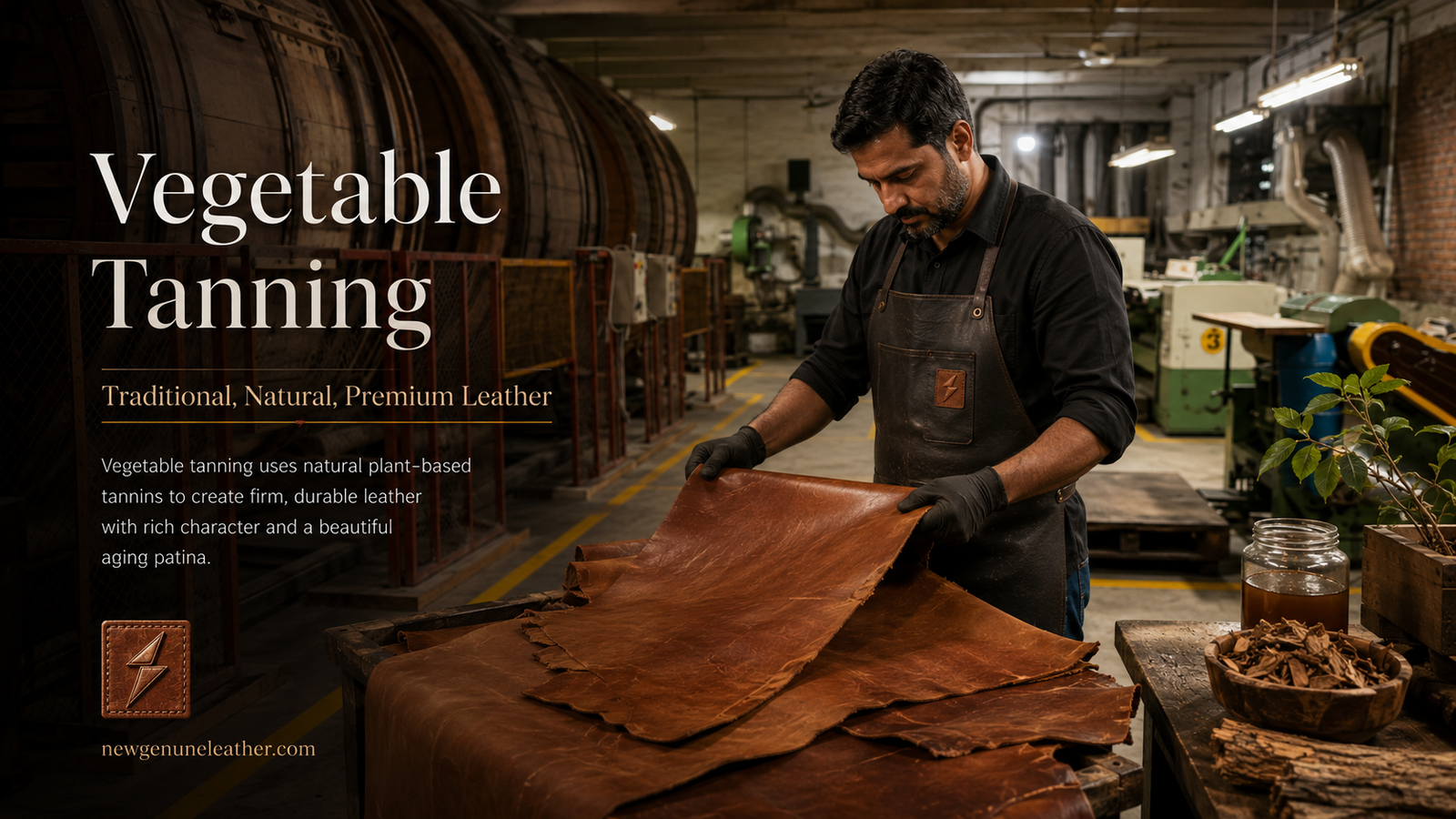
Vegetable tanning is one of the oldest and most respected methods of transforming raw animal hides into durable, usable leather. Rather than using chromium salts as the primary tanning agent, this traditional process relies on natural tannins extracted from bark, wood, roots, leaves, and fruit.
The finished leather is recognised for its rich colour, firm structure, natural grain, and ability to develop a distinctive patina. These characteristics make it highly suitable for belts, wallets, bags, straps, footwear components, saddlery, and other structured leather products.
For international wholesalers, retailers, fashion labels, and private-label businesses, understanding the tanning method is important. It influences the leather’s appearance, flexibility, durability, price, production time, and suitability for a particular product.
At New Genuine Leather, we support wholesale and OEM buyers by helping them select suitable leather materials, finishes, colours, thicknesses, and construction methods for their target markets.
What Is Vegetable Tanning?
Vegetable tanning is a leather-production method that uses plant-derived tannins to stabilise animal hide. Tannins naturally occur in different trees and plants and can be extracted from materials such as oak bark, mimosa, chestnut, quebracho, and other botanical sources.
During tanning, these natural substances bind with proteins within the hide. This prevents decomposition and gives the leather strength, shape, and resistance to normal wear.
The finished material often retains visible variations in grain, colour, and texture. These variations should not automatically be considered defects. They are part of the natural character that differentiates genuine leather from highly uniform synthetic alternatives.
How the Vegetable Tanning Process Works
The process begins with hide preparation. Hair, dirt, unwanted tissue, and excess natural fats are removed. The hides are then washed and prepared so that the tanning agents can penetrate evenly.
The prepared hides are placed in drums, pits, or controlled vessels containing tanning solutions. The concentration of the vegetable extracts is increased gradually to allow the tannins to move through the material.
This gradual penetration is important. If the outside of the hide absorbs tannins too quickly, the surface may become hard before the inner layers are fully treated.
Depending on the hide thickness and production method, vegetable tanning may take several days or several weeks. After tanning, the leather can be dried, dyed, conditioned, waxed, polished, softened, embossed, or finished according to the required specification.
The longer production period is one reason this leather may cost more than faster tanning alternatives.
7 Powerful Benefits of Vegetable Tanning
1. Natural Grain and Individual Character
Vegetable tanning allows much of the hide’s original grain and natural variation to remain visible. Each piece may contain slight differences in tone, pores, and surface markings.
This makes the material attractive to brands that want a traditional, handcrafted, or heritage-inspired product identity.
A wallet or belt made from this leather does not look completely identical to every other piece. That individuality can increase the perceived value of a premium leather collection.
2. A Rich Patina That Develops Over Time
One of the most recognised advantages of vegetable tanning is the way the material ages.
Through regular handling, exposure to air, sunlight, and natural oils, the leather gradually becomes deeper and richer in colour. This natural ageing effect is known as patina.
A well-used leather bag, belt, wallet, or watch strap may become more visually attractive over time. Instead of simply looking worn, the product develops a surface that reflects how it has been used.
This characteristic is especially valuable for heritage brands and retailers selling long-lasting leather goods.
3. Firm and Supportive Structure
Vegetable-tanned leather generally has more body than soft garment leather. It is therefore suitable for products that must retain their shape.
Common applications include:
- Structured handbags and briefcases
- Belts and waist accessories
- Tool pouches and protective cases
- Wallets and card holders
- Watch and camera straps
- Saddlery and equestrian products
- Footwear soles and selected upper components
The firmness can be modified through oils, waxes, thickness selection, and mechanical softening. Buyers should clearly state whether they need rigid, semi-firm, or softened leather during sample development.
4. Excellent Tooling and Embossing Performance
Leatherworkers frequently select vegetable tanning for carving, stamping, tooling, moulding, embossing, and edge burnishing.
The material responds effectively to controlled moisture and pressure. This allows manufacturers to create decorative patterns, recessed logos, raised designs, and clearly defined branded marks.
For OEM and private-label buyers, this performance creates opportunities for customised:
- Brand logos
- Monograms
- Decorative patterns
- Product names
- Heritage motifs
- Personalised customer details
Good-quality embossing can help a leather product appear distinctive without adding a separate printed label.
5. Rich Colour and Dye Absorption
Vegetable-tanned leather can absorb dyes, oils, waxes, and finishing materials effectively. It is often seen in natural tan, cognac, chestnut, dark brown, and black, but it can also be produced in other colours.
Because the underlying hide contains natural variation, the finished colour may have more depth than a heavily coated or synthetic surface.
For wholesale orders, colour approval is essential. Buyers should review physical samples before bulk manufacturing and agree on an acceptable shade range.
Natural leather may not look mechanically identical across every product, particularly when lighter or transparent finishes are used.
6. Long-Lasting Performance
Products produced from suitable vegetable-tanned leather can remain functional for many years when properly constructed and maintained.
The compact fibre structure provides support for products exposed to frequent handling, bending, pulling, and abrasion.
However, the tanning method is only one part of product quality. Long-term durability also depends on:
- Leather thickness
- Hide selection
- Stitching quality
- Seam reinforcement
- Edge finishing
- Hardware strength
- Product design
- Storage and maintenance
A premium leather cannot fully compensate for weak stitching or low-quality hardware. Wholesale buyers should therefore inspect the complete product rather than relying only on the leather description.
7. Strong Premium Brand Positioning
Vegetable tanning provides valuable product storytelling for fashion labels, heritage brands, boutiques, and specialist retailers.
Brands can communicate the use of plant-derived tannins, traditional processing, skilled finishing, natural grain, and long-term patina development.
This positioning works particularly well for premium belts, wallets, luggage, outdoor accessories, traditional leather goods, and limited-edition collections.
Claims should always be accurate. Buyers should confirm the tanning method with their manufacturer before describing a product as vegetable-tanned.
Vegetable Tanning vs Chrome Tanning
Vegetable tanning and chrome tanning are both established leather-production methods, but they produce different characteristics.
Chrome tanning is normally faster and often creates leather that is softer, lighter, and more flexible. It is commonly used for jackets, gloves, upholstery, footwear uppers, and products requiring consistent colours.
Vegetable-tanned leather is generally firmer and more suitable for structured goods. It also develops a more visible patina and responds well to tooling and burnishing.
Neither method is automatically suitable for every product. The correct choice depends on:
- Required softness
- Product construction
- Target price
- Colour requirements
- Leather thickness
- Performance expectations
- Market positioning
- Compliance requirements
A soft motorcycle jacket and a structured leather belt, for example, may require very different leather specifications.
Is Vegetable Tanning Environmentally Friendly?
Vegetable tanning uses botanical tannins and does not use chromium as its primary tanning agent. This makes it attractive to buyers seeking traditional or metal-free leather options.
However, natural tanning should not automatically be described as impact-free. The process still uses water, energy, chemicals, and processing equipment. Wastewater must also be managed and treated correctly.
Environmental performance depends on responsible chemical management, water treatment, worker safety, traceability, energy use, and tannery operating standards.
Wholesale buyers can consult the Leather Working Group for information about leather manufacturing assessments and responsible supply-chain practices.
The International Council of Tanners also provides useful industry information about leather production, material characteristics, and responsible manufacturing.
Ensure these outbound links are set as dofollow unless your website policy requires otherwise.
How to Identify Quality Vegetable-Tanned Leather
Good leather should feel substantial but should not be excessively dry or brittle. It may show natural surface variation, but it should not contain uncontrolled cracking, weak fibres, or severe loose grain.
Examine the cut edge. Quality vegetable-tanned leather normally has a dense, fibrous cross-section that can be sanded and burnished.
Bend the sample gently. It should flex without immediately cracking or causing serious surface damage.
The material may also have a warm, earthy, or woody smell. However, smell alone is not a reliable technical test because dyes, oils, waxes, and surface finishes can change the scent.
For wholesale orders, physical sampling remains the safest method of evaluating leather quality.
Caring for Vegetable-Tanned Leather
Keep vegetable-tanned products away from prolonged moisture, intense heat, and direct sunlight.
If the leather becomes wet, allow it to dry naturally at room temperature. Avoid heaters, hair dryers, and other aggressive drying methods because they can remove moisture too quickly and cause stiffness.
Dust can be removed with a clean, soft cloth. A suitable leather conditioner may be applied sparingly when the material begins to feel dry.
Excessive conditioner can darken the surface or soften a structured product more than intended. Always test care products on a hidden area first.
Store finished goods in a ventilated environment. Breathable dust bags are generally more suitable than sealed plastic packaging for long-term storage.
Vegetable Tanning for Wholesale and OEM Buyers
Buyers sourcing vegetable-tanned products should provide a detailed product specification before sampling.
The specification should include:
- Type of leather
- Required thickness
- Desired firmness
- Grain and surface finish
- Approved colour
- Embossing requirements
- Stitching details
- Lining material
- Hardware finish
- Product dimensions
- Branded labels
- Packaging requirements
Because natural leather can contain tonal variation, buyers should establish an acceptable colour range instead of expecting every piece to look completely identical.
A pre-production sample should be approved before bulk manufacturing begins.
New Genuine Leather (NGL) is a leather-products manufacturer and exporter based in Sialkot, Pakistan. We support international wholesalers, retailers, distributors, and private-label brands with material selection, custom sizing, branded labels, colours, packaging, and OEM manufacturing.
Our standard minimum order quantity is 50 pieces, depending on the product design and customisation requirements.
Frequently Asked Questions
Is vegetable-tanned leather waterproof?
No. Untreated leather can absorb moisture. Oils, waxes, and protective finishes can improve water resistance, but they may also change the colour or feel.
Why is it more expensive?
The tanning cycle is generally longer and requires careful material control, hide selection, and skilled finishing.
Can it be used for leather jackets?
It can be used for selected garment designs, but it is generally firmer than conventional jacket leather. Specially softened versions may be suitable for fashion panels or structured garments.
Does it only come in brown?
No. Natural tan and brown are common, but the leather can be dyed in many colours according to the required finish.
Does vegetable-tanned leather crack?
It can crack if it becomes excessively dry or is exposed to intense heat. Appropriate conditioning and storage help maintain its flexibility.
Final Thoughts
Vegetable tanning combines traditional leather-making knowledge with natural character, excellent tooling performance, strong structure, and long-term patina development.
It is particularly suitable for belts, bags, wallets, straps, saddlery, footwear components, cases, and heritage leather accessories.
For wholesale and private-label buyers, successful production depends on selecting the right thickness, approving physical samples, setting realistic colour tolerances, and working with an experienced manufacturer.
New Genuine Leather provides customised leather manufacturing, OEM production, private labeling, sample development, and export support for international buyers.
Contact NGL through newgenuineleather.com to discuss your product design, vegetable-tanned leather requirements, target market, and bulk-order specifications.
Contact New Genuine Leather
Website: New Genuine Leather
Instagram: Follow New Genuine Leather
WhatsApp: Discuss Your Wholesale Order
