

Understanding Leather Grades: 7 Essential Buying Facts

Understanding Leather Grades: Full-Grain vs Top-Grain vs Bonded LeatherUnderstanding leather grades is essential when purchasing a leather jacket, handbag, skirt, pair of gloves, or custom-made leather product. Terms such as full-grain, top-grain, genuine, split, suede, and bonded leather can sound like a simple quality ranking, but the reality is more detailed.
These terms usually describe the section of the hide used, how much of the natural grain remains, and what surface treatments have been applied. They do not always provide a complete assessment of the finished product.
At New Genuine Leather (NGL), we help wholesale, OEM, and private-label buyers choose materials according to the product’s design, target price, durability requirements, and intended market. This guide explains the most common categories so buyers can compare samples and place orders with greater confidence.
What Does Understanding Leather Grades Mean?
Leather is produced by tanning animal hides or skins so that the material becomes stable, flexible, and suitable for manufacturing. A hide contains a dense outer grain area and lower fibrous layers. It may be used at full thickness or divided horizontally into grain and flesh splits during processing.
The phrase “leather grades” is widely used in retail, but there is no single worldwide grading ladder that perfectly ranks every leather product.
Full-grain leather is often presented as the highest category, followed by top-grain, genuine, split, and bonded leather. This simplified ranking can be useful, but it does not consider tanning quality, hide selection, thickness, finishing, craftsmanship, or the product’s intended use.
Proper understanding leather grades therefore requires looking beyond the label.
1. Full-Grain Leather
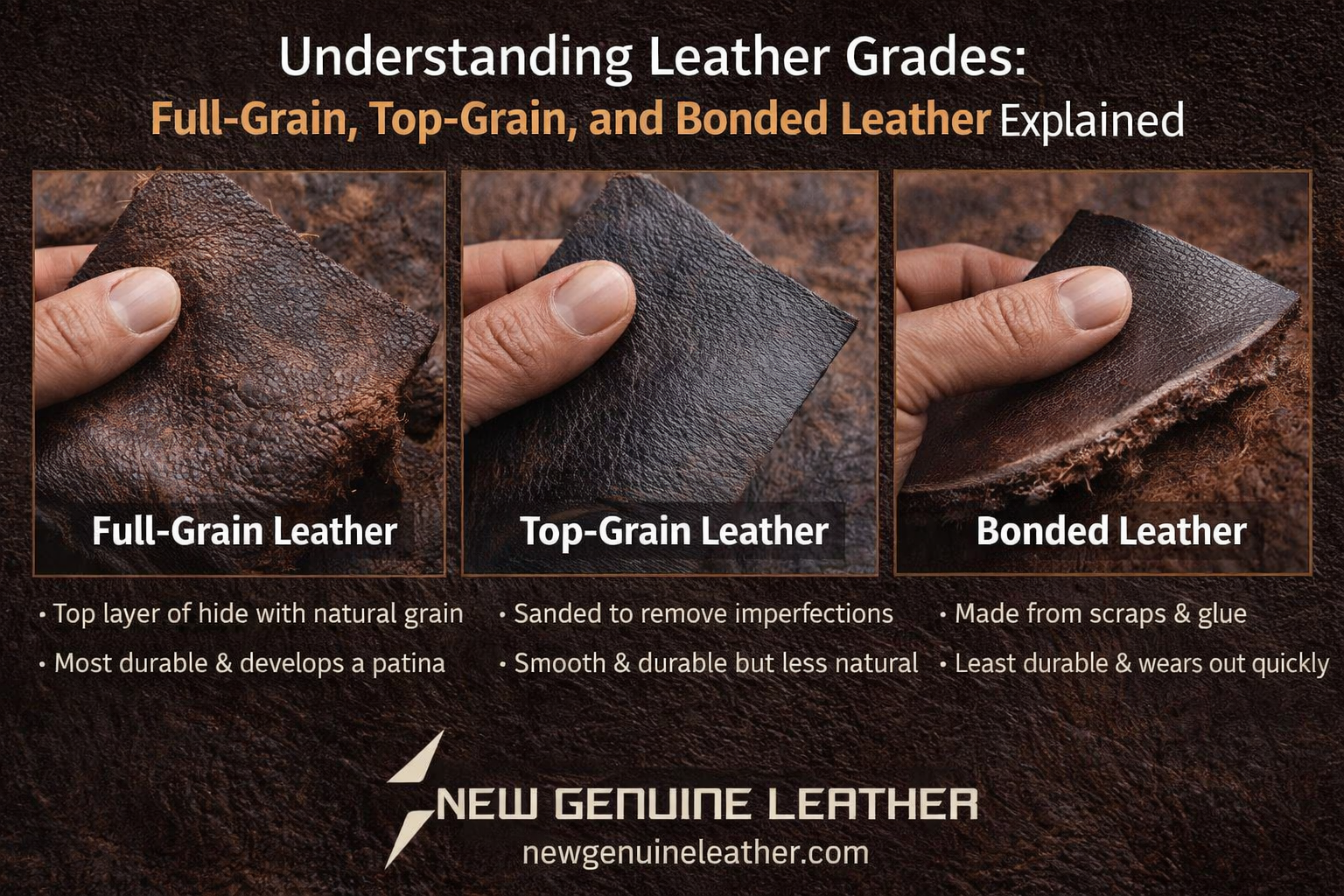
Full-grain leather retains the natural grain surface of the hide. It has not been heavily sanded or buffed to remove natural pores, wrinkles, scars, or grain variations.
Because the grain remains intact, full-grain leather usually offers excellent strength and develops a distinctive appearance with use. Natural markings are considered part of its character rather than manufacturing defects.
However, full-grain does not necessarily mean completely unfinished. It may receive dyes, oils, waxes, pigments, or protective coatings while still retaining its natural grain structure. Leather Naturally describes full-grain as leather in which the original grain surface remains present.
Full-grain leather is commonly used for:
- Premium jackets
- High-quality bags
- Belts and straps
- Boots and footwear
- Luxury accessories
- Durable furniture and upholstery
Buyers should expect some natural variation between panels. A perfectly identical pattern across every piece may indicate heavy correction, embossing, or synthetic material rather than natural full-grain leather.
2. Top-Grain Leather
Top-grain leather comes from the upper section of the hide after it has been split horizontally. It includes the strong grain-side fibers but may receive more surface correction than full-grain leather.
In many commercial products, the surface is lightly sanded or buffed to reduce scars and uneven areas. Color, protective finishes, and an embossed grain pattern may then be applied to create a cleaner and more uniform appearance.
Top-grain leather can provide a useful balance between durability, softness, consistency, and price. It is widely used in jackets, handbags, trousers, skirts, shoes, and upholstered products.
A common misunderstanding is that top-grain always means a single, fixed quality. In reality, its performance depends on factors such as:
- Hide selection
- Degree of surface correction
- Thickness
- Tanning process
- Type of finish
- Flexibility and strength
- Quality-control standards
For wholesale buyers, an approved physical sample is more valuable than relying only on the words “top-grain.”
3. Corrected-Grain Leather
Corrected-grain leather is grain-side leather that has been sanded or buffed to reduce visible imperfections. The manufacturer may apply pigments and emboss a new grain texture onto the prepared surface.
This process creates a more uniform color and pattern, making corrected-grain leather suitable for large production runs where visual consistency is important.
Corrected-grain leather is commonly used for fashion garments, footwear, bags, furniture, automotive interiors, and accessories. It may also provide better resistance to surface staining when a protective pigment coating is applied.
The quality can vary significantly. Lightly corrected leather may remain soft and natural, while heavily coated material may feel firmer and less breathable.
When understanding leather grades, buyers should ask how heavily the grain has been corrected rather than assuming all corrected leather is identical.
4. Genuine Leather
“Genuine leather” means that the product contains real leather rather than being made entirely from synthetic PU or PVC material.
However, genuine leather is a broad description. It does not automatically identify the layer of the hide, tanning quality, thickness, finish, or expected durability.
A genuine leather product may be made from grain leather, corrected leather, or a finished split. Some genuine leather is strong and well manufactured, while other material is created for lower-priced products with heavier surface coatings.
This makes physical evaluation especially important.
Buyers should inspect:
- Surface flexibility
- Leather thickness
- Backing structure
- Edge appearance
- Smell and hand feel
- Stitching quality
- Coating strength
- Resistance to cracking
At New Genuine Leather, material descriptions are matched with approved samples so buyers understand what will be used before bulk production begins.
5. Split Leather, Suede and Nubuck
When a thick hide is divided, the lower layer is known as split leather or flesh split. It does not contain the original outer grain surface, but it is still produced from animal hide. The Leather Working Group defines grain, flesh, and middle splits according to their positions within a horizontally divided hide.
Split leather can be finished with pigments, coatings, embossing, or other treatments. It is often used for bags, footwear, gloves, protective products, and budget-conscious fashion items.
Suede
Suede has a soft, fibrous nap. It is commonly produced from the flesh side or from split leather.
Its velvety surface makes it popular for:
- Lederhosen
- Jackets
- Skirts
- Shoes
- Gloves
- Bags and accessories
Suede requires careful handling because its open nap can collect dust and absorb moisture more easily than heavily coated smooth leather.
Nubuck
Nubuck is normally produced by lightly buffing the grain side of leather. It has a fine, soft nap but retains the stronger grain-side structure.
Nubuck often feels smoother and finer than conventional suede. It is used in premium footwear, bags, jackets, and accessories.
Leather Naturally distinguishes split leather, suede, nubuck, and lightly buffed grain surfaces in its industry terminology guidance.
6. Bonded Leather
Bonded leather is manufactured using leather fibers or particles combined with binders and supporting materials. A surface coating and artificial grain pattern may be added to create a leather-like appearance.
The exact composition and labeling requirements can differ between markets, so buyers should request a clear material specification.
Bonded leather offers a consistent appearance and a lower price, but it generally does not age in the same way as solid hide leather. Its durability depends heavily on the binder, backing, coating thickness, and manufacturing quality.
It is commonly found in:
- Lower-cost furniture
- Book covers
- Desk accessories
- Promotional goods
- Fashion accessories
- Decorative products
Bonded leather should not be marketed as full-grain or top-grain leather. Clear labeling helps buyers understand exactly what they are purchasing.
7. Faux Leather Is Not a Leather Grade
Faux leather is not a grade of natural leather. It is a synthetic material usually produced by applying polyurethane or polyvinyl chloride to a fabric backing.
Common names include:
- PU leather
- PVC leather
- Vegan leather
- Synthetic leather
- Leatherette
- Artificial leather
Faux leather can offer uniform color, easy cleaning, and lower production costs. However, it does not have the same natural fiber structure as animal-hide leather.
Some synthetic products are suitable for particular markets, especially where buyers specifically request animal-free materials. They should still be accurately labeled so customers are not led to believe they are buying genuine hide leather.
Why Leather Grade Is Only Part of Quality
A leather category alone cannot predict the quality of a finished jacket, skirt, bag, or pair of gloves.
Two full-grain hides can perform differently if they were tanned, dried, conditioned, or finished using different methods. Likewise, professionally produced corrected-grain leather may perform better for a specific product than poorly processed full-grain material.
A complete evaluation should include:
- Hide origin and selection
- Tanning quality
- Leather thickness
- Tear and tensile strength
- Colorfastness
- Surface-coating adhesion
- Flexibility
- Stitching and construction
- Hardware quality
- Intended application
This is why understanding leather grades should be combined with sample testing and supplier evaluation.
Choosing Leather for Different Products
The best material depends on how the finished item will be used.
Leather Jackets
Jackets require flexibility, softness, and resistance to repeated bending. Full-grain, top-grain, corrected-grain, sheep, goat, or cow leather may all be suitable depending on the required weight and style.
Leather Skirts and Trousers
Skirts and trousers need a comfortable drape while retaining enough strength around seams, waistbands, pockets, and closures. Softer garment leather is normally preferred over thick bag or belt leather.
Lederhosen
Traditional lederhosen often use suede or suede-like leather because the surface supports embroidery and provides an authentic Bavarian appearance.
Leather Gloves
Glove leather must offer flexibility, touch sensitivity, comfort, and suitable abrasion resistance. The ideal material differs between fashion, driving, welding, safety, and motorcycle gloves.
Leather Bags
Bags usually require greater structure and resistance to scratching. Full-grain, top-grain, corrected-grain, and selected split leathers may be used depending on the design and price level.
Understanding Leather Grades for Wholesale Orders
Wholesale and private-label buyers should never approve material using only a written name.
Request a physical swatch and finished product sample before confirming bulk production. The approved sample should establish the expected color, grain, thickness, softness, finish, and overall appearance.
Buyers should also confirm:
- Leather type and animal source
- Grain or split construction
- Surface treatment
- Color tolerance
- Thickness tolerance
- Minimum order quantity
- Testing requirements
- Labeling and packaging
- Production lead time
Keep one approved sample with the buyer and one with the manufacturer. Both samples should be signed or clearly identified for production comparison.
Responsible Leather Sourcing
Leather quality and responsible production are related but separate considerations. A high-grade leather label does not automatically confirm how responsibly the tannery operates.
The Leather Working Group certification program evaluates leather manufacturing facilities in areas such as water and energy use, waste, effluent, chemical management, traceability, emissions, and health and safety.
Buyers can also review the official Leather Naturally terminology guide for industry explanations of full-grain, split, suede, nubuck, and related terms.
These external resources should remain normal dofollow links in WordPress.
Why Choose New Genuine Leather?
New Genuine Leather manufactures customized leather garments and accessories for wholesalers, distributors, retailers, and private-label brands.
Our product capabilities include:
- Leather jackets
- Custom lederhosen
- Leather skirts and trousers
- Fashion and safety gloves
- Motorcycle apparel
- Bags and accessories
- OEM and private-label products
We assist buyers with leather selection, surface finishes, embroidery, custom sizing, branded labels, packaging, and sample development.
For NGL, understanding leather grades is part of building the right product rather than simply selecting the most expensive material. Every order should match the buyer’s design, target customer, performance expectations, and price range.
Frequently Asked Questions
Is full-grain always the best leather?
Full-grain is valued for its natural surface and durability, but it may not be the best option for every product. A soft corrected or top-grain leather may be more suitable when consistent color, lightweight construction, or a specific finish is required.
Is genuine leather real?
Yes. Genuine leather is made from animal hide, but the term does not specify a consistent grade or quality level.
Is suede real leather?
Yes. Suede is real leather with a napped surface, commonly made from the flesh side or from a split layer.
Is nubuck the same as suede?
No. Nubuck is generally created by lightly buffing the grain side, while suede is commonly produced from the flesh side or split leather.
Is faux leather a leather grade?
No. Faux leather is synthetic material and should be clearly identified as PU, PVC, vegan, artificial, or synthetic leather.
Final Thoughts
Understanding leather grades helps consumers and wholesale buyers make more informed purchasing decisions. Full-grain, top-grain, corrected-grain, genuine, split, suede, nubuck, and bonded leather each offer different characteristics.
The label is only the beginning. Thickness, tanning, finishing, flexibility, construction, and supplier quality all influence how a finished leather product will perform.
For custom leather jackets, skirts, gloves, lederhosen, bags, and OEM products, New Genuine Leather (NGL) provides material guidance, sample development, branded manufacturing, and worldwide export support.
Contact New Genuine Leather
Website: New Genuine Leather
Instagram: Follow New Genuine Leather
WhatsApp: Discuss Your Wholesale Order
