

Setting Out Process in Leather: 7 Proven Benefits

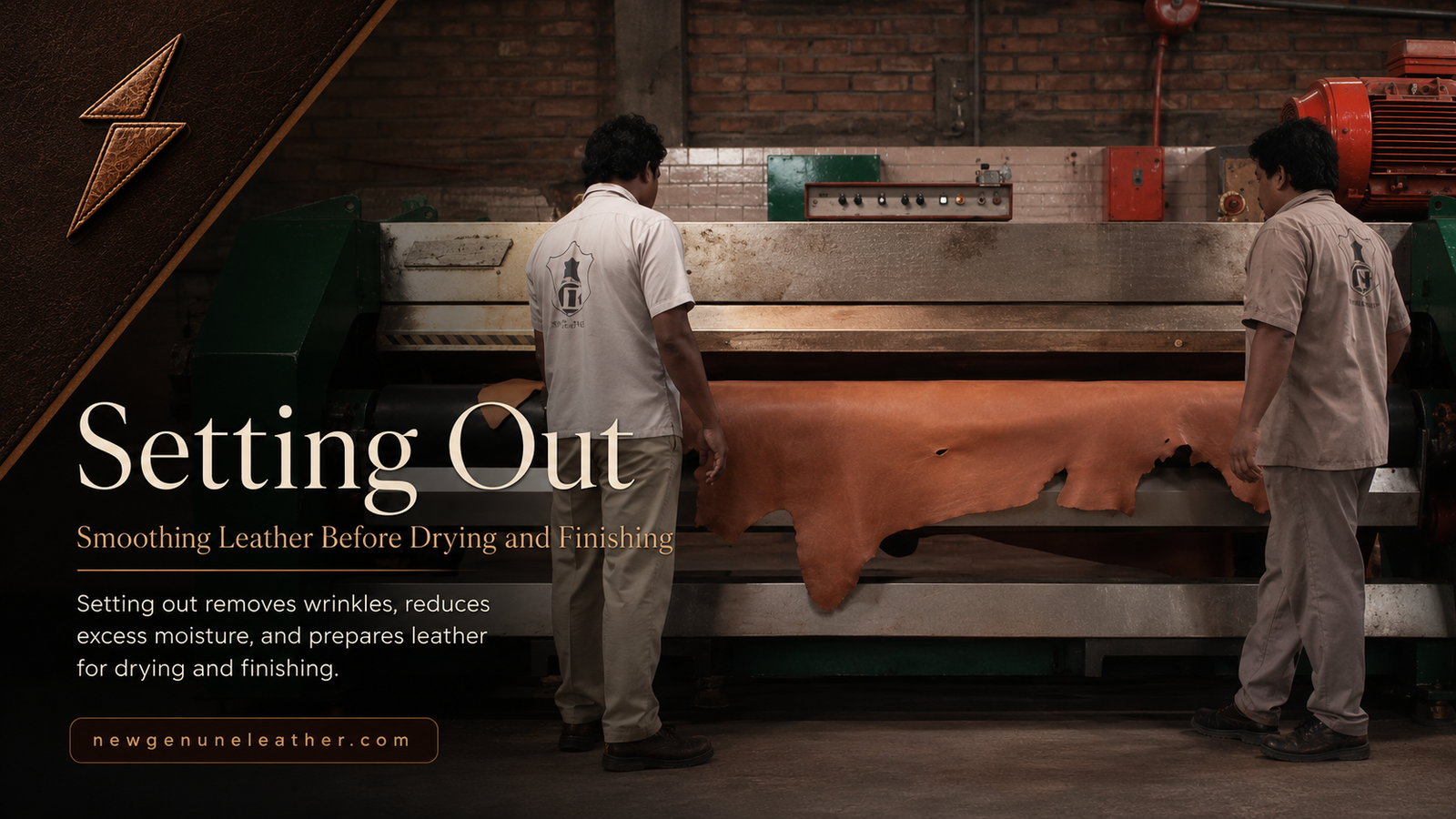
The setting out process in leather is an important mechanical operation that removes excess moisture, smooths the grain surface, opens the hide, and prepares it for controlled drying. Although it may appear to be a simple flattening stage, correct setting out can influence the leather’s usable area, appearance, softness, dimensional stability, and final finishing quality.
At New Genuine Leather (NGL), we understand that consistent finished products begin with carefully controlled leather preparation. Whether the material is intended for jackets, skirts, lederhosen, gloves, trousers, bags, or private-label accessories, every production stage affects the final result.
For wholesale and OEM buyers, understanding setting out makes it easier to evaluate leather quality, compare manufacturing samples, and communicate surface and performance requirements with a supplier.
What Is the Setting Out Process in Leather?
The setting out process in leather is a mechanical method used to spread, flatten, and smooth wet leather while pushing out part of the remaining water.
After tanning and wet-end processing, leather contains a considerable amount of moisture. It may also have folds, wrinkles, compressed sections, and uneven areas caused by handling inside drums or processing equipment.
During setting out, the leather is passed through a specialized machine or worked with suitable tools. Controlled pressure stretches the leather outward, reduces folds, smooths the grain, and distributes moisture more evenly across the hide.
This operation is often performed before drying. The exact point can vary according to the tannery’s workflow, leather type, and intended finish.
Setting Out Compared with Samming and Setting Out Process in Leather
Setting out and samming are related processes, but they are not identical.
Samming mainly removes bulk water from wet leather by passing it through pressure rollers. It is comparable to controlled squeezing, although industrial machinery is designed to prevent unnecessary damage to the grain.
Setting out goes further. In addition to removing moisture, it opens the hide, smooths wrinkles, stretches the surface, and helps restore a flatter shape.
A tannery may use samming first and setting out afterward. Some modern machinery combines moisture removal and setting-out functions in one operation.
The important difference is that samming focuses primarily on water removal, while setting out also improves shape, surface condition, and usable area.
Where Setting Out Fits in Leather Manufacturing Setting Out Process in Leather.
Leather manufacturing includes several linked stages. Hides are prepared, tanned, retanned, dyed, lubricated, mechanically processed, dried, finished, inspected, and graded.
The setting out process in leather generally takes place after wet processing and before a major drying stage. At this point, the leather is still flexible enough to be opened and flattened without creating harsh permanent folds.
A simplified production sequence may include:
- Tanning
- Samming or moisture reduction
- Shaving and thickness adjustment
- Retanning, dyeing, and fatliquoring
- Setting out
- Drying
- Conditioning and softening
- Surface finishing
- Final inspection
The exact order may differ according to the leather article being produced. Leather Working Group describes modern leather manufacturing as a connected series of preparation, tanning, drying, and finishing operations rather than a single treatment.
1. Removes Excess Moisture
The first major benefit of setting out is moisture reduction.
After wet-end treatments, water remains between the leather’s fiber structures. If too much water is carried directly into drying, the process may take longer and require more energy.
Setting out presses water toward the edges while spreading the leather across the machine. It does not completely dry the material, but it brings the moisture level closer to the range needed for the next operation.
More uniform moisture distribution also helps different areas of the hide dry at a similar rate. This reduces the risk of one section becoming dry and firm while another remains excessively wet.
2. Smooths the Grain Surface
The grain is the outer surface of leather and one of the first features a buyer notices. Setting Out Process in Leather.
Wrinkles, folds, and handling marks can become more visible after drying if they are not corrected while the leather is still damp. Setting out smooths these irregularities before they become fixed into the surface.
Properly adjusted machinery applies enough pressure to improve the grain without crushing or damaging it.
This is particularly important for leather used in visible garment panels. Jacket fronts, leather skirt panels, bag flaps, and trouser legs require a clean and consistent appearance.
3. Increases the Usable Leather Area
A wet hide can contract, fold, and gather during drum processing. Setting out opens the material and spreads it closer to its natural working dimensions.
Increasing the usable cutting area does not mean overstretching the leather. Excessive force could weaken the structure or create distortion.
Instead, the operator aims to remove unnecessary folds and gently extend compressed areas. This can provide a flatter surface for measuring, grading, and pattern placement.
For manufacturers, improved area utilization can reduce cutting waste. For buyers, it supports more consistent costing and better material use across bulk production.
4. Reduces Creases and Processing Marks
Leather moves continuously during tanning, dyeing, washing, and fatliquoring. It may develop temporary folds or pressure lines during these wet operations.
The setting out process in leather helps reduce these marks while the fibers remain flexible.
This is important because a crease that looks minor in wet leather may become more noticeable after drying, finishing, or pigment application. Correcting it early is easier than trying to conceal it later with heavy surface coatings.
Setting out cannot remove every natural feature. Scars, growth marks, pores, and natural grain variations are part of the hide itself. The goal is to correct avoidable processing marks without eliminating the leather’s natural character.
5. Prepares Leather for Even Drying Setting Out Process in Leather.
Drying is one of the most sensitive stages of leather production. The leather must lose moisture without becoming excessively hard, distorted, or uneven.
Setting out creates a flatter and more uniform shape before leather enters vacuum drying, toggle drying, hanging, or another drying system.
When the hide is spread properly, air, heat, or vacuum pressure can act more evenly across its surface. This supports better dimensional control and reduces irregular drying patterns.
The process also helps manufacturers organize leather more efficiently before loading it into drying equipment.
Modern leather-production guides treat water removal and reconfiguration into a flat form as a distinct manufacturing phase because these operations affect the structure and appearance of the material.
6. Supports Consistent Finishing Setting Out Process in Leather
Leather finishing may involve dyes, pigments, waxes, oils, binders, protective coatings, embossing, polishing, or special visual effects.
These materials perform best when the leather surface is reasonably flat and moisture is controlled.
If the grain contains folds or unevenly compressed areas, a finish may appear darker in one section and lighter in another. Coatings may also collect inside creases, creating visible lines or inconsistent gloss.
By smoothing the grain before drying and finishing, setting out supports more uniform color and coating distribution.
This is particularly valuable for OEM buyers who require repeated color matching across different production batches.
7. Improves Final Product Consistency Setting Out Process in Leather
The final benefit is overall consistency.
A well-managed setting out process in leather contributes to a more predictable surface, shape, area, and moisture condition. These qualities help later departments perform cutting, stitching, finishing, and assembly more accurately.
For example, uneven leather may create difficulties when matching two jacket front panels. A distorted hide can also affect the way long skirt or trouser patterns are positioned.
Consistent preparation therefore supports both visual quality and production efficiency.
Machinery Used for Setting Out
Industrial setting-out machines generally use rollers and specially designed blades to spread wet leather while applying controlled pressure.
The working components must move smoothly across the material. Sharp, poorly adjusted, or contaminated parts could mark the grain.
Operators normally control factors such as:
- Roller pressure
- Blade condition
- Feed speed
- Leather moisture
- Number of passes
- Direction of processing
- Required degree of extension
Different leather types need different settings. Soft garment leather cannot always be treated with the same pressure used for heavier bag or footwear leather.
Traditional hand-setting methods may still be used for specialist or small-batch production, but mechanical systems provide greater speed and repeatability for industrial orders.
Quality Control During the Setting Out Process in Leather
Quality inspection should take place before, during, and after setting out.
Before processing, the operator checks whether the leather is too wet, too dry, folded, damaged, or incorrectly prepared. Leather that has begun drying unevenly may not respond consistently.
During processing, attention is given to grain direction, pressure, stretching, and surface behavior.
Afterward, quality-control staff check:
- Surface smoothness
- Remaining creases
- Grain damage
- Moisture uniformity
- Shape and usable area
- Edge condition
- Unwanted machine marks
- Excessive stretching
The leather should be evenly opened without feeling strained or unnaturally thin.
Common Setting-Out Mistakes Setting Out Process in Leather
One common mistake is using excessive pressure. This may flatten the natural grain, create shine, or overstretch weaker areas.
Another problem is processing leather with unsuitable moisture content. Leather that is too wet may not hold the desired shape, while leather that is too dry may develop marks or resist smooth stretching.
Dirty rollers or damaged blades can transfer lines and scratches onto the grain. Poor maintenance can therefore turn a quality-improvement stage into a source of defects.
Repeated passes should also be controlled. More processing does not automatically produce better leather. Each pass should have a defined purpose.
Setting Out Process in Leather for Different Products
The required result depends on the finished product.
Leather Jackets
Jacket leather must remain soft, flexible, and visually consistent. Setting out helps create smoother panels while preserving the natural drape needed for comfortable garments.
Leather Skirts and Trousers
Long garment patterns require flatter cutting areas. The setting out process in leather helps reduce folds that could interfere with pattern placement or create visible distortion.
Custom Lederhosen
Lederhosen leather often requires a traditional matte, suede-like, or aged character. Setting out should prepare the material without removing the authentic texture needed for embroidery and Bavarian styling.
Leather Gloves
Glove leather requires softness and controlled stretch. Heavy pressure could affect comfort, so processing settings must be carefully selected.
Bags and Accessories
Bag leather often needs dimensional stability and an even surface. Correct setting out supports straight edges, clean panels, and more consistent finishing.
Why the Process Matters to Wholesale Buyers
Wholesale buyers may never see the setting-out machine, but they can see the results of poor processing.
Uneven panels, deep creases, shade variation, distorted shapes, and inconsistent surface finishes may all be connected to weak material preparation.
Before approving a bulk order, buyers should evaluate:
- Surface uniformity
- Leather softness
- Grain appearance
- Panel-to-panel color matching
- Flexibility after bending
- Consistency between samples
- Visible wrinkles or machine marks
A physical pre-production sample remains one of the best tools for confirming expectations.
Buyers researching responsible production can also review the manufacturing and certification information published by the Leather Working Group. Its standards are used to assess practices within leather-manufacturing operations.
For broader educational information about hide structure and modern leather production, the Leather Naturally leather-making guide is another useful external resource.
New Genuine Leather Manufacturing Services
New Genuine Leather (NGL) manufactures genuine leather garments and accessories for international wholesale, OEM, and private-label clients.
Our product capabilities include:
- Genuine leather jackets
- Leather skirts and trousers
- Custom lederhosen
- Motorbike and safety gloves
- Leather bags and accessories
- Customized private-label products
We work with buyers on material selection, sizing, color development, embroidery, hardware, logo placement, labels, packaging, and surface finishing.
Careful control of the setting out process in leather supports the consistent appearance and performance expected across approved production runs.Contact New Genuine Leather
Website: New Genuine Leather
Instagram: Follow New Genuine Leather
WhatsApp: Discuss Your Wholesale Order
Frequently Asked Questions
What is the main purpose of setting out leather?
Its main purpose is to remove part of the remaining moisture, flatten the hide, smooth the grain, reduce creases, and prepare the material for drying.
Is setting out the same as drying?
No. Setting out removes some moisture and prepares the leather’s shape, but a separate drying process is still required.
Can setting out increase leather area?
It can improve usable area by opening folds and spreading compressed sections. It should not involve uncontrolled overstretching.
Does every type of leather require the same pressure?
No. Pressure, speed, and the number of passes should be selected according to thickness, softness, moisture, leather type, and final use.
Can poor setting out damage leather?
Yes. Excessive pressure, unsuitable moisture, damaged machine parts, or repeated processing may flatten the grain, create marks, or distort the hide.
Final Thoughts
The setting out process in leather may take place before the most visible finishing stages, but its effect continues throughout production.
By reducing excess moisture, opening the hide, smoothing the grain, minimizing creases, and preparing the material for even drying, setting out creates a stronger foundation for dependable finishing and accurate cutting.
For wholesale and private-label buyers, these details matter because material consistency affects every finished item in the order. New Genuine Leather combines controlled leather preparation with customization, sample development, and quality inspection to manufacture leather products for international markets.
