

Aldehyde Tanning: 7 Powerful Facts Buyers Must Know

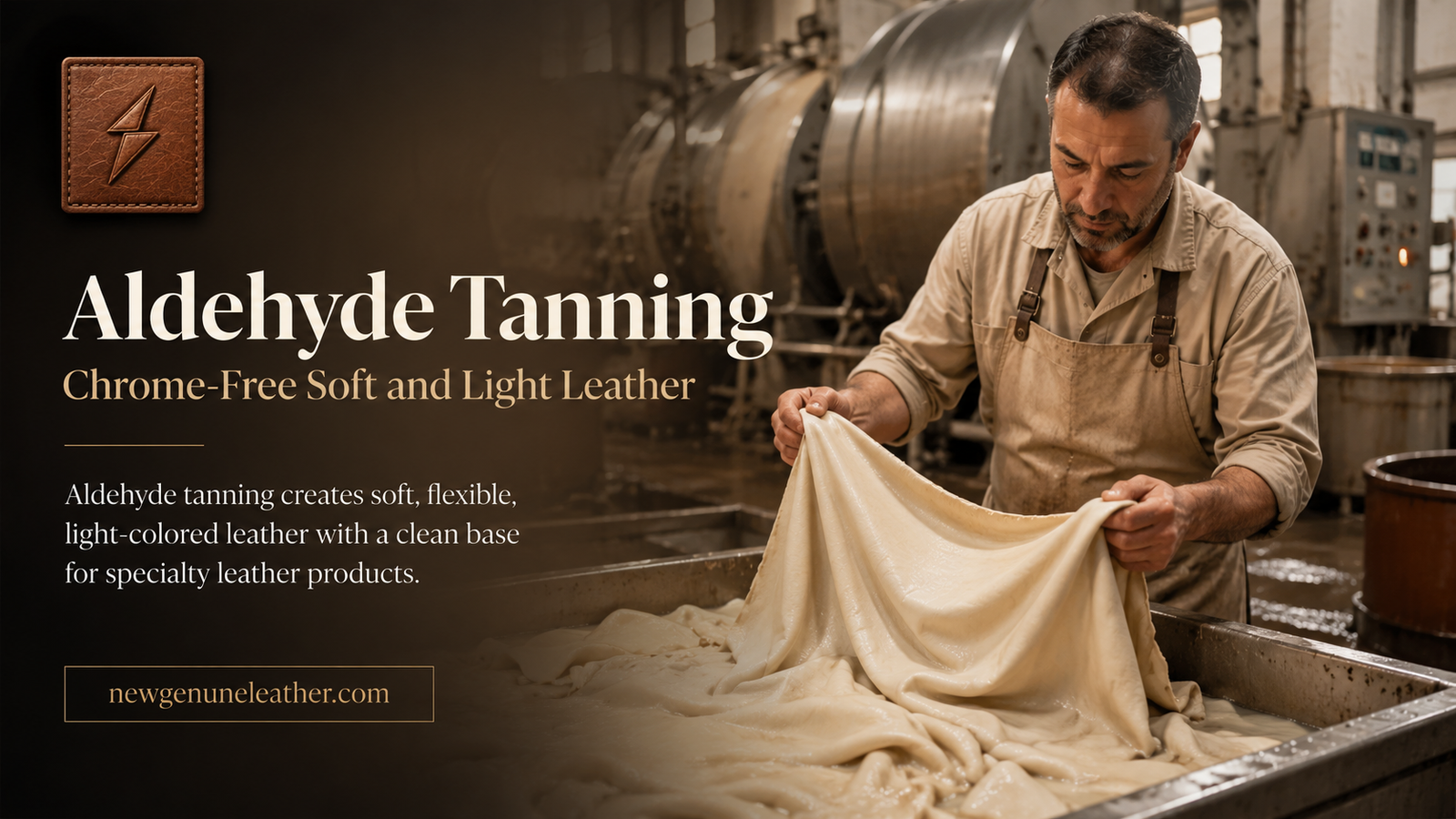
Aldehyde tanning is a chrome-free leather-processing method used to stabilize animal hides and produce pale, versatile leather for garments, gloves, footwear, upholstery, bags, and other products. For wholesale buyers and private-label brands, understanding the tanning method is important because it can affect colour, softness, chemical compliance, durability, finishing options, and final product performance.
Unlike conventional chrome tanning, which mainly uses chromium salts, aldehyde-based processes use reactive compounds such as glutaraldehyde or modified aldehydes. These materials interact with the collagen structure of the hide and help convert it into stable leather.
The method is commonly associated with wet-white leather. However, wet-white is a broader category and can also be produced with aluminium salts, zirconium salts, syntans, and other chrome-free tanning technologies. The Leather Working Group includes modified aldehydes and glutaraldehydes among the substances used to produce wet-white leather.
What Is Aldehyde Tanning?
Raw animal hide is naturally vulnerable to bacterial activity, moisture damage, stiffness, and decomposition. Tanning stabilizes the collagen fibres so that the hide can be processed, dried, softened, finished, and converted into usable leather.
In aldehyde tanning, aldehyde groups act as cross-linking agents within the collagen structure. Research into aldehyde-based systems has examined materials including formaldehyde, glyoxal, glutaraldehyde, dialdehyde starch, and other polyfunctional aldehydes.
Modern commercial processes are more commonly associated with glutaraldehyde derivatives and modified aldehyde products rather than traditional formaldehyde tanning. The selected chemistry, concentration, pH, temperature, processing time, and retanning system all influence the final result.
The method may be used as the main tanning stage or as a pretanning process. After pretanning, manufacturers can apply vegetable tanning agents, syntans, polymers, dyes, fatliquors, and finishing products to create the required feel and appearance.
1. Aldehyde Tanning Can Produce Wet-White Leather
One of the most recognizable results of aldehyde tanning is wet-white leather. Wet-white refers to leather in a wet, intermediate manufacturing condition after chrome-free tanning.
Leather Working Group defines wet-white as leather tanned with substances such as modified aldehydes, glutaraldehydes, aluminium salts, zirconium salts, and syntans that produce a whitish appearance.
This light-coloured base can be useful when manufacturers need pale, bright, pastel, or fashion-sensitive shades. Because the material does not have the blue-green colour normally associated with chrome-tanned wet-blue leather, technicians have greater flexibility when developing certain colours.
However, not every aldehyde-tanned hide will be perfectly white. Glutaraldehyde-based systems can produce cream, beige, or slightly yellow tones, especially when the chemistry or storage conditions are not carefully controlled. Industry literature notes that glutaraldehyde conversion products can contribute to yellowish colouring.
For light-coloured products, buyers should approve a physical leather swatch and finished sample before bulk production.
2. How the Aldehyde Tanning Process Works
The process normally begins after beamhouse operations such as soaking, liming, hair removal, fleshing, deliming, and bating. These stages clean and prepare the hide so the tanning agent can penetrate properly.
The prepared pelt may then be pickled or adjusted to the conditions required by the selected tanning product. The aldehyde agent must penetrate through the full cross-section of the hide before final fixation.
Process technicians control:
- Chemical concentration
- Float length
- Drum movement
- Processing time
- Temperature
- Penetration
- pH adjustment
If fixation occurs too quickly, the surface may tan before the centre. This can result in uneven penetration, inconsistent colour, loose grain, or differences in physical performance.
After tanning or pretanning, the leather can be split and shaved to the required thickness. Wet-white pretanning stabilizes the hide sufficiently for mechanical thickness adjustment and produces chrome-free splitting and shaving waste.
The leather is then retanned, dyed, fatliquored, dried, softened, buffed, and finished according to the intended product.
3. Benefits of Aldehyde Tanning
A major benefit of aldehyde tanning is its ability to support chrome-free leather production. This can be useful for brands whose material policies, customer requirements, or product specifications restrict chromium-based tanning.
The pale base also supports a broad range of colours. Light browns, beige, grey, cream, pastel, and selected fashion shades may be easier to develop when the starting leather is pale rather than blue.
The tanning route can also provide considerable flexibility during retanning. Manufacturers can use different combinations of vegetable extracts, synthetic tanning agents, polymers, resins, dyes, and fatliquors to adjust:
- Softness and drape
- Fullness and body
- Grain appearance
- Colour intensity
- Surface character
- Handle and flexibility
Glutaraldehyde pretanning may also contribute a softening effect when it is combined with suitable vegetable tanning materials.
This flexibility makes the process relevant to garment leather, bags, footwear uppers, upholstery, gloves, accessories, and other product categories.
4. Chrome-Free Does Not Always Mean Metal-Free
A common sourcing mistake is treating the terms chrome-free, metal-free and wet-white as though they have the same meaning.
They do not.
Chrome-free leather is produced without chromium salts and must meet the applicable chromium-content definition. Metal-free-tanned leather must remain below the specified total content for all tanning metals, not only chromium. Leather Working Group distinguishes between these two definitions.
A wet-white system could use an aldehyde, an aluminium salt, a zirconium salt, a syntan, or a combination of materials. Therefore, a wet-white description alone does not prove that the leather is metal-free.
Wholesale buyers should clearly state whether they require:
- Chrome-free leather
- Metal-free-tanned leather
- Formaldehyde-free leather
- Aldehyde-free leather
- Leather compliant with a specific restricted-substance list
These requirements should be written into the approved material specification and confirmed by relevant laboratory reports.
5. Limitations of Aldehyde-Tanned Leather
Aldehyde-tanned leather does not automatically outperform chrome-tanned or vegetable-tanned leather in every application.
Its physical and visual properties depend heavily on the tanning formulation and post-tanning process. Heat resistance, colour stability, lightfastness, softness, grain tightness, tear strength, flex resistance, odour, finish adhesion, and ageing should be tested for the intended product.
The slightly yellow colour associated with some glutaraldehyde systems can be a challenge for pure white or cool pastel collections. Modified aldehydes and carefully selected retanning materials may help manufacturers manage the shade, but physical sample approval remains essential.
Manufacturers must also develop the correct retanning recipe. Aldehyde pretanning alone may not provide all the fullness, firmness, grain character, dye response, or handle required by the finished article.
For example, soft leather for a fashion skirt will require a different recipe from leather used for a structured bag, protective glove, shoe upper, or upholstered seat.
6. Safety and Responsible Chemical Management
Aldehyde tanning should not automatically be marketed as completely harmless or environmentally friendly simply because it is chrome-free.
Glutaraldehyde requires controlled handling during production. The European Chemicals Agency identifies glutaral as a recognized skin and respiratory sensitizer.
A responsible tannery should therefore use suitable:
- Chemical storage systems
- Worker training
- Ventilation
- Dosing controls
- Personal protective equipment
- Spill procedures
- Wastewater treatment
- Exposure management
Finished leather is different from the concentrated chemical used during production, but the final material should still be tested for relevant restricted substances, residues, physical performance, and customer-specific requirements.
The European Commission’s Best Available Techniques reference for tanning provides useful information about industrial tanning processes and environmental management. The document covers large installations processing bovine and ovine hides and skins.
Buyers can also consult the European Chemicals Agency’s information on glutaral when reviewing chemical safety requirements.
7. What Wholesale and OEM Buyers Should Check
Before ordering products made with aldehyde-tanned leather, buyers should request a physical material swatch and a finished pre-production sample.
The supplier should clearly identify the tanning system instead of using general terms such as “eco leather,” “non-toxic leather,” or “chemical-free leather.” All commercial tanning processes involve chemical or biological treatment, so vague descriptions should be supported by technical documentation.
Buyers should confirm the following details:
- Hide or skin type
- Leather thickness
- Tanning system
- Retanning materials
- Colour tolerance
- Surface finish
- Softness and handle
- Physical testing requirements
- Restricted-substance limits
- Target market regulations
- Batch consistency
For repeat orders, an approved master sample should be retained. Future production batches can then be compared for colour, grain, thickness, softness, embroidery compatibility, finish, and overall appearance.
The Leather Working Group terminology guide is a useful outbound reference for buyers who need clear definitions of wet-white, chrome-free, metal-free, full-grain, split leather, and other industry terms.
Aldehyde Tanning Compared with Other Tanning Methods
Chrome tanning is widely used because it can produce soft, versatile leather with strong thermal stability and efficient processing.
Vegetable tanning uses natural tannins and is commonly selected when manufacturers need firmness, structure, body, and traditional leather character.
Aldehyde tanning occupies a different position. It can provide a pale, chrome-free base that manufacturers can modify through retanning, dyeing, lubrication, drying, and finishing.
No method is automatically best for every article. The tanning route should be selected according to the finished product’s performance requirements rather than marketing language alone.
A motorcycle garment, leather skirt, welding glove, lederhosen, handbag, and upholstered seat all require different combinations of thickness, softness, strength, finish performance, flexibility, and colour stability.
Aldehyde Tanning at New Genuine Leather
New Genuine Leather is a B2B leather garments, gloves, Bavarian apparel, and accessories manufacturer based in Sialkot, Pakistan.
We work with international wholesale buyers, retailers, distributors, importers, and private-label brands to develop products according to buyer-approved material, construction, sizing, colour, branding, and finishing requirements.
Customization options can include:
- Genuine leather selection
- Custom colours and finishes
- Size grading
- Private-label branding
- Custom packaging
- Embroidery and logo placement
- OEM product development
- Bulk export production
Our standard MOQ is 50 pieces, depending on the product design, leather type, colours, and customization requirements.
Frequently Asked Questions
Is aldehyde tanning chrome-free?
A properly designed aldehyde-based tanning system can produce chrome-free leather. Buyers should verify the tanning recipe and test results instead of relying only on the product description.
Is all wet-white leather aldehyde-tanned?
No. Wet-white can also be produced with aluminium salts, zirconium salts, syntans, and other chrome-free systems.
Can aldehyde-tanned leather be used for clothing?
Yes, provided the leather is engineered and tested for the required softness, drape, strength, colourfastness, finish adhesion, and comfort.
Is aldehyde tanning completely environmentally friendly?
No tanning system should be called environmentally friendly without supporting evidence. Environmental performance depends on chemical selection, water use, energy, wastewater treatment, emissions, material yield, durability, and waste management.
Should buyers request laboratory testing?
Yes. Testing is particularly important for large OEM orders, products with prolonged skin contact, workwear, children’s products, and goods intended for regulated markets.
Final Thoughts
Aldehyde tanning is an important chrome-free method for producing pale and adaptable leather. Its light base, retanning flexibility, and suitability for wet-white production make it valuable for a range of fashion, footwear, glove, upholstery, and leather-goods applications.
However, the term should not be used as a guarantee of quality or sustainability. Successful results depend on controlled tanning, responsible chemical management, an appropriate retanning system, physical testing, and clearly written buyer specifications.
For custom leather garments, gloves, lederhosen, accessories, and private-label collections, New Genuine Leather supports wholesale and OEM development with an MOQ starting from 50 pieces.
Contact New Genuine Leather
Website: New Genuine Leather
Instagram: Follow New Genuine Leather
WhatsApp: Discuss Your Wholesale Order
