

De-Liming in Leather: 7 Powerful Quality Benefits

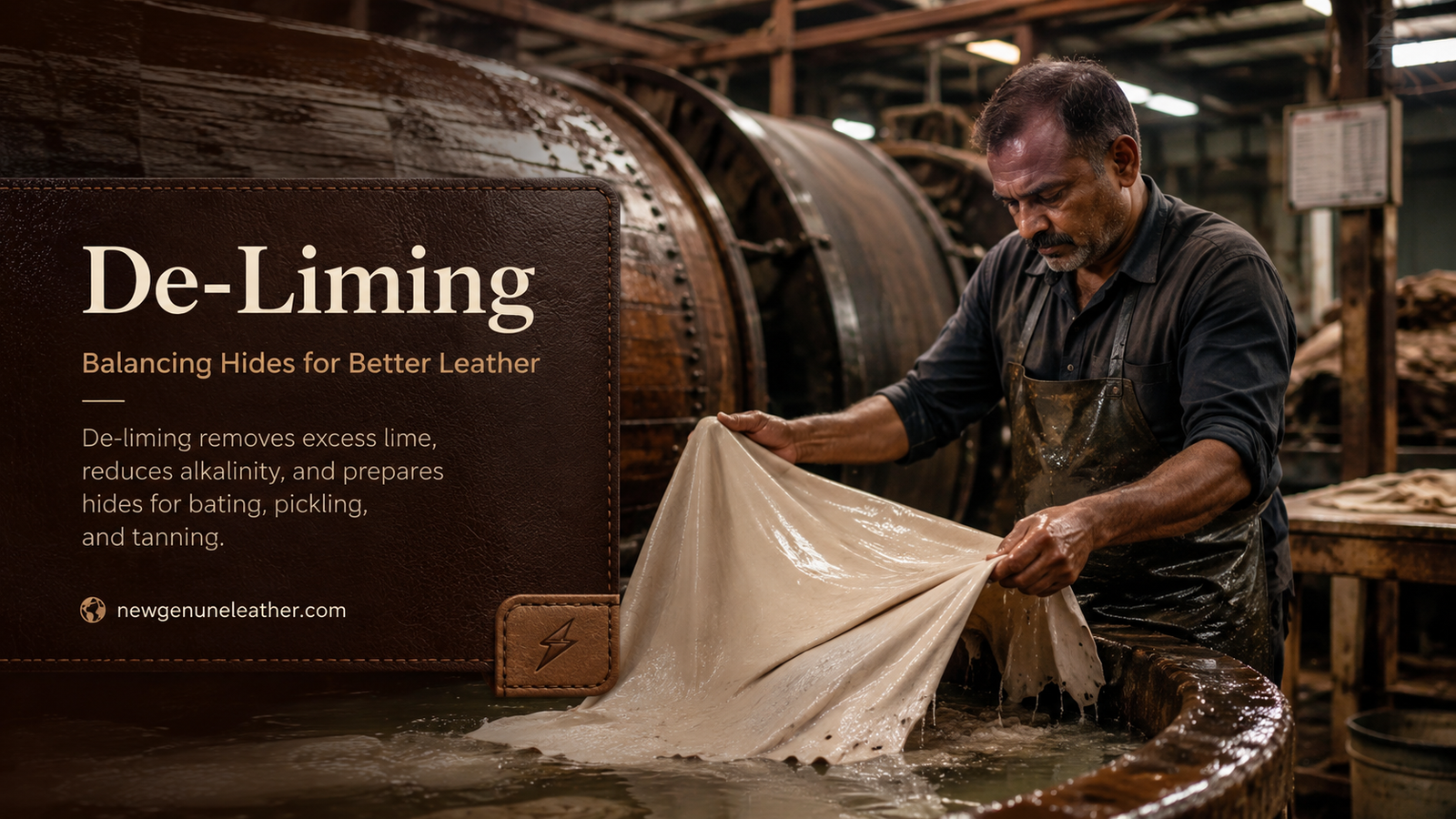
De-Liming in Leather is one of the most important beamhouse operations in leather manufacturing. It removes residual lime and alkaline chemicals from hides after liming and prepares the material for bating, pickling, and tanning.
Although customers rarely see this production stage, it strongly influences the softness, grain cleanliness, flexibility, colour consistency, and overall quality of the finished leather.
At New Genuine Leather, we understand that reliable leather garments, gloves, lederhosen, jackets, and accessories begin with properly processed raw material. Good cutting and stitching cannot fully correct leather that was poorly prepared during its early processing stages.
This guide explains how de-liming works, why manufacturers use it, which factors must be controlled, and how it affects leather quality for wholesale, OEM, and private-label buyers.
Table of Contents
- What Is De-Liming in Leather?
- Why Is Lime Used Before De-Liming?
- Seven Important Benefits of De-Liming
- How the De-Liming Process Works
- Common De-Liming Agents
- Problems Caused by Poor De-Liming
- Environmental Considerations
- Quality Control for Leather Buyers
- Frequently Asked Questions
What Is De-Liming in Leather?
De-Liming in Leather is the controlled removal or neutralisation of lime and other alkaline substances remaining inside hides after the liming and unhairing stages.
During liming, hides are treated under alkaline conditions to loosen hair, remove unwanted proteins, open the fibre structure, and prepare the material for further processing. This treatment also causes the hide to swell.
The hide cannot proceed directly from this strongly alkaline condition into bating or tanning. Its alkalinity must first be reduced gradually.
The Leather Working Group describes de-liming as the stage in which split hides move from an alkali-swollen state toward a more neutral and relaxed condition. This change allows unwanted materials to be released from the hide structure and prepares the material for subsequent operations.
Why Is Lime Used Before De-Liming?
Lime plays an important role in traditional leather production. It supports hair removal, helps open the collagen structure, and produces the swelling required for effective beamhouse processing.
However, lime remaining inside the hide can interfere with later chemical reactions. It may prevent bating enzymes and tanning chemicals from working evenly throughout the cross-section.
Therefore, De-Liming in Leather is not simply an optional washing stage. It is a controlled chemical transition between liming and the processes that follow.
Its purpose is to:
- Remove residual lime and alkaline chemicals.
- Reduce the pH gradually.
- Reverse excessive alkaline swelling.
- Relax the collagen fibre structure.
- Prepare the hide for bating.
- Support even penetration of later chemicals.
The process must be gradual because sudden or poorly controlled acidification can damage the grain or create uneven conditions between the surface and centre of the hide.
7 Powerful Benefits of De-Liming in Leather
1. Removes Residual Lime
The primary purpose of De-Liming in Leather is to remove lime remaining on the surface and inside the hide.
Washing alone may remove some loose chemicals, but it is generally not enough to eliminate lime held within the fibre structure. Deliming agents react with or dissolve these alkaline residues so they can leave the hide through the processing float.
Effective removal reduces the risk of unwanted deposits and uneven chemical reactions during later stages.
2. Reduces Alkalinity Gradually
Hides leaving the liming process are strongly alkaline. Bating and other following operations require a lower and more carefully controlled pH environment.
The de-liming process lowers alkalinity gradually rather than forcing an abrupt change. This helps the outside and inner layers of the hide move toward similar processing conditions.
A controlled reduction is particularly important for thicker hides because chemicals need time to penetrate from the surface toward the centre.
3. Relaxes the Swollen Fibre Structure
Alkaline liming causes collagen fibres to absorb water and swell. De-liming helps reverse this condition.
As the lime is removed and the alkalinity decreases, the hide begins to de-swell. The fibres become more relaxed and better prepared for further cleaning, enzyme treatment, and tanning.
This fibre relaxation can contribute to a more balanced feel, better drape, and improved flexibility in the finished leather.
4. Prepares Hides for Bating
Bating is an enzyme-based process used to clean and refine the hide structure. The enzymes used during bating perform most effectively within an appropriate pH range.
Poor De-Liming in Leather can leave the hide too alkaline for consistent enzyme action. One section may receive sufficient bating while another remains under-processed.
Properly de-limed hides allow the bating process to work more evenly, helping remove unwanted residual proteins and produce a cleaner grain.
5. Supports a Cleaner Leather Grain
The grain is the visible outer surface of the finished leather. Its cleanliness, smoothness, and consistency are critical for leather jackets, skirts, gloves, bags, and premium Bavarian apparel.
Correct de-liming and bating help release unwanted materials from the hide structure. This can support a cleaner, smoother, and more uniform grain surface.
Leather intended for fashion garments requires particularly careful processing because large panels make surface irregularities more noticeable.
6. Improves Chemical Penetration
Later processes depend on chemicals moving evenly through the hide. These may include bating agents, pickling chemicals, tanning materials, dyes, and fatliquors.
If residual lime remains in certain areas, the hide may react unevenly. Differences between the surface and centre can affect colour, softness, fullness, and tanning consistency.
Controlled De-Liming in Leather helps create more uniform conditions throughout the hide, supporting predictable chemical penetration during later stages.
7. Supports Consistent Finished Leather
The quality of finished leather is the result of many connected manufacturing operations. An error during an early stage may remain visible even after dyeing, finishing, cutting, and stitching.
Effective de-liming supports:
- More consistent softness.
- Improved grain appearance.
- Better colour uniformity.
- Reliable tanning reactions.
- More balanced leather thickness.
- Easier handling during garment production.
- Reduced variation across production batches.
For wholesale buyers, this consistency is essential. Retailers and private-label brands need every leather jacket, glove, skirt, or lederhosen order to maintain similar colour, texture, and performance.
How the De-Liming Process Works
The exact process depends on hide type, thickness, production method, equipment, and the required finished leather.
Initial Washing
After liming, hides are normally washed to remove loose lime, dirt, degraded hair, and other surface residues.
Washing reduces the quantity of chemicals that must be handled during the main de-liming stage. However, it does not completely remove lime held inside the hide structure.
Addition of De-Liming Agents
The hides are placed in a processing drum or suitable vessel with water and selected de-liming agents.
These agents reduce alkalinity and help convert residual lime into forms that can be removed from the hide. The chemicals must penetrate evenly rather than acting only on the outside surface.
Controlled Drum Action
Mechanical movement helps distribute the processing liquor and improves contact between the chemicals and hides.
However, excessive action may damage weakened grain, while insufficient movement may cause uneven treatment. Drum speed, float length, temperature, processing time, and chemical addition must therefore be controlled.
Penetration Through the Hide
A successful process must reach the centre of the hide. Surface-only de-liming can leave an alkaline inner section even when the outside appears properly treated.
Manufacturers may check the hide cross-section to evaluate whether de-liming has progressed evenly.
Transition to Bating
Once the required condition has been achieved, the hides are prepared for bating. In many production systems, de-liming and bating are carried out as closely connected operations.
UNIDO identifies de-liming and bating as major beamhouse stages and discusses their chemical and environmental contribution within leather processing.
Common Agents Used for De-Liming in Leather
Traditional de-liming systems commonly use ammonium-based salts because they provide useful buffering and can penetrate hides effectively.
Alternative systems may use:
- Organic acids.
- Buffered acid salts.
- Carbon dioxide-based processes.
- Low-ammonium formulations.
- Ammonium-free proprietary agents.
- Combination de-liming systems.
No single chemical system is ideal for every leather type. A formula suitable for soft garment leather may not be the best choice for heavy footwear, upholstery, belts, or industrial leather.
Manufacturers must select a system according to hide thickness, required softness, processing equipment, environmental targets, and the final product.
Problems Caused by Poor De-Liming
Uneven pH
If the surface changes faster than the centre, later chemicals may react differently across the hide.
Incomplete Bating
Residual alkalinity can reduce enzyme effectiveness, resulting in uneven cleaning and fibre opening.
Grain Damage
Overly aggressive or poorly controlled chemical addition may damage the grain surface.
Uneven Tanning
Lime remaining inside the hide can interfere with tanning-material penetration and fixation.
Colour Variation
Differences in chemical uptake may become visible during dyeing, producing patchy or inconsistent shades.
Hard or Uneven Areas
Incomplete de-liming may contribute to areas that feel firmer or less flexible than the surrounding leather.
Batch Inconsistency
Poor process control can make one production lot behave differently from another, creating difficulties for manufacturers cutting matching garment panels.
Environmental Considerations in De-Liming
Traditional ammonium-based processes can contribute ammonia and nitrogen to tannery wastewater. For this reason, the leather industry has been developing low-ammonium and ammonium-free alternatives.
The Leather Working Group’s production guidance encourages ammonium-free or ammonium-reduced de-liming to minimise ammonia emissions and nitrogen loading in wastewater.
Manufacturers may improve environmental performance through:
- Accurate chemical dosing.
- Low-nitrogen de-liming systems.
- Ammonium-free alternatives.
- Better process monitoring.
- Reduced water consumption.
- Proper wastewater treatment.
- Responsible chemical storage and handling.
The Leather Working Group provides information about leather-manufacturing standards, environmental management, chemical control, water use, waste, and effluent treatment.
Readers can also consult the UNIDO mass-balance guide for leather processing for technical information about inputs, outputs, and processing stages.
How New Genuine Leather Evaluates Leather Quality
At New Genuine Leather, quality evaluation extends beyond the appearance of a finished product.
Leather selected for our garment, glove, accessories, and Bavarian apparel programs is assessed for characteristics such as:
- Surface consistency.
- Flexibility and hand feel.
- Colour uniformity.
- Suitable thickness.
- Grain appearance.
- Cutting performance.
- Stitching suitability.
- Product-specific durability.
Our Sialkot-based manufacturing services support wholesale buyers, importers, distributors, boutiques, workwear suppliers, and private-label brands.
We produce leather jackets, leather skirts, gloves, lederhosen, dirndls, and related leather products with OEM options such as custom colours, sizing, embroidery, labels, packaging, and product specifications.
Buyer Checklist for Processed Leather
Wholesale buyers may not observe De-Liming in Leather directly, but they can still assess its possible influence on finished material.
When reviewing leather or a product sample, check:
- Is the leather equally soft across the panel?
- Does the colour appear uniform?
- Are there unusually hard areas?
- Is the grain clean and balanced?
- Do matching panels have a similar texture?
- Does the leather bend without excessive stiffness?
- Is the manufacturer able to explain its material specifications?
- Can the supplier maintain consistency across bulk production?
Physical samples should always be approved before placing a large OEM or private-label order.
Frequently Asked Questions
What is the main purpose of De-Liming in Leather?
Its main purpose is to remove residual lime, lower alkalinity, reduce swelling, and prepare the hide for bating and later tanning operations.
Is de-liming the same as bating?
No. De-liming mainly removes lime and adjusts the hide’s chemical condition. Bating uses enzymes to clean and refine the hide structure. The two operations are closely connected but have different functions.
Why can’t hides be washed with water only?
Water can remove loose surface material, but lime held inside the fibre structure usually requires controlled chemical treatment for effective removal.
Does de-liming affect leather softness?
Yes. It helps reverse alkaline swelling and relax the fibre structure. However, final softness also depends on tanning, retanning, fatliquoring, drying, staking, and finishing.
Can de-liming affect leather colour?
It can influence how evenly later chemicals and dyes penetrate. Poorly processed hides may produce inconsistent tanning or dyeing results.
Are ammonium-free systems available?
Yes. Leather-chemical suppliers offer low-ammonium, nitrogen-free, and alternative de-liming systems designed to reduce nitrogen entering wastewater.
Final Thoughts
De-Liming in Leather may be an intermediate production stage, but its influence continues throughout the complete manufacturing process.
Correct lime removal, controlled pH reduction, fibre relaxation, and preparation for bating support cleaner grain, improved chemical penetration, consistent softness, and dependable finished-leather quality.
For international buyers, understanding this process makes it easier to evaluate suppliers and ask informed questions about material quality.
New Genuine Leather (NGL) manufactures genuine leather garments, gloves, lederhosen, Bavarian apparel, and accessories for wholesale, OEM, and private-label customers worldwide.
Contact New Genuine Leather
Website: New Genuine Leather
Instagram: Follow New Genuine Leather
WhatsApp: Discuss Your Wholesale Order
