
Walk through any high-end leather goods store and you will hear the term ‘saddle stitch’ used as a mark of quality. But what exactly is saddle stitching, why does it command premium prices, and how does it compare to machine stitching? For anyone investing in lederhosen, leather jackets, or any garment built to last decades, understanding stitching is as important as understanding the leather itself.
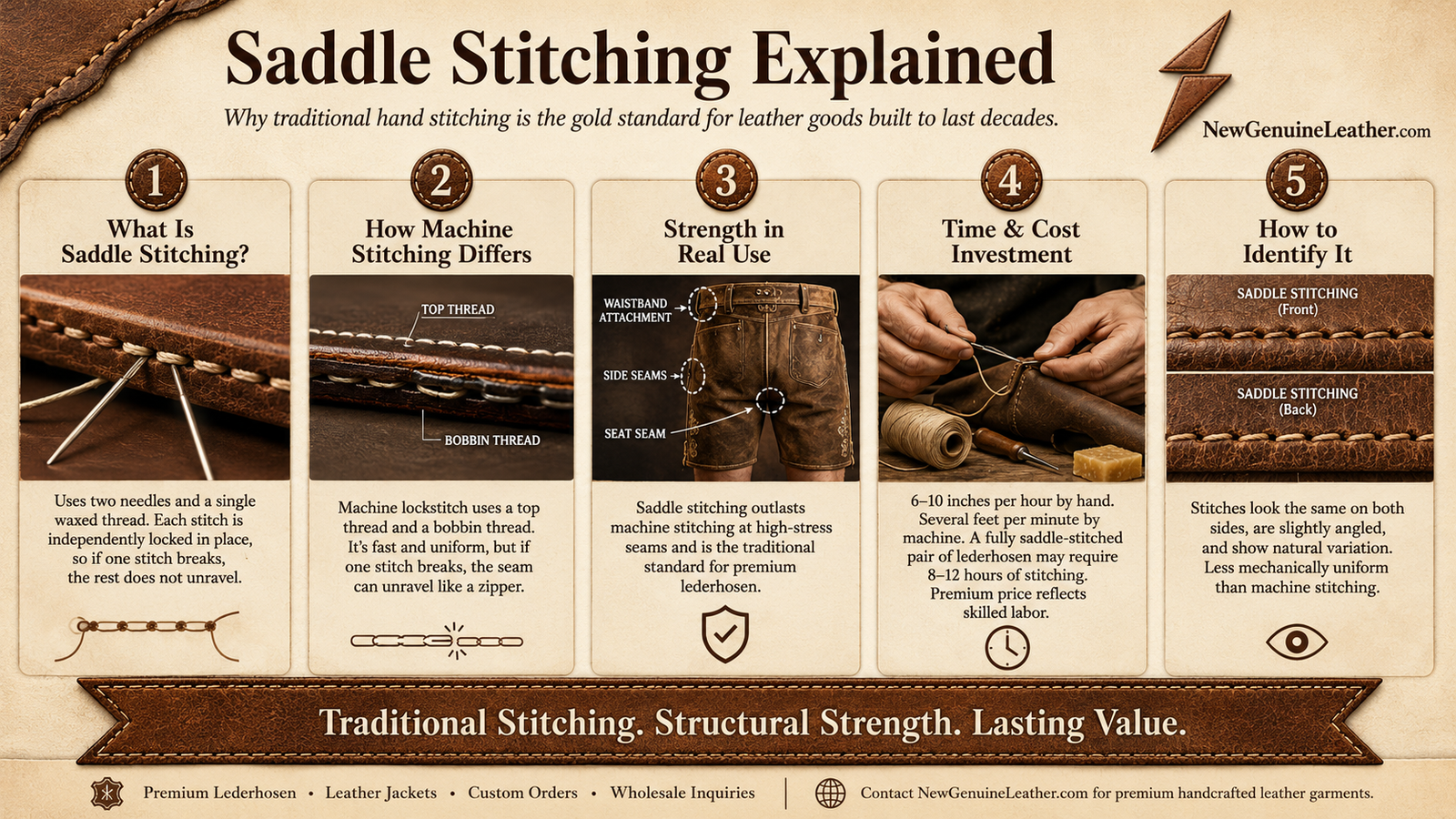
Saddle stitching is a hand-sewing technique that uses two needles working from opposite sides of the leather, with a single waxed thread passing through each hole twice. The result is a stitch where each hole carries two thread loops — one going one direction, one going the other. If a stitch is cut or breaks, the surrounding stitches do not unravel because each is independently locked.
Industrial sewing machines use a lockstitch — a single thread on top connected to a bobbin thread on the bottom. The two threads interlock in the middle of the leather. This is fast and uniform, but if a single stitch breaks, the entire seam can unravel like a zipper. Machine stitching is excellent for many applications, but it is structurally weaker than saddle stitching for high-stress garment seams.
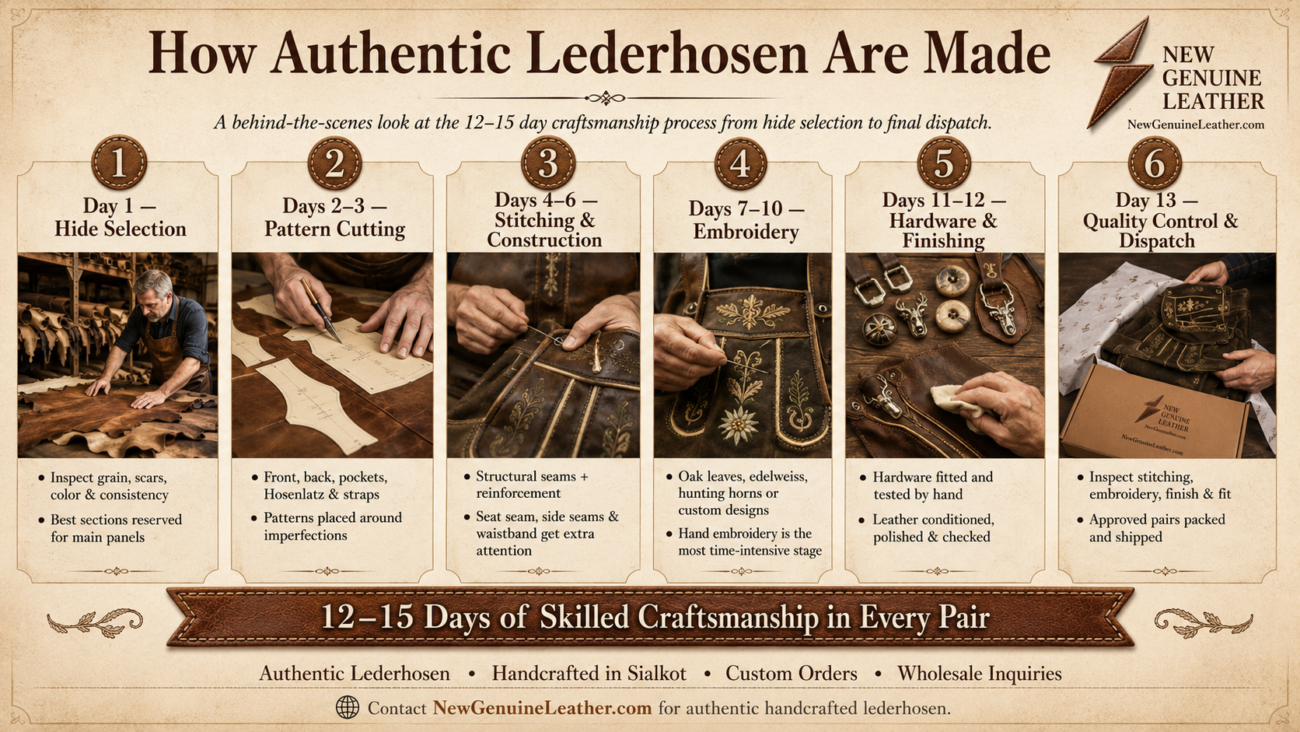
On lederhosen, the seat seam, side seams, and waistband attachment all experience constant stress from movement, sitting, and wear. A saddle-stitched seam in these locations will outlast a machine-stitched seam by decades. This is why traditional Bavarian lederhosen have always been saddle-stitched, and why the technique remains the gold standard for premium leather garments worldwide.
Saddle stitching is dramatically slower than machine stitching. A skilled artisan stitches roughly 6-10 inches per hour by hand, compared to several feet per minute on a machine. A single pair of fully saddle-stitched lederhosen represents 8-12 hours of pure stitching time. This is why hand-saddle-stitched garments command premium prices — you are paying for hours of skilled human labor, not just material.
Look at the stitching from both sides of the leather. Saddle stitching shows identical stitches on both sides — front and back look the same because both threads are visible. Machine stitching usually shows a slight visual difference between the top and bottom because of the different threads. Saddle stitches are also typically slightly angled and less mechanically uniform than machine stitches.
All premium Genuine Leather lederhosen feature traditional saddle-stitched construction at high-stress seams. Explore the difference quality stitching makes — browse our collection or visit our craftsmanship pages. Contact our team for inquiries, custom orders, and wholesale pricing.