

Genuine Leather vs PU Leather: 7 Powerful Differences

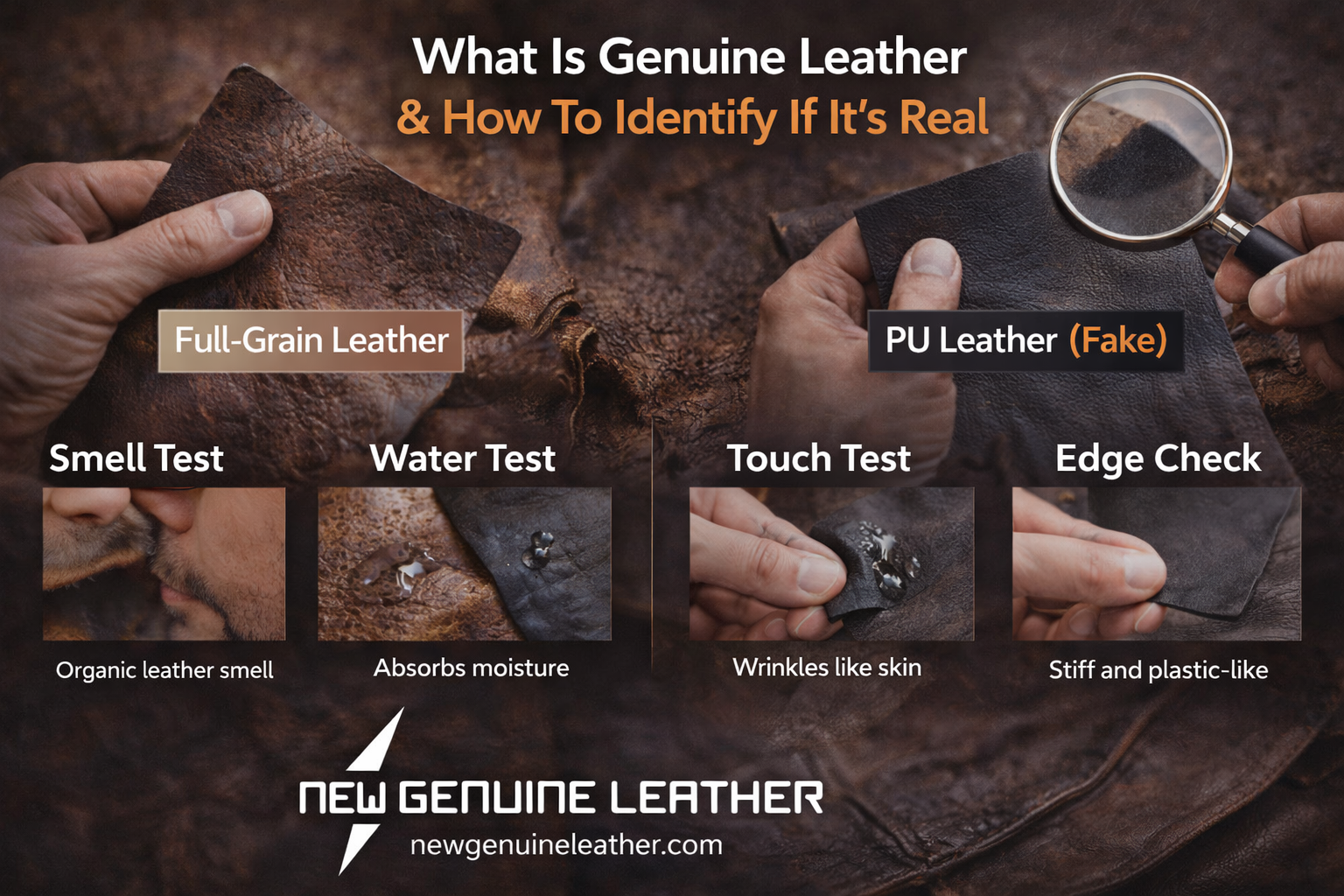
Genuine leather vs PU leather is one of the most important comparisons for anyone buying jackets, gloves, skirts, bags, lederhosen, trousers, or other leather products. From a distance, the two materials can look remarkably similar, but they behave very differently in terms of comfort, flexibility, durability, ageing, maintenance, and price.
For wholesalers, retailers, importers, and private-label brands, understanding the material is essential. Incorrect specifications can result in misleading product descriptions, dissatisfied customers, and expensive sourcing problems.
At New Genuine Leather (NGL), we manufacture genuine leather garments and accessories for wholesale, OEM, and private-label buyers worldwide. Clear material selection, sample approval, and accurate product descriptions are central to our manufacturing process.
What Is Genuine Leather?
Genuine leather is made from real animal hide that has been cleaned, tanned, processed, and finished for use in clothing and accessories.
The term “genuine leather” confirms that the product contains real leather. However, it does not necessarily mean that it is the highest leather grade.
Full-grain leather retains most of the natural outer grain of the hide. Top-grain leather may be lightly corrected to create a smoother, more uniform appearance. Other genuine leather grades can be buffed, embossed, pigmented, or coated according to the required product finish.
Because genuine leather is a natural material, it often contains slight variations in grain, pores, shade, and texture. These differences can be signs of natural hide rather than manufacturing defects.
What Is PU Leather?
PU leather is generally a synthetic material produced by applying a polyurethane coating over a woven, knitted, or non-woven fabric backing.
Manufacturers can emboss the surface to imitate the pores, grain, shine, and texture of natural leather. Modern PU materials can look highly convincing, especially in online photographs or from a short distance.
Some materials described as PU-coated leather may contain a split-leather base beneath the polyurethane coating. Buyers should therefore request a complete material specification instead of relying only on phrases such as “PU leather” or “leather finish.”
PU leather is popular because it is affordable, visually consistent, easy to color, and available in large production quantities. However, it does not have the same natural fiber structure or ageing behavior as real hide.
Genuine Leather vs PU Leather: 7 Main Differences
1. Material Composition
The most fundamental difference is the material itself. Genuine leather comes from natural hide, while standard PU leather is made primarily from polyurethane and fabric.
Natural hide has an interlocking fiber structure that gives it strength, flexibility, and the ability to adapt gradually during wear. PU leather depends on the quality of its coating and textile backing.
A well-manufactured PU material may work effectively for occasional-use products or trend-led fashion. However, it must still be described accurately as PU, synthetic, faux, or vegan leather.
Buyers should be cautious when suppliers use unclear expressions such as “leather style,” “leather look,” or “premium leather feel” without stating the complete composition.
2. Grain and Surface Appearance
Natural leather usually has an irregular grain pattern. Its pores, wrinkles, creases, and texture can change across the same panel because animal hide is not perfectly uniform.
PU leather is manufactured to produce a consistent appearance. Its grain is normally pressed or printed into the polyurethane surface.
When a large section of PU leather is examined closely, the same texture may appear repeatedly at regular intervals. This mechanical repetition can indicate a synthetic material.
However, this test is not conclusive by itself. Genuine leather can also be corrected, pigmented, and embossed to achieve a uniform grain. Buyers should combine the grain check with an inspection of the edge, backing, flexibility, and supplier documentation.
3. Touch and Flexibility
When comparing genuine leather vs PU leather, touch is often one of the quickest ways to notice a difference.
Genuine leather normally feels warm, flexible, and slightly varied. It may have softer and firmer areas depending on the section of hide used. With regular wear, real leather often becomes more flexible and conforms to the wearer’s shape.
PU leather usually feels smoother and more consistent. Some grades can feel slightly plastic-like, cool, or rigid. It may also return to its original shape more quickly after being pressed.
For garments such as jackets, skirts, trousers, gloves, and lederhosen, flexibility directly affects comfort. The lining, leather thickness, garment pattern, and construction should also be considered.
4. Breathability and Comfort
Genuine leather has a fibrous structure with natural pores. This allows limited air and moisture movement, helping it feel more comfortable during repeated or extended wear.
PU leather normally has a coated surface that is less breathable. Heat and moisture may remain trapped more easily, particularly in fitted garments or warm environments.
This does not mean every genuine leather garment will automatically feel cool. Thickness, finishing, lining, ventilation, and design also influence comfort.
For example, a heavily coated genuine leather jacket may feel less breathable than soft, lightly finished garment leather. Similarly, a PU jacket with ventilation panels and a breathable lining may feel more comfortable than a poorly designed alternative.
5. Durability and Ageing
Durability is one of the biggest differences in the genuine leather vs PU leather comparison.
Well-selected and properly maintained genuine leather can remain usable for many years. It often develops natural creases, softness, shade variation, and patina as it ages.
PU leather may provide a clean appearance at a lower initial cost, but its surface coating can eventually crack, flake, or peel. Deterioration commonly begins around folds, cuffs, sleeves, pockets, seat areas, and other high-friction locations.
Exposure to direct sunlight, heat, moisture, and repeated bending may accelerate the breakdown of polyurethane coatings.
Material quality remains important in both categories. Poorly processed genuine leather can fail prematurely, while better-quality PU can perform more effectively than very cheap synthetic alternatives.
6. Edge, Backing, Water, and Smell
A cut edge often provides useful information about the material.
Genuine leather normally has a dense, fibrous edge. Depending on the leather type, the reverse side may look slightly rough or suede-like.
Standard PU leather often reveals a fabric layer beneath its surface coating. A woven or knitted backing visible along a seam or cut edge is a strong sign that the material is synthetic.
A tiny water drop can also help. On lightly finished genuine leather, water may absorb slowly and temporarily darken the surface. PU leather usually causes the drop to remain on top because the coating is less porous.
Real leather often has an earthy or tanned-hide smell, while PU leather may smell more like plastic or chemicals. Coatings, perfumes, packaging, and storage can affect smell, so several tests should be used together.
Do not perform flame or burn tests. They can permanently damage the product and may produce unpleasant or harmful fumes.
7. Price, Value, and Intended Use
Genuine leather usually costs more because hide selection, tanning, grading, cutting, and finishing require multiple production stages.
Natural hide also contains marks and irregular shapes, which can reduce cutting efficiency. Manufacturers must carefully position patterns to achieve consistent product panels.
PU leather normally has a lower initial cost and offers uniform color, texture, and thickness. It may be suitable for costume clothing, promotional fashion, display products, trend-based collections, and customers who specifically prefer non-animal materials.
For premium positioning, long-term wear, natural comfort, and attractive ageing, genuine leather is generally the stronger option.
For buyers prioritizing lower cost, consistent appearance, and short fashion cycles, PU leather may be practical.
The most important requirement is truthful labeling. A customer paying for genuine leather should not receive a synthetic product, while a customer requesting PU leather should be informed if any animal-derived material is present.
How to Identify Genuine Leather vs PU Leather
No single test is completely reliable, particularly when genuine leather has a heavy protective finish or PU leather has been carefully embossed.
A better identification method combines several observations:
- Read the material label and technical specification.
- Inspect a cut edge or unfinished section.
- Look for a textile backing beneath the surface.
- Examine the grain for repeating patterns.
- Press and flex the material gently.
- Notice how quickly it warms in your hand.
- Test one tiny water drop on a hidden area.
- Ask the supplier for a loose material swatch.
For wholesale orders, always request a finished sample before approving bulk production. Keep one signed or sealed reference sample so the final order can be checked for leather type, shade, thickness, grain, stitching, hardware, and finishing.
Genuine Leather vs PU Leather for Wholesale Buyers
Wholesale buyers should describe the required material clearly in their purchase orders. Writing only “leather jacket” or “leather skirt” leaves too much room for interpretation.
For genuine leather products, specifications may include the hide type, leather grade, thickness, surface finish, color, softness, lining, and intended performance.
For PU products, buyers should specify the polyurethane coating, backing fabric, total thickness, grain pattern, color, and required resistance to abrasion or repeated flexing.
A reliable manufacturer should be able to explain exactly what is being supplied. Unclear answers about the material, coating, tanning, or backing can be warning signs, particularly when the quoted price is significantly lower than expected.
For further industry information, buyers can review the Leather Working Group and educational resources provided by Leather Naturally.
Caring for Genuine Leather and PU Leather
Genuine leather should be wiped with a soft cloth after use and kept away from prolonged direct sunlight or excessive heat. A suitable leather conditioner can be applied periodically to help prevent dryness and stiffness.
PU leather can usually be cleaned with a slightly damp cloth and mild soap. Strong chemicals, alcohol-based cleaners, abrasive brushes, and excessive heat may damage its surface coating.
Both materials should be stored in a cool, dry, ventilated place. Garments should be placed on suitable hangers rather than compressed inside plastic packaging for long periods.
Always test a cleaning product on a hidden area before treating the entire item.
New Genuine Leather Manufacturing Services
New Genuine Leather (NGL) is a Sialkot-based manufacturer and exporter of genuine leather clothing, gloves, Bavarian apparel, and accessories.
Our product range includes leather jackets, motorcycle jackets, leather skirts, trousers, safety gloves, fashion gloves, lederhosen, bags, and customized leather accessories.
We support international retailers, wholesalers, importers, distributors, fashion labels, workwear suppliers, and private-label brands with:
- Genuine leather selection
- Custom colors and finishes
- Embroidery and decorative details
- Custom sizing and patterns
- Branded labels and packaging
- OEM and private-label production
- Export-quality inspection
- Bulk manufacturing services
We recommend physical sample approval before production so buyers can confirm the grain, softness, shade, thickness, stitching, hardware, and overall product finish.
Contact New Genuine Leather
Website: New Genuine Leather
Instagram: Follow New Genuine Leather
WhatsApp: Discuss Your Wholesale Order
Frequently Asked Questions
Is genuine leather real leather?
Yes. Genuine leather is made from real animal hide. However, the term does not automatically mean that it is full-grain or top-grain leather.
Is PU leather waterproof?
PU leather is usually more water-resistant at the surface than untreated genuine leather. However, water can still enter through seams, edges, scratches, or damaged coating.
Does genuine leather peel?
Real leather does not normally peel in the same way as a polyurethane film. Heavy coatings can crack or wear, while bonded or poorly constructed materials may separate.
Which material is better for jackets?
Genuine leather is generally preferred for premium jackets requiring durability, flexibility, comfort, and natural ageing. PU leather may suit lower-cost fashion collections, costumes, or short-term trends.
Final Thoughts
The genuine leather vs PU leather decision should be based on intended use, budget, durability expectations, comfort, and customer preference.
Genuine leather offers natural grain, flexibility, long-term character, and the ability to age attractively. PU leather provides a lower initial price, uniform appearance, broad color availability, and a non-animal option for customers who specifically request it.
Neither material should be misrepresented. Buyers should examine labels, inspect samples, verify composition, and include clear material requirements in all purchase documents.
For wholesale, OEM, and private-label genuine leather products, New Genuine Leather (NGL) supports international buyers with material selection, custom product development, branding, sampling, and export-quality production.
