Types of Leather Used in Jackets: 9 Best Choices

The types of leather used in jackets directly affect comfort, durability, weight, appearance, and price. A soft lambskin fashion jacket feels very different from a heavy cowhide motorcycle jacket, even though both products may be described as genuine leather.
For retailers, distributors, fashion brands, and private-label buyers, choosing the right leather is one of the most important production decisions. The material must match the jacket’s intended use, target price, climate, design, and customer expectations.
At New Genuine Leather (NGL), we manufacture custom leather jackets for wholesale, OEM, and private-label buyers. This guide explains the most widely used jacket leathers and helps buyers select the right option for their product line.
Why Jacket Leather Selection Matters
Leather is a natural material, and each animal hide has its own fiber structure, thickness, softness, grain, and strength. Some hides are naturally lightweight and flexible, while others are dense, firm, and highly resistant to abrasion.
A fashion brand may prioritize softness, drape, and a refined surface. A motorcycle apparel buyer may require thicker leather, reinforced construction, and stronger abrasion resistance. A winterwear supplier may want warmth and insulation, while a vintage clothing retailer may prefer leather that develops a visible patina.
Understanding the different types of leather used in jackets helps buyers avoid choosing a material based only on appearance.
1. Cowhide Leather
Cowhide is one of the most common materials used for leather jackets. It is known for its durability, strength, and ability to withstand regular wear.
Cowhide jackets usually feel firmer and heavier than lambskin jackets. The leather gradually becomes more flexible as it is worn, and its surface may develop an attractive patina over time.
Because of its strength, cowhide is often selected for:
- Motorcycle jackets
- Bomber jackets
- Workwear jackets
- Aviator jackets
- Heavy winter leather coats
- Vintage-style outerwear
The final feel depends on the thickness, tanning method, finishing process, and garment construction. Cowhide can be produced with smooth, pebbled, matte, waxed, distressed, or corrected-grain finishes.
For wholesale buyers, cowhide offers a dependable balance between durability, availability, and commercial value.
2. Lambskin Leather
Lambskin is valued for its softness, lightweight feel, and smooth surface. It generally has a finer grain than cowhide and creates a more comfortable jacket from the first wear.
Lambskin works especially well for fitted silhouettes because it drapes naturally around the body. It is widely used in premium fashion jackets, leather blazers, women’s jackets, shirts, skirts, and lightweight outerwear.
Compared with heavier hides, lambskin requires more careful handling. It may be more vulnerable to scratches, sharp objects, and rough use. However, when properly manufactured and maintained, it offers an elegant appearance and excellent wearing comfort.
Among the types of leather used in jackets, lambskin is one of the strongest choices for buyers prioritizing softness and refined styling.
3. Sheepskin Leather
Sheepskin and lambskin are related, but they are not always identical in commercial use. Lambskin generally comes from younger sheep and tends to be finer and softer. Sheepskin from mature animals may have a slightly more substantial structure.
Sheepskin is flexible, comfortable, and naturally suitable for apparel. It can be used with the wool removed or retained.
When the wool remains attached, the material is commonly used for shearling jackets. These jackets have leather or suede on the outside and natural wool on the inside, providing warmth and insulation.
Sheepskin is commonly chosen for:
- Shearling coats
- Aviator jackets
- Winter jackets
- Lightweight fashion outerwear
- Casual leather jackets
Its combination of warmth and flexibility makes it particularly useful for colder markets.
4. Goatskin Leather
Goatskin is strong, flexible, and lighter than many cowhide options. Its natural grain is often visible as a slightly pebbled or textured pattern.
One of goatskin’s main advantages is its balance of strength and softness. It can withstand regular wear without feeling excessively heavy, making it suitable for jackets that need both durability and comfort.
Goatskin has historically been used in military-style flight jackets, field jackets, gloves, bags, and practical outerwear. It also performs well in casual and fashion collections.
For private-label buyers, goatskin can be a useful alternative when cowhide feels too heavy and lambskin feels too delicate.
5. Buffalo Leather
Buffalo leather has a bold grain, substantial weight, and rugged appearance. Its natural texture is usually more pronounced than the grain of standard cowhide.
This leather is frequently used for jackets with a vintage, outdoor, heritage, or motorcycle-inspired look. The strong surface character works especially well with distressed, waxed, pull-up, and antique finishes.
Buffalo leather jackets may require a short break-in period because the material can initially feel firm. However, the leather becomes more comfortable through regular wear while maintaining its strong structure.
Among the heavier types of leather used in jackets, buffalo leather is suitable for buyers who want a durable garment with visible natural character.
6. Pigskin Leather
Pigskin is durable, breathable, and often more affordable than lambskin or premium cowhide. It usually has a recognizable pore pattern that appears in small groups across the surface.
Pigskin can be finished as smooth leather or processed into suede. It is commonly used in casual jackets, workwear, gloves, linings, and lower-to-mid-priced leather products.
The material has good resistance to repeated use, although its grain may not have the same refined appearance as lambskin. For commercial buyers, pigskin can provide practical performance at a competitive price.
Clear material labeling remains important, especially in markets where customers have cultural, religious, or personal preferences concerning animal origin.
7. Deerskin Leather
Deerskin is recognized for its softness, flexibility, and distinctive natural grain. Despite feeling soft, it can provide good strength and resistance to repeated movement.
It is commonly found in premium casual jackets, heritage garments, gloves, western-style clothing, and selected motorcycle apparel.
Deerskin tends to move comfortably with the wearer, which makes it suitable for garments requiring flexibility. Its surface may develop a rich, natural appearance over time.
However, supply, consistency, and pricing can vary. Wholesale buyers should confirm material availability before building a large seasonal collection around deerskin.
8. Suede Leather
Suede is not an animal species. It is a leather surface created by working with the inner side of a hide or with a leather split. The surface is sanded or buffed to produce a soft, raised nap.
Suede jackets have a matte appearance and a comfortable, velvety feel. They are widely used in fashion, western wear, casual jackets, overshirts, and traditional clothing.
Common suede sources include:
- Cow leather
- Goat leather
- Sheep leather
- Pig leather
- Calf leather
Suede requires careful finishing because the nap must remain even across every garment panel. It is also more sensitive to water, oil, and stains than heavily protected smooth leather.
For international buyers, color consistency should be carefully checked because the nap direction can make the same shade appear lighter or darker under different lighting.
9. Nubuck Leather
Nubuck is created by lightly sanding or buffing the outer grain side of leather. This produces a soft, fine nap while retaining more of the grain layer than traditional split suede.
Nubuck often feels smooth and luxurious, with a premium matte appearance. It is used in high-quality jackets, footwear, bags, and accessories.
The main difference between nubuck and suede is the surface being treated. Nubuck is generally made from the grain side, while suede is usually produced from the flesh side or split layer.
Nubuck can be durable, but its delicate surface may show water spots, oil marks, and changes in nap direction. Protective treatments and proper care are therefore essential.
Leather Types Versus Leather Grades
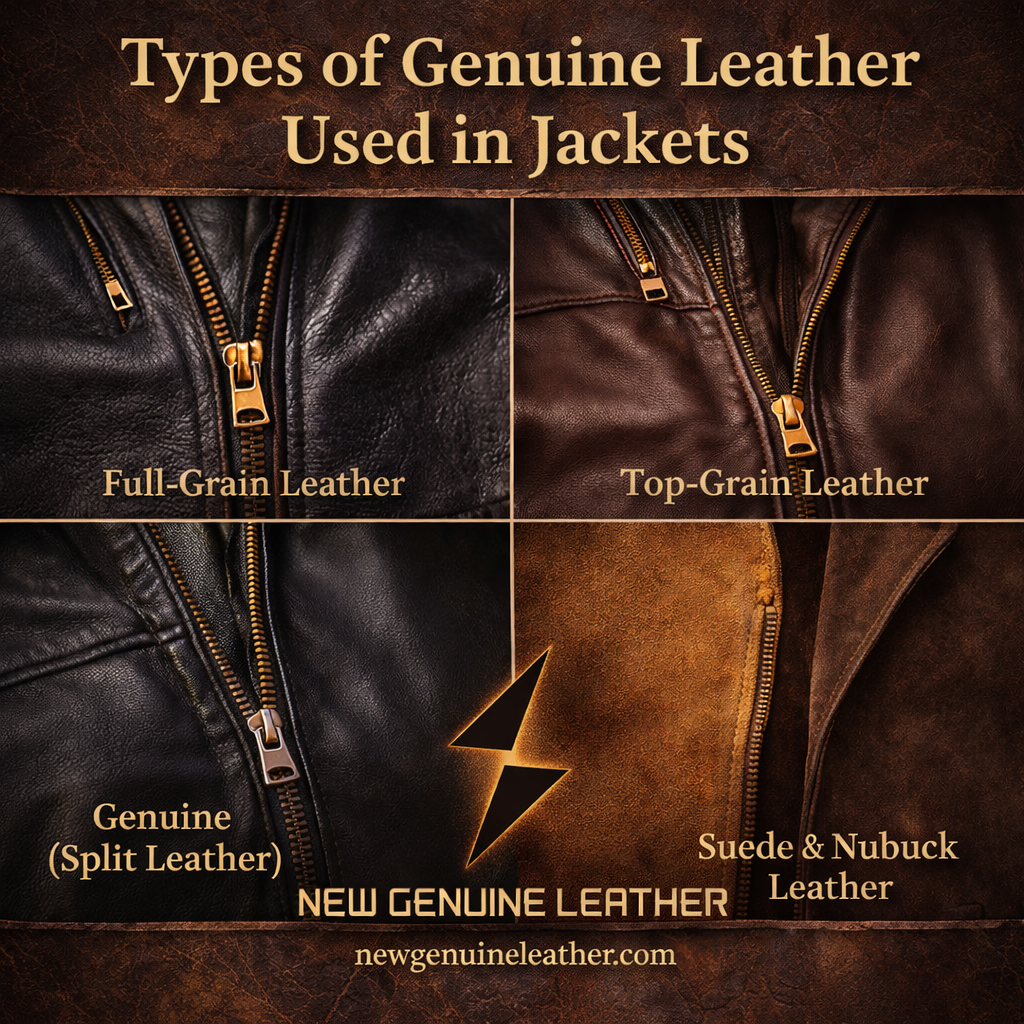
The types of leather used in jackets should not be confused with leather grades. Cowhide, lambskin, goatskin, and buffalo leather describe the animal source. Full-grain, top-grain, corrected-grain, split, and bonded leather describe how the hide has been processed.
Full-Grain Leather
Full-grain leather retains the natural grain surface with minimal correction. It may display pores, wrinkles, scars, and natural variations.
It is valued for durability and its ability to develop patina. However, it requires higher-quality hides because natural marks remain visible.
Top-Grain Leather
Top-grain leather comes from the upper section of the hide. Its surface may be lightly sanded or corrected to create a more consistent appearance.
It is widely used in leather jackets because it offers a useful balance between durability, softness, and visual uniformity.
Corrected-Grain Leather
Corrected-grain leather is buffed to reduce surface imperfections. It may then receive pigments, protective coatings, and an embossed grain pattern.
This process helps manufacturers create consistent color and texture across large production orders.
Split Leather
Split leather comes from the lower layer of the hide after the grain layer has been separated. It is commonly used to produce suede or coated leather products.
Its performance depends on thickness, finishing, backing, and intended use.
Bonded Leather
Bonded leather is manufactured from leather fibers or scraps combined with binding materials. It does not offer the same structure or durability as a complete natural hide.
Buyers should not treat bonded leather as equivalent to full-grain, top-grain, or genuine hide leather.
Which Leather Is Best for Different Jackets?
The best material depends on the intended jacket category.
For motorcycle jackets, cowhide and buffalo leather are commonly preferred because of their strength and substantial construction. Goatskin may also work where buyers need a lighter, more flexible jacket.
For fashion jackets, lambskin and sheepskin offer softness, comfort, and clean draping. These materials are particularly suitable for slim-fit and contemporary designs.
For winter jackets, shearling sheepskin provides natural insulation. Heavy cowhide may also be used with quilted or insulated linings.
For vintage and heritage jackets, buffalo, cowhide, goatskin, and horsehide-inspired finishes can create a rugged appearance.
For lightweight casual collections, lambskin, goatskin, thin sheepskin, and selected suede materials are practical options.
How Wholesale Buyers Should Select Jacket Leather
Before placing a bulk order, buyers should request physical leather swatches and a complete finished sample. Digital photographs cannot fully show thickness, softness, smell, grain, flexibility, or surface coating.
The approved sample should establish:
- Leather source
- Thickness range
- Surface finish
- Color standard
- Softness and hand feel
- Lining material
- Hardware quality
- Stitching construction
- Branding requirements
- Packaging specifications
Buyers should also confirm whether the leather is full-grain, top-grain, corrected-grain, split, suede, or nubuck.
For information about environmental auditing and responsible leather production, buyers can review the work of the Leather Working Group. General leather education and material information are also available from Leather Naturally.
Custom Leather Jacket Manufacturing by NGL
New Genuine Leather (NGL) is a leather garments manufacturer based in Sialkot, Pakistan. We produce custom leather jackets, motorcycle jackets, bomber jackets, aviator jackets, leather coats, blazers, trousers, skirts, gloves, lederhosen, and accessories.
Our OEM and private-label services include leather selection, custom colors, pattern development, embroidery, printing, hardware selection, branded labels, size grading, packaging, and bulk manufacturing.
We help international retailers, distributors, importers, workwear suppliers, and fashion brands select the right types of leather used in jackets according to design, budget, market, and performance requirements.
Buyers can request custom development using cowhide, lambskin, sheepskin, goatskin, buffalo leather, suede, nubuck, and other materials subject to availability and product specifications.
Visit New Genuine Leather to learn more about our wholesale and private-label manufacturing services.
Frequently Asked Questions
Which leather is most durable for a jacket?
Cowhide and buffalo leather are commonly selected for strong, durable jackets. The final performance also depends on leather thickness, tanning, finishing, stitching, and garment construction.
Which leather is softest for fashion jackets?
Lambskin is one of the softest and lightest options for premium fashion jackets. Sheepskin and selected goatskin can also provide good flexibility.
Is suede real leather?
Yes. Suede is real leather when it is produced from natural animal hide. It usually comes from the flesh side or split layer and has a soft, raised surface.
Is nubuck better than suede?
Neither material is automatically better. Nubuck generally uses the outer grain side and can offer a finer, premium feel. Suede is often softer and may be more affordable. The right choice depends on the intended product.
Can leather jackets be customized for private labels?
Yes. Private-label leather jackets can be customized in material, color, thickness, design, lining, zippers, hardware, labels, packaging, embroidery, and sizing.
Final Thoughts
There is no single leather that is best for every jacket. Cowhide offers strength, lambskin provides softness, goatskin balances comfort and durability, buffalo leather creates a rugged appearance, and sheepskin delivers excellent warmth.
Suede and nubuck provide distinctive matte textures, while pigskin and deerskin serve specific performance and pricing needs.
Understanding the types of leather used in jackets allows buyers to choose materials based on actual function rather than appearance alone. It also helps wholesale and private-label buyers communicate more clearly with manufacturers and maintain consistency across bulk production.
For custom leather jacket development, sample production, OEM manufacturing, or private-label orders, contact New Genuine Leather (NGL).
Contact New Genuine Leather
Website: New Genuine Leather
Instagram: Follow New Genuine Leather
WhatsApp: Discuss Your Wholesale Order
