

How to Tell Real Leather vs Fake Leather (7 Simple Tests)

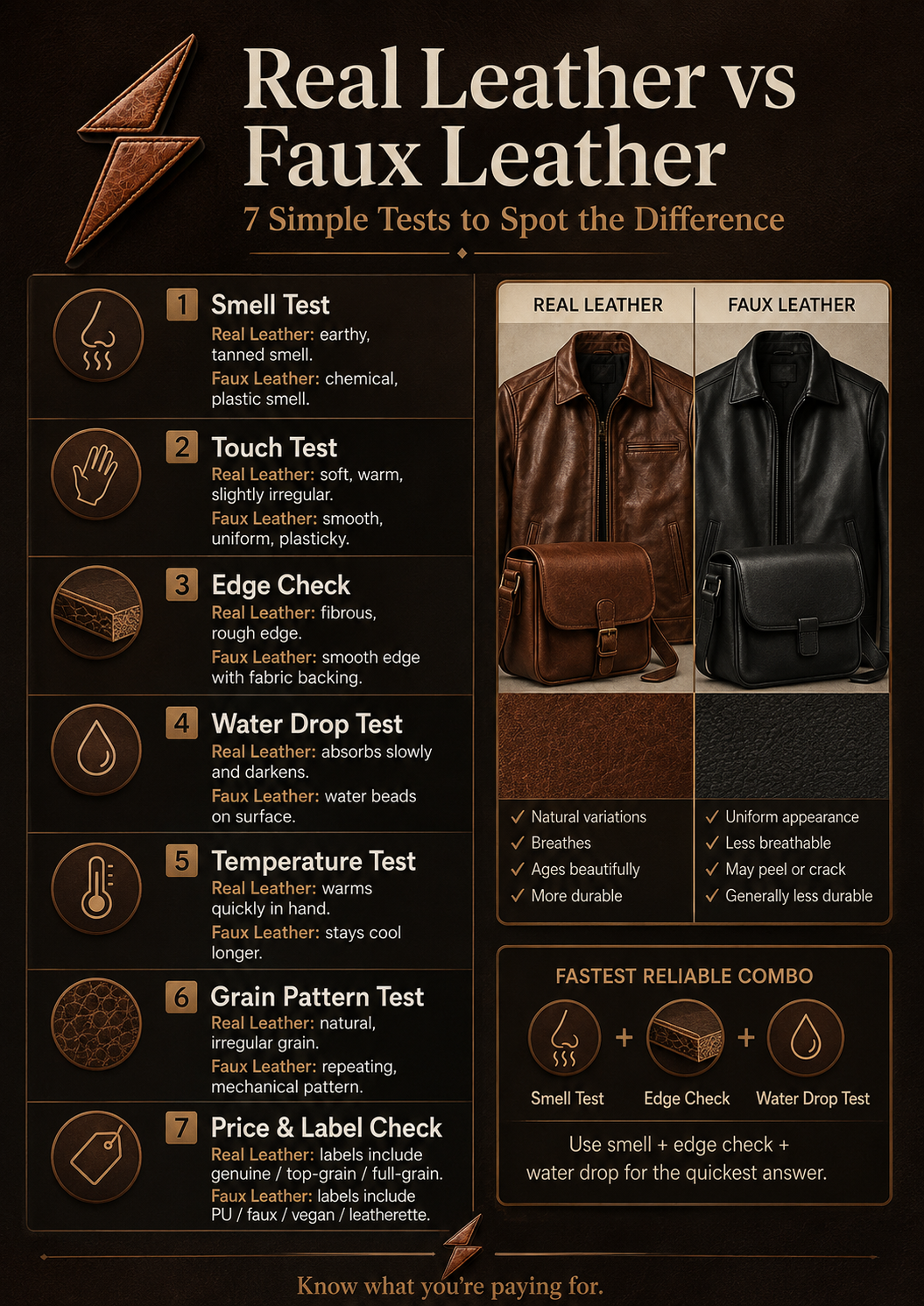
Real Leather vs Fake Leather shopping has a problem: from a few feet away, real leather and synthetic “faux leather” can look nearly identical. Manufacturers have gotten very good at replicating leather’s texture, sheen, and even its grain pattern using PU (polyurethane) and PVC materials. But real leather and synthetic leather behave very differently over time — in durability, comfort, and how they age.
Whether you’re buying a jacket, evaluating a wholesale supplier’s samples, or just want to know if that “leather” bag is the real deal, these seven tests will tell you what you’re actually looking at.
Why This Matters Real Leather vs Fake Leather
Real leather — including full-grain, top-grain, and genuine leather — is made from tanned animal hide. Faux leather is entirely synthetic, made from plastic polymers layered onto a fabric backing. Real leather typically costs more, lasts longer, and ages naturally. Faux leather is cheaper, more consistent in appearance, but tends to crack, peel, and degrade faster, especially with regular use.
Neither is inherently “wrong” to buy — but you should know which one you’re paying for.
Test 1: The Smell Test Real Leather vs Fake Leather
This is the fastest and most reliable test. Real leather has a distinct, earthy, slightly smoky smell — a result of the tanning process. It’s a smell most people recognize instantly once they’ve encountered genuine leather.
Faux leather typically has a chemical or plastic smell, sometimes similar to a new shower curtain or vinyl material. If a product smells like plastic rather than tanned hide, it’s very likely synthetic.
Caveat: Heavily perfumed or treated leather products can mask this smell, so use it alongside other tests rather than relying on it alone.
Test 2: The Touch Test Real Leather vs Fake Leather
Run your fingers across the surface. Real leather feels slightly irregular — even corrected or finished grades like genuine leather have subtle texture variation, warmth, and a soft give when pressed.
Faux leather tends to feel uniformly smooth, sometimes slightly tacky or plasticky, and cooler to the touch initially. It also often feels more rigid or bounces back too perfectly when pressed, since it lacks the natural fiber structure of hide.
Test 3: The Edge Check Real Leather vs Fake Leather
This is one of the most reliable visual tests, especially for jackets, bags, and wallets. Look closely at a cut edge of the material — inside a pocket, along a seam, or underneath a strap.
- Real leather has a fibrous, slightly rough, uneven edge, since it’s cut from natural hide.
- Faux leather has a smooth, uniform, almost plastic-like edge, often with a visible fabric backing layer where the material was cut.
If you can see a woven fabric layer peeking out from the edge, you’re looking at synthetic material.
Test 4: The Water Drop Test Real Leather vs Fake Leather
Place a small drop of water on an inconspicuous area of the material.
- Real leather will absorb the water slowly, often darkening slightly at the point of contact, since natural hide is porous.
- Faux leather will cause the water to bead up and sit on the surface, since synthetic coatings are non-porous.
This test works well for genuine leather too — even though it has a finished surface, it still absorbs moisture more than plastic-based materials. Use a small, hidden spot to avoid visible water marks on a real leather item.
Test 5: The Temperature Test Real Leather vs Fake Leather
Real leather naturally warms up when you hold it, adjusting to your body temperature within a minute or two, similar to how natural fabrics behave. This is due to leather’s breathable, porous structure.
Faux leather tends to stay cool to the touch for longer, since synthetic materials don’t have the same breathability or natural insulation properties. If a “leather” jacket feels cold and stays cold even after you’ve been wearing it for several minutes, that’s a signal it may be synthetic.
Test 6: The Grain Pattern Test Real Leather vs Fake Leather
Look closely at the surface pattern.
- Real leather — particularly full-grain — has an irregular, organic grain pattern. No two square inches look exactly alike, because it comes from a natural material with natural variation. Even genuine leather, which has a corrected, applied texture, shows subtle inconsistency.
- Faux leather often has a grain pattern that repeats in a visible, mechanical way. If you look across a large surface area — like a sofa or a big handbag panel — and notice the exact same texture pattern repeating at regular intervals, that’s a strong sign it’s synthetic.
Test 7: The Price and Label Check Real Leather vs Fake Leather
This isn’t a physical test, but it’s an important sanity check. Genuine leather production is a multi-step process involving tanning, splitting, and finishing real hide — it has a cost floor that synthetic materials don’t. If a “leather” jacket is priced dramatically below typical leather market rates, that’s a red flag.
Also read labels carefully:
- “Genuine leather,” “full-grain,” and “top-grain” all indicate real leather.
- “Faux leather,” “vegan leather,” “PU leather,” and “leatherette” all indicate synthetic material.
- “Leather-look” or “leather-style” almost always means synthetic, even if the word “leather” appears prominently in the product name.
Putting It All Together Real Leather vs Fake Leather
No single test is 100% foolproof on its own, especially with high-quality synthetics designed to mimic real hide closely. But combining two or three of these tests — smell, edge check, and water drop are usually the fastest and most reliable trio — will give you a confident answer in under a minute.
For wholesale and private-label buyers, it’s worth going a step further: request physical samples from any supplier before committing to bulk orders, and ask directly about tanning method and hide sourcing. A reputable manufacturer will have no problem answering these questions in detail — vague or evasive answers about sourcing are themselves a warning sign.
Why This Matters Beyond Just Knowing Real Leather vs Fake Leather
Understanding real vs. fake leather isn’t just about avoiding being misled. It directly affects:
- Longevity — real leather products, properly cared for, can last years or decades; synthetic leather typically shows cracking and peeling within one to three years of regular use.
- Value for money — paying leather prices for a synthetic product is a poor deal, even if it looks convincing on day one.
- Sustainability considerations — some buyers specifically want synthetic (vegan) leather for ethical reasons, in which case these tests help confirm you’re getting what you actually want, rather than an unintentional mix-up in either direction.
Final Thoughts Real Leather vs Fake Leather
Real leather and faux leather can look deceptively similar at first glance, but they behave very differently under simple physical tests. The smell, the edge, the way it absorbs water, and how the grain pattern behaves across a larger surface will almost always tell you the truth about what you’re holding — whether you’re buying a single jacket or evaluating a supplier for a wholesale order.
Follow Us
Instagram: https://www.instagram.com/newgenuineleather/
WhatsApp: https://wa.me/+923008758207
