

Leather Staking and Softening: 7 Powerful Steps

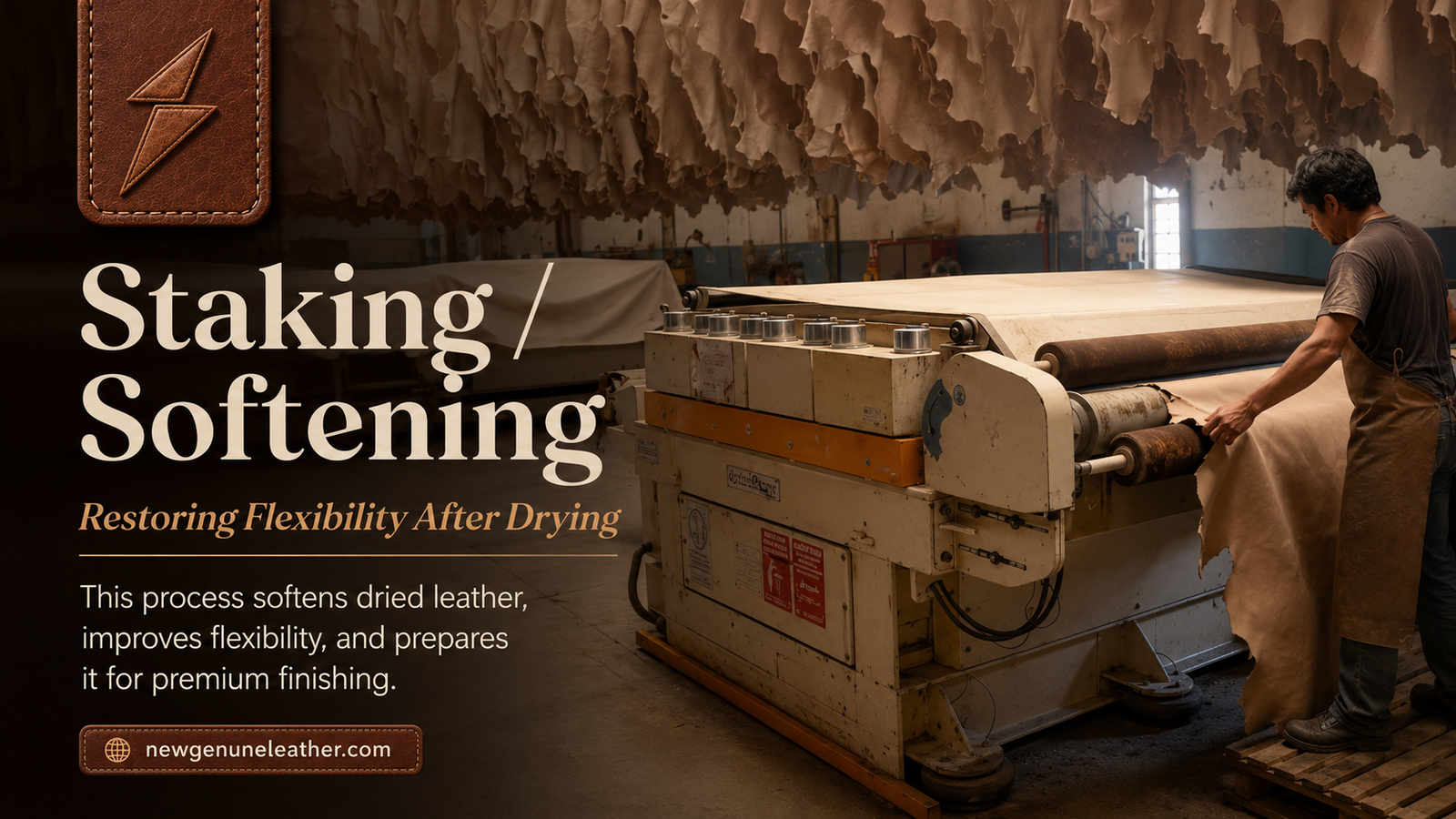
Leather staking and softening are important manufacturing processes that transform dried, firm leather into a more flexible, comfortable, and workable material. After tanning, dyeing, retanning, lubrication, and drying, leather may become tighter or firmer than required for its final application.
Staking mechanically works the leather so its internal fibre structure can relax. The process improves flexibility, drape, softness, and comfort without necessarily reducing the material’s strength.
At New Genuine Leather (NGL), the required level of softness is selected according to the finished product. Leather used for jackets and skirts normally needs a flowing handle, while lederhosen, bags, belts, and structured accessories require more body and shape retention.
For wholesale, OEM, and private-label buyers, understanding this stage makes it easier to evaluate leather samples and communicate the desired product quality to a manufacturer.
What Are Leather Staking and Softening?
Staking is a controlled mechanical process in which leather is repeatedly stretched, flexed, and worked after drying. Traditional leather workers performed the operation manually by pulling leather over a smooth-edged tool.
Modern manufacturers generally use mechanical, through-feed, or vibration staking machines. These machines work larger areas more evenly and help manufacturers maintain consistency across production batches.
Softening is the broader objective. It is affected by tanning chemistry, fatliquoring, moisture, drying, milling, conditioning, and mechanical staking. Therefore, leather staking and softening should be treated as part of the complete production process rather than as a last-minute correction.
The aim is not always to make leather extremely soft. A lightweight fashion skirt may need fluid movement, but a leather bag panel requires firmness. The correct balance depends on the product’s function, construction, and approved buyer sample.
Why Leather Becomes Firm After Drying Leather Staking and Softening
Leather contains a natural network of collagen fibres. During wet processing, moisture and lubricating materials allow these fibres to move more freely.
As moisture is removed during drying, the fibres can tighten and become less mobile. The leather may then feel firmer, flatter, or less flexible than it did during wet processing.
Drying methods can also create different results. Some techniques produce flatter and firmer leather, while others retain a softer and more natural character. Mechanical action after drying helps reopen the compacted fibre structure and restore flexibility.
However, staking cannot completely repair leather that has been improperly lubricated, excessively dried, or poorly processed. Consistent softness must begin with suitable tanning, retanning, fatliquoring, and moisture control.
1. Inspecting the Leather Leather Staking and Softening
The first stage of leather staking and softening is a careful inspection. Operators examine the leather’s moisture, thickness, grain condition, colour, flexibility, and intended application.
Leather that is extremely dry may develop cracks, grain damage, or uneven stretching if it is worked too aggressively. Leather containing excessive moisture may stretch beyond the intended dimensions or lose its original shape.
Technicians also identify weak areas, heavy wrinkles, loose grain, scars, or differences in thickness. Sensitive sections may need less pressure or fewer machine passes.
At New Genuine Leather, the approved product specification guides the process. Soft jacket leather, medium-temper lederhosen leather, and structured bag leather cannot be treated with the same machine settings.
2. Restoring Moisture Balance Leather Staking and Softening
The leather must contain an appropriate and evenly distributed level of moisture before staking. A controlled amount of moisture helps the fibres move during mechanical action.
The purpose is not to soak the material. Instead, the leather is conditioned so it becomes flexible enough to withstand staking without damaging the grain or creating uncontrolled stretch.
Uniform moisture is particularly important. If one area is much drier than another, the finished hide may contain both soft and firm sections. This can later cause garment panels to hang differently or react unevenly during cutting and stitching.
Proper conditioning contributes to more predictable leather staking and softening, particularly when manufacturers are processing large quantities for wholesale orders.
3. Selecting the Correct Staking Method Leather Staking and Softening
Different machines and techniques can be used depending on the leather type.
Vibration staking machines repeatedly flex the leather using moving mechanical components. Through-feed machines allow leather to pass continuously through the working area, supporting faster and more repeatable production.
Another method is dry milling. During milling, leather tumbles inside a rotating drum. This mechanical movement can increase softness and create a fuller or more visible grain effect.
The Leather Working Group explains that milling may be used for additional softening, while vibration staking can provide relaxation, flattening, and lighter softening during leather finishing.
The most suitable method depends on thickness, grain, finish, order quantity, and the desired handle. Some leather requires only staking, while other articles benefit from a controlled combination of staking and milling.
4. Controlling Machine Pressure Leather Staking and Softening
Machine pressure has a direct effect on the final result. Insufficient pressure may leave the leather firm, while excessive pressure can cause overstretching, loose grain, edge distortion, or dimensional instability.
Operators may use several moderate passes rather than one highly aggressive pass. They may also change the feeding direction to work different areas more evenly.
This control is essential for bulk manufacturing. If one batch receives more mechanical action than another, finished products can feel noticeably different even when they have the same colour and thickness.
At NGL, the leather is evaluated by hand and compared with the approved reference sample. Machine settings provide consistency, but trained inspection remains essential because every natural hide contains some variation.
5. Protecting the Grain and Finish Leather Staking and Softening
Although staking mainly works the internal fibre structure, it can also influence the visible grain surface.
On natural full-grain or lightly finished leather, strong mechanical action may create a more pronounced grain break. On coated or pigmented leather, aggressive flexing can place unnecessary stress on the surface film.
Manufacturers must therefore match the process to the type of finish. Some hides are staked before final coating, while others receive light staking later to restore flexibility after drying.
Industry guidance notes that milling and vibration staking can also be included during finishing, depending on whether the required result is greater softness, surface relaxation, flattening, or grain development.
For fashion garments, the desired result is generally a supple handle and attractive natural movement. Traditional lederhosen may require a fuller, more substantial feel that supports embroidery and maintains the garment’s distinctive shape.
6. Testing Softness and Drape Leather Staking and Softening
After leather staking and softening, quality-control staff examine more than the initial touch of the material.
They check flexibility, stretch, grain condition, colour, drape, recovery, thickness, and dimensional stability. Drape describes the way leather hangs and moves, making it particularly important for jackets, skirts, dresses, and trousers.
Recovery refers to the leather’s ability to return toward its original form after bending or stretching. Leather may feel soft but still be unsuitable if it stretches too easily and fails to recover.
A physical sample is extremely useful for OEM and private-label production. Terms such as “soft,” “very soft,” or “medium soft” can mean different things to different buyers.
An approved leather swatch and finished product sample provide a clearer standard for softness, drape, flexibility, appearance, and overall handle.
7. Relaxing and Sorting the Leather Staking and Softening
After staking, the leather may be allowed to rest before final sorting, finishing, cutting, or garment manufacturing.
This relaxation period helps the material settle following mechanical treatment. Inspectors can then identify any remaining differences in softness, thickness, colour, or surface character.
Different areas of the same hide may have slightly different properties. Softer sections can be selected for sleeves or panels requiring greater movement. Firmer sections may be used for waistbands, pocket flaps, straps, or reinforced areas.
Careful sorting and pattern placement are especially important for premium garments. Proper panel selection helps manufacturers create a more consistent product without wasting useful areas of the hide.
Leather Staking and Softening for Different Products Leather Staking and Softening.
Leather jackets require flexibility around the shoulders, elbows, sleeves, and body. The material should move naturally while retaining enough structure to support the jacket design.
Leather skirts and trousers often require an even softer drape. If one panel is firmer than another, the garment may not hang symmetrically.
Glove leather requires excellent flexibility because it repeatedly bends around the hands and fingers. Excessive firmness can reduce comfort and freedom of movement.
Custom lederhosen need a balanced temper. The material must be comfortable during sitting, walking, and dancing, but it should not become so loose that the waistband, embroidery, or traditional silhouette loses definition.
Bags, belts, and structured accessories generally require less softening. Too much staking may reduce the firmness necessary for shape retention.
Common Problems to Avoid
Over-staking may produce excessive stretch, loose grain, distorted edges, and inconsistent dimensions. Under-staking can leave hard areas that affect comfort and cutting performance.
Uneven conditioning is another common issue. Dry and moist sections may react differently when they enter the staking machine, producing inconsistent softness across the hide.
Manufacturers should also avoid using mechanical treatment to hide earlier production problems. If leather has insufficient lubrication or has been dried incorrectly, repeated staking may provide only temporary softness.
Successful leather staking and softening depend on controlling the full process, from wet-end treatment to drying and final mechanical finishing.
Benefits for Wholesale and Private-Label Buyers
Consistent softness improves comfort, sewing performance, drape, fit, and the overall perception of product quality.
Before confirming bulk production, buyers should approve the leather type, colour, thickness, surface finish, and handle. A complete pre-production garment should also be evaluated because lining, stitching, embroidery, and hardware can influence the final feel.
Private-label buyers can request different temper levels for individual collections. A lightweight fashion jacket may require soft and flowing leather, while a motorcycle-style jacket may need greater structure.
Clear specifications and approved samples reduce misunderstandings and help the manufacturer reproduce the required result throughout the order.
Industry Resources
Buyers interested in understanding leather production can consult the Leather Working Group’s leather manufacturing guide. It covers finishing processes, milling, vibration staking, grain development, and other leather-making operations.
The Leather Naturally manufacturing guide also explains tanning, retanning, softening, drying, and pre-finishing in an accessible format.
Keep at least one of these authoritative external links as dofollow so Rank Math can detect a standard outbound link.
New Genuine Leather Manufacturing Services
New Genuine Leather manufactures leather jackets, skirts, trousers, gloves, lederhosen, bags, and related leather products for international wholesale, OEM, and private-label buyers.
Our services can include leather selection, custom colours, embroidery, hardware, private labels, custom sizing, packaging, and surface finishing.
At NGL, leather staking and softening are adjusted according to the buyer-approved sample and the functional requirements of the product. We recommend approving both a leather swatch and a complete pre-production sample before beginning bulk manufacturing.
Contact New Genuine Leather
Website: New Genuine Leather
Follow Us
Instagram: https://www.instagram.com/newgenuineleather/
WhatsApp: https://wa.me/+923008758207
Final Thoughts
Leather softness is not created by one machine or one production stage. It develops through suitable tanning chemistry, lubrication, moisture control, drying, staking, milling, and inspection.
When properly controlled, leather staking and softening improve flexibility, drape, comfort, and product performance while protecting the grain and intended structure.
For wholesale and private-label buyers, an approved physical sample remains the clearest quality benchmark. New Genuine Leather works with international customers to develop leather products with the required softness, strength, finish, branding, and market-specific presentation.
