Drying Process in Leather: 7 Powerful Quality Steps

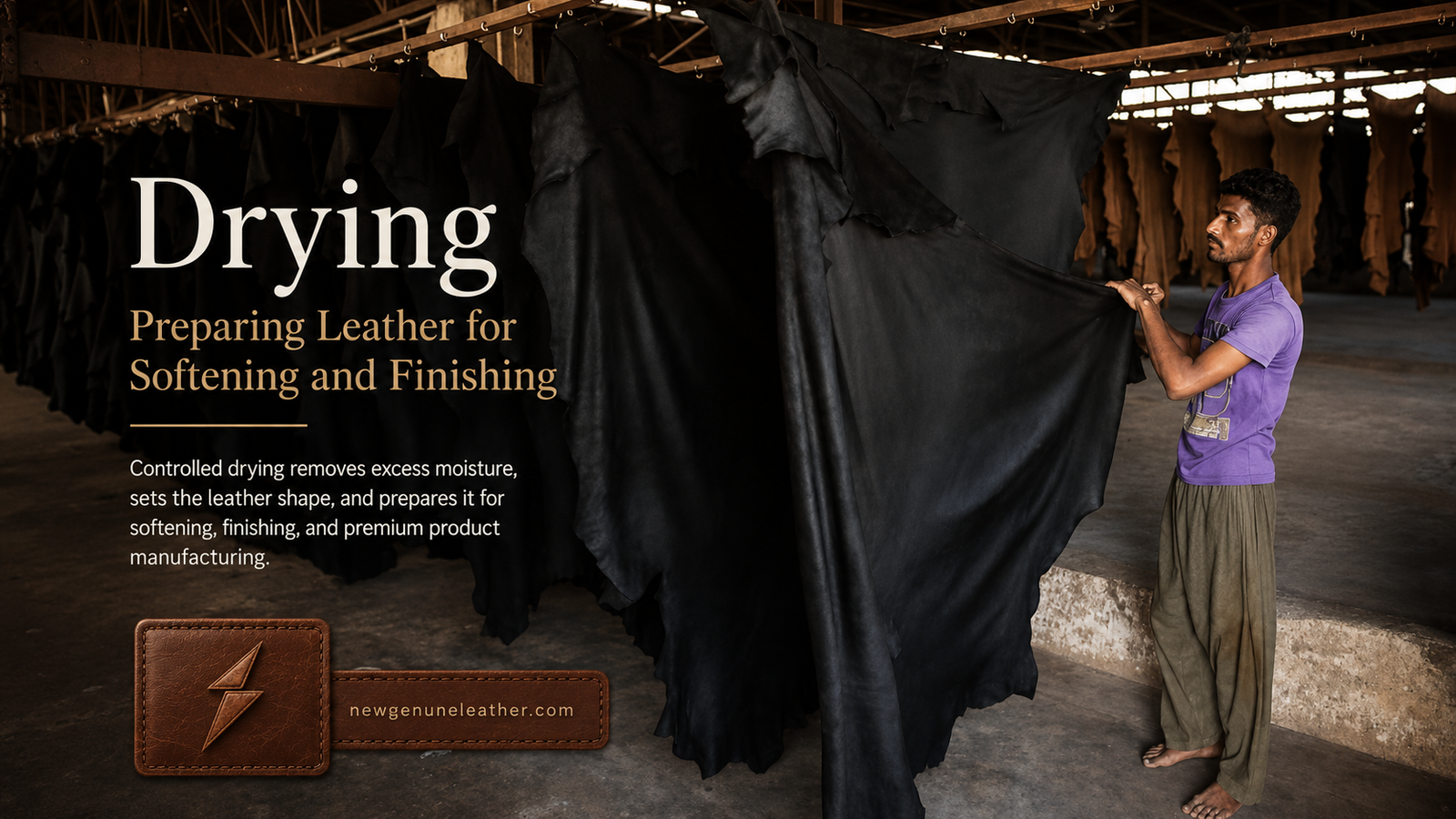
The drying process in leather is one of the most important stages between wet processing and final finishing. Leather cannot simply be left to dry without control because the speed, temperature, tension, and remaining moisture all influence its softness, size, flexibility, appearance, and strength.
After tanning, dyeing, fatliquoring, and other wet-end treatments, leather contains a significant amount of water. This moisture must be removed gradually and evenly. If drying is too fast, the leather may become hard, shrunken, uneven, or brittle. If drying is too slow, production takes longer and the material may develop irregular moisture levels or other quality problems.
At New Genuine Leather (NGL), proper drying and conditioning help prepare leather for jackets, custom lederhosen, gloves, trousers, skirts, bags, and private-label accessories. Understanding this process also helps wholesale buyers evaluate leather samples and communicate their required softness, thickness, texture, and finish.
What Is the Drying Process in Leather?
The drying process in leather refers to the controlled removal of water from a tanned and processed hide. However, drying is not only about eliminating moisture. It also helps determine the leather’s final dimensions, grain appearance, surface flatness, hand feel, and suitability for finishing.
Leather is made from a natural network of collagen fibers. During wet processing, these fibers become surrounded by water, dyes, oils, and chemical agents. As moisture leaves the material, the fibers move closer together.
Without proper control, they can bond too tightly, making the leather stiff. Correct fatliquoring, gradual drying, conditioning, and mechanical softening help keep the fiber structure flexible.
The exact drying method depends on:
- Leather thickness
- Tanning system
- Product category
- Required softness
- Surface finish
- Grain characteristics
- Production volume
- Buyer specifications
Garment leather, bag leather, glove leather, suede, nubuck, and lederhosen leather may all require different drying conditions.
Why Controlled Leather Drying Matters
Improper drying can affect almost every later production stage. Leather that is too dry may crack during staking or stitching. Leather containing too much moisture may create problems during coating, pressing, gluing, cutting, or storage.
A controlled drying process in leather supports:
- Consistent dimensions
- Improved softness
- Better grain appearance
- Reduced shrinkage
- Stable color
- More reliable finishing
- Improved cutting performance
- Better coating adhesion
- Lower risk of mold during storage
For wholesale buyers, drying consistency is especially important. Variations between hides can create visible differences across a bulk order, even when the same color and leather grade are used.
1. Removing Excess Water
The first stage is to remove as much free water as possible without damaging the leather. Freshly processed hides may contain more moisture than can be removed efficiently through air drying alone.
Manufacturers commonly use a setting-out or sammying machine. Sammying works by pressing the leather between rollers, often with absorbent material, to remove excess water.
Setting out also helps flatten the leather, reduce folds, open the grain, and improve its usable surface area. Operators must carefully control roller pressure because excessive pressure may create marks or stretch delicate leather.
This stage makes later drying faster and more consistent. It also reduces the amount of energy required during vacuum, toggle, or controlled chamber drying.
2. Setting Out the Leather
After excess water is removed, the hide is stretched and flattened to improve its shape. Setting out helps eliminate wrinkles and distributes moisture more evenly across the material.
A properly set-out hide has a smoother grain and more stable dimensions. This is especially important for leather intended for jackets, skirts, bags, and other products requiring large visible panels.
If folds remain during drying, they may become difficult to remove later. Uneven positioning can also create areas with different moisture levels, resulting in inconsistent softness and appearance.
At New Genuine Leather, surface condition and usable cutting area are considered together. Better preparation at this stage helps reduce leather waste during pattern cutting and improves appearance across finished products.
3. Selecting the Right Drying Method
Different types of leather require different drying systems. Manufacturers may use one method or a combination of methods depending on production requirements.
Hang Drying
In hang drying, hides are suspended in a controlled area where air circulates around them. It is a relatively gentle method but may require more time and production space.
Hang drying can support a natural appearance, but humidity and airflow must remain consistent. Poorly controlled conditions may cause uneven moisture removal or shape distortion.
Toggle Drying
During toggle drying, leather is stretched on perforated frames and secured around the edges with toggles. Warm, controlled air passes through the drying area.
This method helps maintain a flat surface and increases the usable area of the hide. However, excessive stretching may affect thickness, grain character, or natural elasticity.
Toggle drying is often used when dimensional stability and flatness are important.
Vacuum Drying
Vacuum drying places leather on a heated plate while reduced pressure helps moisture evaporate at a lower temperature. The process can be faster than conventional air drying and can produce a smooth, flat surface.
Temperature, pressure, and drying time must be carefully controlled. Excessive heat or prolonged exposure can make leather firm or reduce its natural feel.
Vacuum drying is commonly combined with additional conditioning or air drying rather than being treated as the only production stage.
Paste Drying
In paste drying, leather is attached to a smooth plate using a temporary adhesive or paste. As it dries, the material remains flat and stable.
This method can produce a smooth grain surface but may not be suitable for every leather type. Any paste residue must be properly managed before later finishing processes.
The chosen method should always match the approved sample and final product requirements.
4. Controlling Temperature, Airflow, and Humidity IN Drying Process in Leather
Temperature alone does not determine drying quality. Airflow and relative humidity also influence how quickly moisture leaves the leather.
High temperatures can accelerate production, but excessive heat may cause rapid surface drying while moisture remains trapped deeper inside the material. This can create stiffness, shrinkage, or uneven color.
Very low humidity may also remove moisture too aggressively. On the other hand, high humidity can extend drying time and make it difficult to reach a stable final moisture level.
An effective drying process in leather balances all three conditions:
- Temperature controls evaporation speed
- Airflow carries moisture away
- Humidity controls how aggressively drying occurs
Thicker leather normally requires more time than lightweight garment or glove leather. Suede and nubuck must also be handled carefully because drying conditions can affect nap direction, shade, and surface feel.
5. Monitoring Moisture Content IN Drying Process in Leather
Leather should not be judged only by appearance. A hide may feel dry on the surface while still containing moisture internally.
Manufacturers may use moisture meters, weight comparisons, timed production controls, and physical inspection to determine whether the material has reached the required condition.
The ideal moisture level depends on what happens next. Leather prepared for staking may need enough moisture to remain flexible, while material entering a finishing line must be sufficiently stable for coating and pressing.
If leather is overdried, it may require reconditioning before mechanical softening. If it remains too wet, it may stretch unpredictably during processing.
Consistent moisture measurement is especially valuable during bulk production because it reduces variation between batches.
6. Conditioning and Softening After Drying Process in Leather
Dry leather is often conditioned before staking or milling. Conditioning reintroduces a controlled amount of moisture so the fiber structure can be softened without cracking or damage.
The leather may be placed in a humidity-controlled chamber or lightly exposed to moisture under carefully managed conditions. The goal is not to make the material wet again. It is to distribute enough moisture throughout the fiber structure to support mechanical softening.
After conditioning, leather may be softened using:
- Staking machines
- Milling drums
- Mechanical flexing
- Hand working for specialized items
Staking stretches and separates the fiber structure, improving softness and flexibility. Milling can create a softer handle and may also develop a more pronounced natural grain.
This stage is particularly important for leather jackets, gloves, skirts, trousers, and other apparel that must move comfortably with the wearer.
7. Final Quality Inspection Drying Process in Leather
The final stage of the drying process in leather is a complete quality inspection. The leather is checked under suitable lighting and handled from multiple directions.
Quality-control teams evaluate:
- Moisture consistency
- Surface flatness
- Grain condition
- Softness and flexibility
- Color uniformity
- Thickness
- Dimensional stability
- Signs of shrinkage
- Drying marks or plate impressions
The leather may be gently folded or stretched to confirm that it remains flexible and does not crack. Suede and nubuck are brushed to check nap uniformity and shade consistency.
Approved production material should also be compared with the buyer’s confirmed swatch or finished sample. This is important because small differences in drying can change the perceived color and surface texture.
How Drying Affects Different Leather Products Drying Process in Leather
The ideal drying result depends on the intended product.
Leather Jackets and Skirts
Garment leather must remain soft, flexible, and lightweight. Aggressive drying can create stiffness that affects comfort and drape.
Leather used for jackets and skirts should move naturally while maintaining enough stability for stitching, zippers, pockets, and linings.
Custom Lederhosen
Lederhosen leather requires durability, shape retention, and a traditional surface character. The drying process must support embroidery and construction without making the material uncomfortable.
Depending on the design, buyers may request a smooth, suede-like, matte, distressed, or aged appearance.
Leather Gloves
Glove leather must remain highly flexible. Even small drying inconsistencies can affect finger movement, fit, and comfort.
The material should feel soft without becoming weak or excessively stretchy.
Bags and Accessories Drying Process in Leather
Bag leather often needs more structure than garment leather. Controlled drying helps create dimensional stability while preserving enough flexibility for folding, stitching, and assembly.
The required balance depends on whether the buyer wants a soft slouchy bag or a firm structured design.
Common Leather-Drying Problems AND Drying Process in Leather
One frequent problem is overdrying. Leather that loses too much moisture can become hard and difficult to soften.
Uneven drying is another issue. Thick areas, folded sections, or poorly positioned hides may dry at different rates, creating variations in color and flexibility.
Excessive stretching during toggle drying can increase surface area but may reduce thickness or alter the grain. Vacuum drying at unsuitable temperatures may also produce unwanted firmness or plate marks.
Other possible problems include:
- Shrinkage
- Curling edges
- Uneven shade
- Grain tightening
- Hard patches
- Wrinkles
- Loss of natural texture
- Mold caused by excessive residual moisture
These issues are easier to prevent than correct after finishing.
Drying Process in Leather for Wholesale Orders Drying Process in Leather
Wholesale and private-label buyers should discuss drying and finishing requirements during product development. The phrase “genuine leather” alone does not describe how the final material should feel or perform.
Buyers should approve:
- Leather type
- Thickness range
- Surface texture
- Softness level
- Color standard
- Grain appearance
- Product sample
- Finished production swatch
For repeat orders, the manufacturer should keep the approved sample as a production reference. This helps maintain consistency across different batches of hides.
Buyers can also review industry information from the Leather Working Group and educational resources published by Leather Naturally. Keep at least one of these external resources as a normal dofollow link in WordPress.
New Genuine Leather Manufacturing Services Drying Process in Leather
New Genuine Leather (NGL) manufactures and exports genuine leather apparel and accessories for wholesale, OEM, and private-label buyers worldwide.
Our product range includes leather jackets, skirts, trousers, custom lederhosen, gloves, bags, and custom leather accessories. Buyers can request material selection, colors, embroidery, patterns, branded labels, sizing, packaging, and surface-finishing options.
A controlled drying process in leather helps us prepare materials for accurate cutting, reliable stitching, consistent finishing, and long-term product performance.
Explore our manufacturing services through the New Genuine Leather website.
Contact New Genuine Leather
Website: New Genuine Leather
Instagram: Follow New Genuine Leather
WhatsApp: Discuss Your Wholesale Order
Final Thoughts
The drying process in leather directly affects softness, dimensions, grain appearance, color, flexibility, and durability. It is not simply a waiting period between tanning and finishing.
Successful drying requires controlled water removal, proper setting out, a suitable drying method, balanced temperature and humidity, moisture monitoring, conditioning, and careful final inspection.
For wholesale and private-label buyers, these controls help ensure that every jacket, skirt, glove, bag, or pair of lederhosen matches the approved quality standard. New Genuine Leather combines material preparation with custom manufacturing services to support dependable leather products for international buyers.
