

Synthetic Tanning: 7 Powerful Benefits for Better Leather

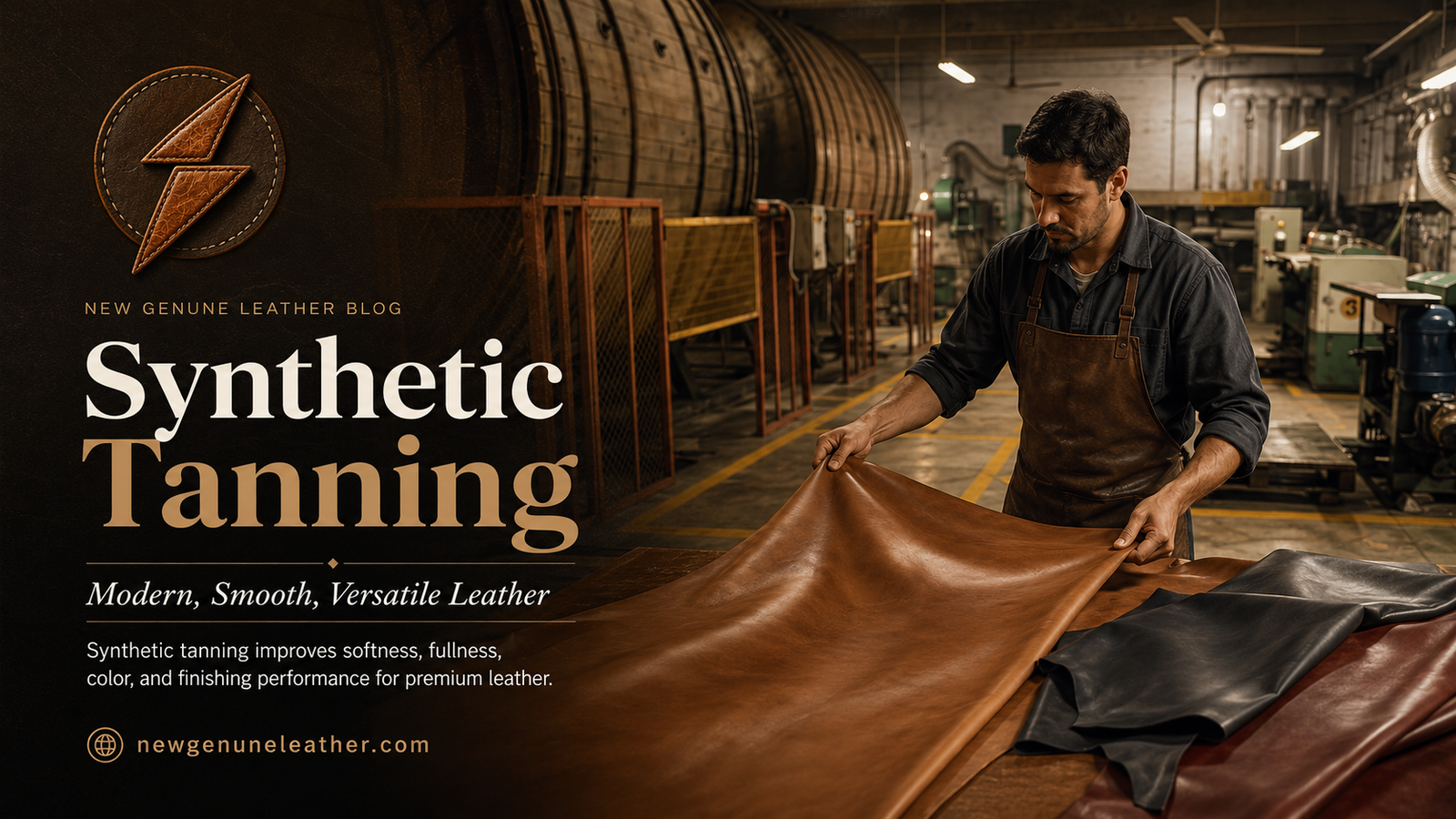
Synthetic tanning is a leather-making method that uses manufactured organic tanning agents to stabilize animal hide and influence its color, softness, fullness, grain, and performance. It should not be confused with synthetic leather. The finished material remains real leather because it begins with natural animal hide; the word “synthetic” describes the tanning chemistry.
At New Genuine Leather (NGL), we help wholesale, OEM, and private-label buyers select suitable leather for jackets, gloves, lederhosen, skirts, trousers, bags, and accessories. Understanding the tanning method helps buyers compare samples, establish quality standards, and choose a finish suited to their target market.
What Is Synthetic Tanning?
Synthetic tanning uses industrially manufactured tanning substances commonly known as syntans. Depending on their formulation, syntans may be used during primary tanning, pretanning, retanning, filling, dyeing, or grain control.
Different syntans perform different functions. Manufacturers may combine them with vegetable extracts, acrylic resins, polymers, or other tanning agents to achieve a particular feel and performance.
Leather Working Group explains that synthetic tanning agents are commonly used during retanning with vegetable materials, acrylic resins, and fillers. Their combined effects can help make leather softer and fuller.
Leather Naturally also identifies synthetic agents as one of the recognized tanning groups used to convert prepared hides into leather.
Synthetic Tanning Is Not Synthetic Leather
This distinction is important for both consumers and professional buyers.
Synthetic leather—often called PU leather, faux leather, vegan leather, or leatherette—is usually made from a textile backing covered with a plastic-based coating. Synthetic tanning, by comparison, treats genuine animal hide.
A syntan-treated hide can therefore remain real leather. However, buyers should still ask whether the complete process is chrome-tanned, chrome-free, vegetable-tanned, wet-white, or combination-tanned.
The term alone does not describe the entire tanning and retanning recipe.
1. Preparing the Hide
Successful synthetic tanning begins before the tanning agents enter the drum. Raw hides must first be sorted and prepared through operations such as soaking, cleaning, liming, fleshing, deliming, and bating.
These processes remove unwanted substances and prepare the collagen fibre structure to receive tanning agents more evenly.
Poor preparation can cause:
- Uneven tanning-agent penetration
- Loose or wrinkled grain
- Patchy dyeing
- Inconsistent softness
- Differences between production batches
Time, water quality, temperature, drum movement, and pH must therefore be controlled carefully.
At New Genuine Leather, leather selection is matched to the finished product. Soft jacket leather, flexible glove leather, structured bag leather, and traditional lederhosen leather do not require the same thickness, firmness, or surface character.
2. Selecting the Correct Syntan
The chosen syntan depends on the result required by the buyer.
Light-colored fashion leather may need a system that supports clean and bright shades. Bag leather may require greater firmness and body. Glove leather normally needs softness, flexibility, and a comfortable hand feel.
Some syntans help tanning materials penetrate the hide. Others improve filling, grain tightness, dye levelness, softness, or fullness.
This is why synthetic tanning is not one fixed chemical formula. Two synthetic agents can produce different results because their structure, reactivity, molecular size, and interaction with collagen may differ.
An experienced manufacturer considers the hide type, thickness, product category, compliance requirements, and approved sample before selecting the tanning system.
3. Achieving Uniform Penetration
During synthetic tanning, prepared hides are placed in rotating drums containing water and selected tanning materials. Drum movement helps the tanning liquor travel through the fibre structure.
Uniform penetration is essential. If the tanning materials react too quickly near the surface, the outer area may absorb more product while the centre remains insufficiently treated.
Technicians manage:
- Chemical concentration
- Drum temperature
- Processing time
- Mechanical action
- Liquor level
- pH adjustment
The recipe must be properly recorded so that the approved leather can be reproduced during bulk manufacturing.
Repeatability is particularly important for international wholesale buyers ordering hundreds or thousands of matching garments.
4. Fixing and Stabilizing the Leather
After the tanning agents have penetrated the hide, process conditions are adjusted to encourage stronger interaction with the collagen structure.
This stabilization changes perishable hide into leather with improved resistance to moisture, heat, microorganisms, and physical handling.
Different synthetic tanning systems stabilize collagen in different ways. Some products work mainly as supporting agents, while others contribute more significantly to the primary tannage.
For this reason, buyers should not assume that every syntan-treated leather offers identical strength, shrinkage resistance, flexibility, or durability.
Physical and chemical testing provides more dependable evidence than general marketing claims.
5. Retanning for Fullness and Grain Control
Retanning is one of the most common and valuable applications of synthetic tanning.
Natural hides are not perfectly uniform. The shoulder, belly, backbone, and other areas can differ in density, softness, and fibre structure.
Selected syntans can help:
- Fill looser sections
- Tighten the grain
- Improve surface uniformity
- Modify softness
- Increase fullness
- Improve usable cutting area
- Support more even dyeing
Leather Working Group notes that several retanning materials are normally used together because their combined effects can provide specific leather properties.
The formulation must remain balanced. Excessive filling can make leather heavy, stiff, or less natural in appearance.
6. Dyeing, Fatliquoring, and Finishing
After synthetic tanning or retanning, leather may be dyed and fatliquored.
Dyeing develops the required color. Fatliquoring introduces selected oils or emulsions that lubricate the fibres and help maintain softness and flexibility.
Certain syntans can support pale, bright, or pastel shades by creating a lighter-colored base. Others may influence dye penetration, levelness, or depth.
The finished shade depends on the complete process, including:
- Initial tanning
- Neutralization
- Retanning
- Dye selection
- Fatliquoring
- Drying
- Surface finishing
The leather is later dried, conditioned, softened, buffed where necessary, and protected with suitable finishing products.
You can also read our internal guide to leather buffing and sanding to understand how surface preparation influences the finished texture.
7. Testing and Final Inspection
Finished leather should be inspected for color, grain, thickness, softness, flexibility, odor, and overall surface consistency.
Depending on the product and buyer requirements, laboratory testing may include:
- Tear strength
- Tensile strength
- Flex resistance
- Colorfastness
- Finish adhesion
- Dimensional stability
- Restricted-substance testing
- Chemical-content analysis
Claims such as chrome-free, metal-free, low-formaldehyde, or restricted-substance compliant should be supported by recognized test results.
Leather Working Group publishes specific definitions for tanning-related terms, including chrome-free and organic-tanned leather. These definitions demonstrate why buyers should request measurable evidence instead of accepting vague product descriptions.
At NGL, approved swatches and development samples serve as references for bulk production. Production lots are checked against those samples during cutting, stitching, finishing, and final inspection.
Main Benefits of Synthetic Tanning
A carefully managed synthetic tanning system can provide valuable control over leather characteristics.
Its potential benefits include:
- Cleaner and lighter color bases
- Improved filling of loose areas
- Better grain tightness
- More consistent softness
- Controlled fullness and firmness
- Improved dye levelness
- Greater production repeatability
- Specialized fashion effects
It is also useful in combination tanning. Syntans may be used alongside vegetable materials, chromium salts, polymers, resins, acrylic products, or other organic tanning agents.
For wholesale buyers, consistency is one of the most important advantages. Genuine leather will always contain natural variation, but a controlled production recipe can reduce unnecessary differences across a large order.
Environmental Considerations
Synthetic tanning should not automatically be described as environmentally superior or inferior. Its environmental impact depends on the exact chemistry, uptake efficiency, wastewater load, biodegradability, and the tannery’s treatment systems.
IULTCS guidance explains that many traditional syntans are based on condensation products involving phenolic materials and formaldehyde. Modern alternatives may use different formulations or be designed to reduce particular restricted substances.
Buyers should request:
- Current safety data sheets
- Chemical supplier information
- Restricted-substance declarations
- Laboratory test reports
- Wastewater-management information
- Evidence supporting environmental claims
Useful industry references include the Leather Working Group, Leather Naturally, and IULTCS cleaner-production guidance.
Keep at least one of these external links as a normal dofollow link in WordPress so Rank Math detects an outbound reference.
Synthetic Tanning for Different Products
The correct tanning and retanning recipe depends on the finished item.
Leather jackets require softness, flexibility, and a finish that moves without cracking. Synthetic tanning can support shade consistency and a balanced garment feel.
Leather gloves need comfort, stretch, sensitivity, and strength. Excessive filling could reduce flexibility, so the formulation must remain carefully controlled.
Lederhosen require durability, embroidery support, body, and often a traditional matte or suede-like character.
Leather skirts and trousers need an even thickness, controlled drape, and a consistent surface. Bags and accessories usually require greater firmness, shape retention, and resistance to repeated handling.
One formula cannot provide ideal results for every leather category.
What Wholesale Buyers Should Ask
Before confirming bulk production, request a representative leather swatch and a finished product sample.
Confirm the following information:
- Main tanning and retanning system
- Chrome, chrome-free, vegetable, wet-white, or combination status
- Required physical and chemical tests
- Approved color and texture tolerances
- Restricted-substance requirements
- Batch-consistency procedures
- Pre-production sample approval
Clear documentation protects both the buyer and manufacturer. It also reduces disputes related to color, softness, grain, thickness, or finishing after production.
New Genuine Leather Manufacturing Services
New Genuine Leather is a Sialkot-based manufacturer serving wholesale, OEM, and private-label buyers worldwide.
Our product range includes genuine leather jackets, custom lederhosen, gloves, skirts, trousers, bags, and leather accessories.
We support buyers with:
- Leather and material selection
- Custom color development
- Embroidery and decorative details
- Private-label branding
- Custom sizing
- Packaging development
- Sample production
- Bulk manufacturing
Synthetic tanning is one of several approaches that may be considered during leather development. The final specification depends on the approved sample, product performance, target price, market expectations, and compliance requirements.
Frequently Asked Questions
Is syntan-treated leather real leather?
Yes. It is produced from genuine animal hide. The term refers to the manufactured tanning agents, not to a plastic imitation material.
Is synthetic tanning always chrome-free?
No. Syntans may be used in chrome-free systems, but they are also commonly used to retan chrome-tanned leather. The complete manufacturing process and laboratory results determine whether a chrome-free claim is accurate.
Can it produce pale or bright leather?
Certain synthetic and organic tanning systems can support lighter-colored bases. The final shade still depends on retanning, dyeing, fatliquoring, drying, and finishing.
Is it automatically sustainable?
No single tanning name proves sustainability. Responsible performance depends on chemical selection, efficient uptake, water and energy use, wastewater treatment, and professional tannery management.
Final Thoughts
Synthetic tanning gives leather manufacturers a flexible method for controlling color, softness, fullness, grain, and production performance.
Its value comes from selecting the correct syntan for the correct hide and finished product. For wholesale and private-label buyers, physical samples, agreed testing standards, verified claims, and pre-production approval are essential.
Contact New Genuine Leather
Website: New Genuine Leather
Instagram: Follow New Genuine Leather
WhatsApp: Discuss Your Wholesale Order
