

Hand-Stitched Leather Goods: 7 Reasons They Outlast Machine-Made

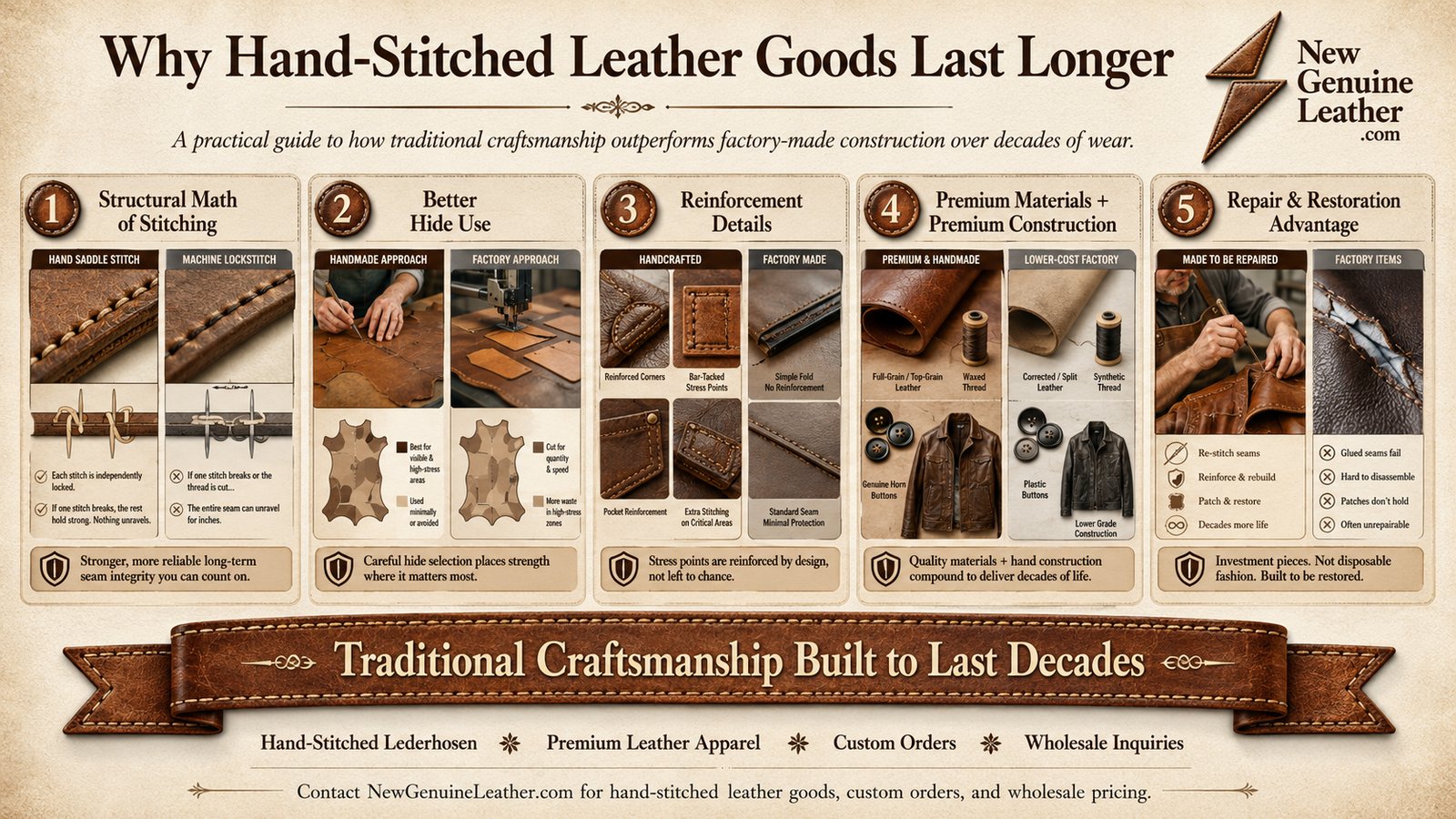
Hand-stitched leather goods occupy a category of their own in the leather world. While machine stitching dominates mass production, stitched leather goods remain the standard for buyers who care about strength, longevity, and craftsmanship that shows in every seam. If you’ve wondered whether stitched leather goods are actually worth the extra cost and production time, this guide breaks down exactly what makes them different — and when they’re the right choice.
What Are Hand-Stitched Leather Goods?
Stitched leather goods are products where the seams are sewn manually, typically using a saddle stitch technique, rather than run through an industrial sewing machine. This method has been used in leatherwork for centuries and remains the standard for premium jackets, bags, belts, and accessories where durability and finish quality matter most.
Unlike machine stitching, which uses a single continuous thread that can unravel if one point fails, leather goods typically use two needles working in opposite directions through the same hole, creating a lock at every stitch. This single difference is responsible for most of the durability advantages hand-stitched leather goods are known for.
Why Hand-Stitched Leather Goods Last Longer
1. Lock-Stitch Strength Because leather goods use interlocking stitches, a single broken thread doesn’t cause the entire seam to unravel — a major advantage over machine-stitched construction, where one failure point can compromise a full seam.
2. Even Tension Control Skilled artisans adjust thread tension by feel as they work, allowing hand-stitched leather goods to handle variations in leather thickness far better than a machine set to a fixed tension.
3. Denser Stitch Placement Hand-stitched leather goods often use closer stitch spacing at stress points — like handle attachments and corners — reinforcing exactly the areas that see the most wear.
4. Thread Quality Control Because the process is slower, artisans producing hand-stitched leather goods can inspect and replace weak sections of waxed thread as they go, rather than running an entire spool through unchecked.
5. Better Adaptation to Thick Leather Hand-stitched leather goods handle multiple layers and thicker cuts of leather more reliably than machine stitching, which can struggle or skip stitches on dense material.
6. Repairability When a seam does eventually wear on hand-stitched leather goods, a skilled leatherworker can often repair just the damaged section without restitching the entire item — a repair advantage machine-stitched goods rarely offer.
7. Visible Craftsmanship Beyond durability, hand-stitched leather goods carry a visual and tactile signature — slightly irregular, evenly spaced stitches — that signals genuine craftsmanship in a way uniform machine stitching can’t replicate.
Hand-Stitched vs. Machine-Stitched: A Direct Comparison
Machine-stitched leather goods aren’t inherently low quality — they’re simply built for different priorities. Machine stitching is faster, more cost-effective at scale, and perfectly adequate for products that don’t face heavy stress at the seams.
Hand-stitched leather goods, by contrast, take significantly longer to produce and cost more as a result, but deliver measurably better durability at stress points like handles, straps, and corners — the areas most likely to fail first on any leather product.
For buyers deciding between the two, the right choice depends on use case. Everyday, lower-stress items may not need hand-stitching to perform well. Premium bags, belts, and goods expected to last decades benefit significantly from it.
Products Best Suited to Hand-Stitching
Bags and Totes — Handle attachment points carry constant weight and stress, making hand-stitched leather goods a strong choice for bags meant to last years of daily use.
Belts — The buckle attachment point on a belt is a high-stress area where hand-stitching offers a meaningful durability advantage.
Wallets and Small Goods — While smaller, the corners and card slots on wallets benefit from the precision hand-stitching allows in tight spaces.
Footwear — Certain premium leather shoe construction methods rely on hand-stitching for both durability and the ability to be resoled and repaired over time.
Custom and Private Label Pieces — Hand-stitched leather goods are often chosen for flagship or signature product lines where craftsmanship is part of the brand story.
How to Identify Genuine Hand-Stitched Leather Goods
Check stitch spacing. Hand-stitched seams typically show slight, natural variation in spacing, while machine stitching is perfectly uniform.
Look at the stitch angle. Saddle stitching — the traditional hand-stitching method — often creates a subtle diagonal pattern where thread crosses through the leather, different from the straight vertical stitches of machine work.
Inspect the back side. On genuine hand-stitched leather goods, both sides of the seam look nearly identical, since two threads are worked simultaneously. Machine stitching often looks different from the top versus the underside.
Ask directly. Reputable manufacturers producing hand-stitched leather goods should be able to explain their stitching method and construction process in detail without hesitation.
Caring for Hand-Stitched Leather Goods
Like all genuine leather products, hand-stitched leather goods benefit from routine care. Wipe hand-stitched leather goods down with a soft, dry cloth regularly to remove surface dust, and keep them away from prolonged direct sunlight, which fades both leather and stitching thread over time.
Condition hand-stitched leather goods every few months using a leather-specific conditioner, applied carefully around stitched seams to avoid oversaturating the thread. Store hand-stitched leather goods in a breathable bag away from excess humidity, which can weaken stitching thread over extended periods.
For documented craftsmanship and material standards referenced across the leather industry, the Leather Working Group publishes guidance worth reviewing when evaluating a manufacturer’s production practices.
Hand-Stitched Leather Goods for Wholesale and Private Label Buyers
For retailers and brands, hand-stitched leather goods offer a genuine point of differentiation in a market saturated with machine-made imports. Because hand-stitching takes longer and requires skilled labor, it also supports premium pricing and positions a product line as craftsmanship-driven rather than mass-produced.
When sourcing hand-stitched leather goods at scale, buyers should confirm production timelines early, since manual stitching takes considerably longer than machine production and directly affects order lead times. Manufacturers should also be able to demonstrate consistent stitch quality across a full production run, not just on sample pieces.
Material sourcing standards are worth confirming as well. Reference points such as those maintained by the International Council of Tanners offer a useful benchmark for evaluating hide quality feeding into hand-stitched leather goods production.
OEM and Customization Options
Hand-stitched leather goods are well suited to premium private label and OEM programs. Common customization requests include:
- Thread color selection, from tonal matches to contrasting accent stitching
- Stitch density adjustments at specific stress points based on intended use
- Leather grade selection, typically full-grain or genuine leather for durability
- Branded embossing or hand-tooled detailing
- Hardware customization, including buckles, clasps, and zipper pulls
- Limited-run or signature product lines built around hand-stitched craftsmanship as a brand story
Buyers exploring private label hand-stitched leather goods should request physical samples before committing to production and build realistic lead times into planning, since this construction method genuinely cannot be rushed without compromising quality.
Frequently Asked Questions
Are hand-stitched leather goods worth the extra cost? Yes, particularly for items with high-stress attachment points like bag handles and belt buckles, where hand-stitching’s lock-stitch strength offers a meaningful durability advantage over machine stitching.
How can I tell if leather goods are really hand-stitched? Look for slight natural variation in stitch spacing, a diagonal saddle-stitch pattern, and identical stitching on both sides of the seam — all signs of genuine hand-stitched leather goods.
Do hand-stitched leather goods take longer to produce? Yes. Hand-stitching is a manual, skilled process that takes significantly longer than machine stitching, which affects production timelines for wholesale and private label orders.
Final Thoughts
Hand-stitched leather goods represent a genuine craftsmanship advantage over machine-made alternatives, particularly at the stress points that determine how long a leather product actually lasts. From lock-stitch strength to repairability and visible craftsmanship, hand-stitched leather goods justify their higher cost and longer production time for buyers who prioritize durability and authenticity. For retailers and private label brands, they offer a meaningful way to differentiate a product line in a market crowded with mass-produced imports.
Looking to source or private-label hand-stitched leather goods for your retail business?
Follow Us
Instagram: https://www.instagram.com/newgenuineleather/
WhatsApp: https://wa.me/+923008758207
