

TOP-Grain vs Full Grain vs Genuine Leather: What’s the Difference?

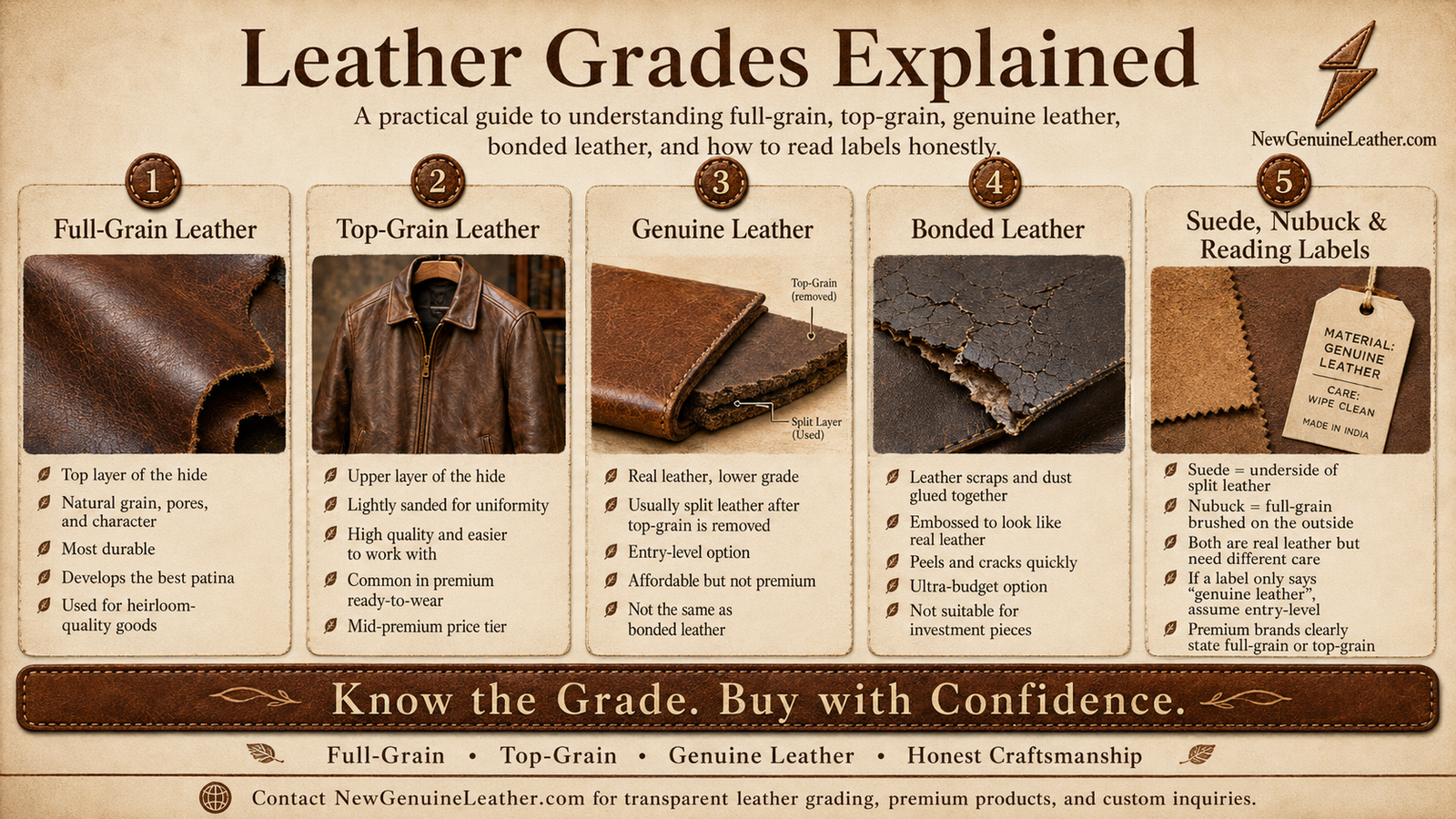
If you’ve been shopping TOP-Grain vs Full Grain vs Genuine Leather: What’s the Difference? for a leather jacket, bag, or wholesale leather goods, you’ve likely seen three terms thrown around interchangeably: full-grain, top-grain, and genuine leather. They sound similar, they’re all “real” leather, and yet they can mean very different things for durability, price, and how the product will look and feel five years from now.
This guide breaks down exactly what separates these three leather grades, so you can buy — or manufacture — with confidence.
The Short Answer TOP-Grain vs Full Grain vs Genuine Leather: What’s the Difference?
All three are made from real animal hide. The difference lies in which layer of the hide is used and how much processing the surface goes through before it becomes a finished product.
- Full-grain leather uses the complete outer layer of the hide, keeping its natural grain intact.
- Top-grain leather uses that same outer layer, but sanded and refinished for a smoother, more uniform look.
- Genuine leather is cut from a lower layer of the hide, beneath the top grain, and finished with an artificial texture to mimic natural grain.
Understanding this hierarchy is the key to understanding leather quality, pricing, and durability across almost every leather product category.
TOP-Grain vs Full Grain vs Genuine Leather: What’s the Difference?: The Premium Standard
Full-grain leather is considered the highest quality leather available. It uses the entire top layer of the hide — including the natural grain, pores, and even minor imperfections like insect bites or healed scars from the animal’s life.
Why it’s premium:
- The natural fiber structure is untouched, making it the strongest and most durable grain layer of the hide.
- It develops a rich patina over time — a natural darkening and softening that many buyers consider more attractive with age, not less.
- It’s more breathable than sanded/corrected leathers, which matters for items worn close to the skin like jackets and gloves.
The trade-off: Full-grain leather is more expensive because it requires higher-quality raw hides (fewer imperfections to work around) and more careful sourcing. It also shows natural markings, which some buyers see as authenticity and others see as inconsistency.
Best for: High-end jackets, premium bags, footwear, and any product where longevity and natural aging are selling points.
Top-Grain Leather: The Polished Middle Ground TOP-Grain vs Full Grain vs Genuine Leather: What’s the Difference?
Top-grain leather also comes from the top layer of the hide, but the surface is lightly sanded and a finish coat is applied. This removes natural imperfections and creates a more consistent, polished appearance.
Why manufacturers use it:
- It’s more affordable than full-grain because a wider range of hides can be used — imperfections are sanded away rather than requiring pristine raw material.
- The finish makes it more resistant to stains and easier to clean.
- It has a smoother, more “finished” look that appeals to fashion-forward buyers.
The trade-off: Sanding removes some of the natural fiber strength, so top-grain leather is slightly less durable than full-grain. It also won’t develop the same deep patina, since the natural surface has been altered.
Best for: Fashion leather goods, handbags, wallets, and premium accessories where a clean, consistent look matters more than natural aging.
Genuine Leather: Real Leather, Practical Pricing TOP-Grain vs Full Grain vs Genuine Leather: What’s the Difference?
Genuine leather is where the most confusion happens. The name suggests premium quality, but in the leather industry it’s actually the third tier — made from the layers of hide beneath the top grain.
How it’s made: Once the top layer is split away for full-grain and top-grain products, the remaining lower layers are still usable. Manufacturers sand these layers smooth, then apply an artificial grain pattern and a protective pigment or polyurethane coating to give it a leather-like appearance and feel.
Why it matters for buyers: TOP-Grain vs Full Grain vs Genuine Leather: What’s the Difference?
- It’s genuinely real leather — not synthetic — just from a different, lower part of the hide.
- It costs significantly less than full-grain or top-grain leather, making it accessible for everyday products.
- The applied finish makes it fairly consistent in color and texture across a production run, which is useful for wholesale buyers who need uniformity across large orders.
The trade-off: It’s less durable than the top two grades and won’t age into a patina the way full-grain does. Over time, the applied surface coating can show wear differently than natural grain.
Best for: Everyday jackets, gloves, wholesale apparel, and accessories where affordability and consistency matter more than long-term natural aging.
Side-by-Side Comparison TOP-Grain vs Full Grain vs Genuine Leather
| Feature | Full-Grain | Top-Grain | Genuine Leather |
|---|---|---|---|
| Hide layer used | Full top layer | Sanded top layer | Layer below top grain |
| Natural grain visible | Yes | Partially | No (artificial texture applied) |
| Durability | Highest | High | Moderate–good |
| Develops patina | Yes | Minimal | No |
| Price | Highest | Mid-high | Mid-low |
| Consistency | Lower (natural markings) | High | Highest |
| Best use case | Investment pieces | Fashion goods | Everyday, wholesale goods |
TOP-Grain vs Full Grain vs Genuine Leather: What’s the Difference? Which One Should You Buy — or Manufacture?
If you’re a retail buyer shopping for a personal item, ask yourself how long you want the product to last and whether you like the idea of leather that changes character over time. Full-grain rewards patience and cost tolerance. Top-grain gives you a clean, consistent product at a lower price. Genuine leather gives you real leather at the most accessible price point — ideal if you want authentic material without a premium price tag.
If you’re a wholesale or private-label buyer, the calculation is different. Genuine leather often makes the most business sense for volume orders: it keeps unit costs manageable, batches finish consistently (important when you’re filling large orders across sizes and colors), and it still gives your customers real, durable leather — not a synthetic substitute. Full-grain and top-grain make sense for premium or limited product lines where you can justify a higher retail price point. TOP-Grain vs Full Grain vs Genuine Leather: What’s the Difference?
Common Misconceptions, Clarified
“Genuine leather is fake leather.” False. It’s 100% real animal hide — it’s simply cut from a different layer than full-grain or top-grain.
“Top-grain is better than full-grain because it’s more refined.” Not necessarily — “refined” here means sanded and processed, which actually reduces some natural durability. Full-grain remains the highest grade despite being less uniform in appearance.
“All leather grades age the same way.” Full-grain develops the most noticeable patina. Top-grain shows minimal aging due to its finish. Genuine leather’s applied coating means it generally wears rather than “ages” in the traditional sense.
Final Thoughts
Full-grain, top-grain, and genuine leather are all real leather — the difference comes down to which part of the hide is used and how much processing the surface undergoes. Full-grain offers unmatched durability and natural character at a premium price. Top-grain offers a polished middle ground. Genuine leather delivers authentic, durable leather at the most accessible price point, making it a smart choice for everyday products and wholesale manufacturing alike.
Understanding these differences means you’ll never be misled by a “genuine leather” label into expecting premium full-grain quality — and you’ll know exactly which grade fits your product, budget, and customer expectations.
Follow Us
Instagram: https://www.instagram.com/newgenuineleather/
WhatsApp: https://wa.me/+923008758207
