

Welding Gloves Guide: TIG vs MIG vs Stick and What to Look For

Welding gloves are the welder’s most important piece of hand protection, and choosing the wrong pair is uncomfortable at best and dangerous at worst. This welding gloves guide explains how gloves differ for TIG, MIG and stick welding, which leathers are used and why, what to look for in cuffs, linings and stitching, and how buyers such as distributors and workshops can plan an order.
Why welding gloves are different
Welding exposes hands to heat, sparks, spatter, ultraviolet radiation and hot metal. Gloves need to resist heat and flame, protect against burns and still let the welder hold a torch, rod or filler wire with control. The balance between protection and dexterity changes depending on the welding process.
For general guidance on welding hazards and protection at work, the UK Health and Safety Executive’s welding guidance is a useful starting point. Always follow the safety rules that apply in your country and workplace.
Welding gloves guide: TIG vs MIG vs stick
TIG welding gloves
TIG (tungsten inert gas) welding needs precise control. The welder often feeds filler rod with one hand and controls the torch with the other. TIG gloves are therefore:
- Thin and close-fitting for maximum dexterity.
- Usually made from soft goatskin, kidskin or deerskin.
- Often unlined or lightly lined.
- Made with shorter or medium cuffs.
TIG produces less spatter than other processes, so thinner leather is practical.
MIG welding gloves
MIG (metal inert gas) welding produces more heat and spatter than TIG but still needs reasonable control of the gun. MIG gloves are:
- Medium weight, balancing protection and feel.
- Commonly made from cowhide, goatskin or pigskin.
- Often partly lined, especially on the back of the hand.
- Made with longer cuffs to protect the wrist from spatter.
Stick welding gloves
Stick (shielded metal arc) welding produces heavy spatter and high heat. Stick gloves prioritise protection:
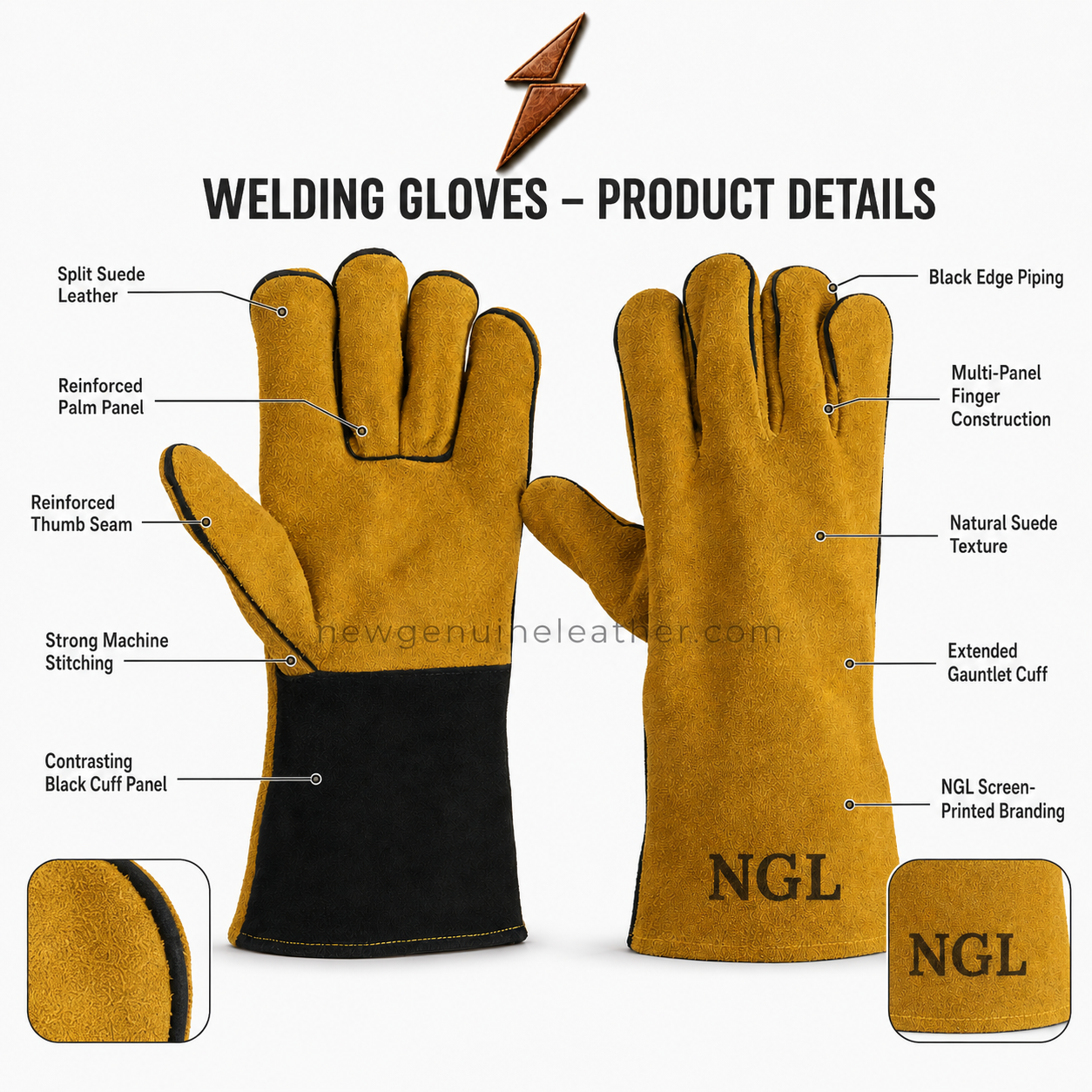
- Thick split cowhide or similar heavy leather.
- Full insulating linings, such as cotton, foam or wool.
- Long gauntlet cuffs that cover the forearm.
- Reinforced palms and thumbs.
The trade-off is reduced dexterity, which is acceptable for the rod-holding work of stick welding.
Leather types for welding gloves
- Cowhide: the most common choice. Durable, heat resistant and affordable. Split cowhide is widely used for MIG and stick gloves.
- Goatskin: soft, strong and flexible with natural lanolin. A favourite for TIG gloves.
- Deerskin: very soft and comfortable, keeping its feel after exposure to heat.
- Pigskin: breathable and resists moisture, staying flexible after getting wet.
- Elk: thick and heat resistant, used in some heavy-duty gloves.
Grain vs split leather
Grain leather is the outer surface of the hide: smoother, tighter and better for dexterity. Split leather comes from the inner layers: rougher, thicker and good at resisting heat and abrasion. Many welding gloves use grain leather on the palm for grip and feel, and split leather on the back and cuff for protection.
Features to look for
Stitching
Welding gloves should be sewn with heat-resistant thread, such as Kevlar®-type aramid thread. Ordinary cotton or polyester thread can burn or melt, causing seams to fail.
Cuff length
Longer cuffs protect wrists and forearms from spatter. Stick and MIG welders usually want gauntlet cuffs; TIG welders often prefer shorter cuffs for movement.
Lining
Linings add insulation against heat. Common options are cotton, fleece, foam and aluminised layers on the back of the hand for radiant heat. The more heat, the more lining is needed, but every layer reduces feel.
Reinforcements
Extra leather patches on the palm, thumb and index finger extend glove life where wear is greatest.
Fit and pattern
Gloves should fit closely without restricting movement. A “keystone” or wing thumb pattern can improve flexibility and comfort.
Standards and markings
Many markets use standards to describe the heat and mechanical protection a glove provides. In Europe, welding gloves are commonly tested to EN 12477, with EN 388 for mechanical risks and EN 407 for thermal risks. Buyers should check which standards their market and customers require and ask suppliers for the relevant documentation for the specific glove model.
Caring for welding gloves
- Keep gloves dry and store them away from oil and solvents.
- Do not use gloves to pick up very hot metal; use tools.
- Replace gloves that are burnt through, stiff or have split seams.
- Have separate gloves for TIG and for heavy welding if possible.
Ordering welding gloves for your business
If you supply workshops, construction firms or retailers, plan your range around the processes your customers use. Many distributors stock a TIG glove, a MIG glove and a heavy stick gauntlet, with sizes from small to extra large. Decide on leather types, linings, cuff lengths and branding for each style.
You can browse our welding gloves and wider safety gloves ranges, and read more about our work as a leather glove manufacturer.
Private label welding gloves
Private label options for work gloves can include your logo on the cuff, branded labels, custom colours for cuffs and binding, and branded packaging such as header cards. Leather samples typically take 7–14 days, so you can test fit and feel before you commit to a bulk order.
Frequently asked questions
Can I use the same gloves for TIG and MIG welding?
You can, but most welders prefer thinner gloves for TIG and heavier gloves for MIG and stick. Using the right glove improves both comfort and protection.
Which leather is best for welding gloves?
Goatskin and deerskin suit TIG; cowhide and pigskin suit MIG; heavy split cowhide suits stick welding.
Why does stitching matter so much?
Heat can burn ordinary thread. Heat-resistant aramid thread keeps seams intact.
Are welding gloves made from genuine leather?
At New Genuine Leather, all our gloves are made from genuine leather.
Get a quote for welding gloves
New Genuine Leather has made genuine leather garments, gloves and accessories since 2019 at our factory on SIE, Defence Road, Umer Town, Sialkot 51310, Pakistan. We work only with genuine leather, hold ISO 9001, BSCI and Sedex credentials, and supply brands and retailers across the USA, Europe and Australia. Leather samples typically take 7–14 days.
Tell us about your designs, materials and quantities, and our team will come back with options and pricing. Send a wholesale inquiry to New Genuine Leather.
