
Blog
Genuine Leather vs PU Leather

Genuine Leather vs PU Leather: Which is Better and Why?
When shopping for leather products, you’ve probably encountered both genuine leather and PU leather options. But what’s the real difference? Which material offers better value, durability, and quality? Understanding genuine leather vs PU leather is crucial before making your next purchase, whether you’re buying a leather wallet, leather bag, or leather furniture.
In this comprehensive guide, we’ll break down everything you need to know about genuine leather and PU leather so you can make an informed decision that matches your needs, budget, and values.
What is Genuine Leather?
Genuine leather, also referred to as full-grain leather, is crafted entirely out of animal skin and is known for being the highest grade of leather available on the market. It’s a natural material that comes from animal hides, typically cowhide, that has been tanned and treated to create durable, long-lasting products.
Types of Genuine Leather:
- Full-Grain Leather: The highest quality, using the top layer of hide with natural grain intact
- Top-Grain Leather: The second-highest quality, with the surface sanded for uniformity
- Genuine Leather: Lower quality, made from layers beneath the top grain
- Bonded Leather: Lowest quality, made from leather scraps mixed with polyurethane
When you shop at New Genuine Leather, we clearly label which grade of leather each product uses, ensuring complete transparency.
What is PU Leather?
PU (Polyurethane) leather is a more affordable, vegan alternative to genuine leather, boasting benefits like water resistance and easier maintenance. It’s a synthetic material made by coating fabric (usually polyester or cotton) with a polyurethane layer designed to mimic the look and feel of real leather.
Types of PU Leather:
- 100% PU Leather (Full-Synthetic): Completely artificial with no animal products – truly vegan
- Semi-Synthetic PU Leather (Split Leather): Contains a natural leather base with PU coating on top
Important Note: Only the full-synthetic version is completely vegan and animal-free.
Genuine Leather vs PU Leather: The Key Differences
Let’s compare these two materials across the factors that matter most to consumers.
1. Material Composition
Genuine Leather:
- Made from 100% animal hide (typically cowhide)
- Natural material with organic fibers
- Produced through tanning process
- Each piece is unique with natural imperfections
PU Leather:
- Made from polyurethane (plastic polymer)
- Synthetic, man-made material
- Manufactured by coating fabric with plastic
- Uniform, consistent appearance
Winner: Depends on your values – genuine leather for natural materials, PU leather for vegan options
2. Durability & Lifespan
This is where the biggest difference emerges in genuine leather vs PU leather.
Genuine Leather:
- When cared for properly, real leather products can last anywhere from 10 to 20 years
- Can last several decades with proper maintenance
- Becomes softer and more comfortable with age
- Develops a beautiful patina over time
- Highly resistant to tears and punctures
PU Leather:
- PU leather has a lifespan of just 3 to 5 years under normal use conditions
- Shows deterioration including cracking, peeling, and fading
- Over time, faux leather can dry out and crack and flake, resulting in items that can lose function and look worn
- Becomes stiffer and more brittle with age
- High-friction areas deteriorate fastest
Winner: Genuine Leather – hands down. Real leather lasts 4-7 times longer than PU leather.
💡 Value Analysis: A $500 PU leather sofa replaced every 4 years costs more over time than a $2,000 genuine leather sofa lasting 20+ years. Genuine leather offers better long-term value despite the higher upfront cost.
3. Appearance & Texture
Genuine Leather:
- Natural grain with unique patterns
- Visible pores and natural imperfections
- Each piece looks different (no two are identical)
- Rough, fibrous edges
- Rich, authentic appearance
- Develops character and patina over time
PU Leather:
- PU leather’s grain follows a consistent pattern
- Uniform, “perfect” texture that can look artificial
- Repeating patterns like wallpaper
- Smooth, machine-cut edges
- Can be made to mimic various textures
- Doesn’t improve with age
Winner: Genuine Leather – for authenticity and character. PU leather for uniformity and color variety.
4. Feel & Comfort
Genuine Leather:
- Soft, supple texture
- Warm to the touch (warms with body heat)
- Highly breathable (has natural pores)
- Comfortable in all weather conditions
- Adapts to your body over time
- Natural, organic feel
PU Leather:
- PU leather tends to be thinner than genuine leather and is considered to be less breathable
- Can feel plastic-like or synthetic
- Cold to the touch initially
- Less breathable (can cause sweating)
- Doesn’t adapt to body shape
- Can feel uncomfortable in warm weather
Winner: Genuine Leather – significantly more comfortable, especially for clothing and furniture.
5. Maintenance & Care
Genuine Leather:
- Requires regular conditioning (every 6-12 months)
- Needs leather-specific cleaning products
- Can absorb stains if not treated
- Requires proper storage to prevent cracking
- More effort to maintain properly
- Can be repaired and restored
PU Leather:
- PU leather requires only occasional cleaning with mild soap and warm water
- Easy to wipe clean
- Water-resistant surface
- No conditioning required
- Low maintenance
- Difficult or impossible to repair once damaged
Winner: PU Leather – if you want minimal maintenance and easy care.
Learn more about how to care for genuine leather products to maximize their lifespan.
6. Price & Affordability
Genuine Leather:
- Genuine leather is considerably more expensive than PU leather
- Higher manufacturing costs
- Prices vary by leather grade
- Investment purchase
- Better long-term value
PU Leather:
- Significantly cheaper to produce and purchase
- Often half the price of genuine leather
- More accessible for budget shoppers
- Lower upfront cost but needs frequent replacement
Winner: PU Leather – for initial affordability. Genuine Leather – for long-term value.
Budget Breakdown:
- PU Leather Bag: $50 – lasts 3 years = $16.67/year
- Genuine Leather Bag: $200 – lasts 20 years = $10/year
Browse our affordable genuine leather collection for quality products at competitive prices.
7. Environmental Impact
This is where the comparison gets complex.
Genuine Leather:
- Natural, biodegradable material
- Often a byproduct of meat industry
- Requires intensive tanning process
- Uses water and chemicals in production
- But lasts decades, reducing waste
PU Leather:
- Made from petroleum-based materials (fossil fuels)
- Energy-intensive methods of manufacture and petroleum-based materials contribute to consumption of non-renewable resources and emissions
- Non-biodegradable (takes hundreds of years to break down)
- Releases microplastics into environment
- Short lifespan means more frequent disposal
Winner: Neither is perfect, but genuine leather’s longevity and biodegradability give it an edge for long-term sustainability.
8. Ethical Considerations
Genuine Leather:
- Made from animal products
- Not suitable for vegans or those avoiding animal products
- Raises animal welfare concerns
- Traditional material with centuries of use
PU Leather:
- 100% vegan (if full-synthetic)
- No animal products used
- Animal-friendly alternative
- Cruelty-free production
Winner: PU Leather – for those prioritizing vegan and animal-free products.
9. Water Resistance
Genuine Leather:
- Naturally porous and absorbs water
- Requires waterproofing treatments
- Can be damaged by excessive moisture
- Water causes staining if untreated
PU Leather:
- Water-resistant by nature
- Doesn’t absorb moisture
- Easy to wipe dry
- Ideal for wet environments
Winner: PU Leather – naturally water-resistant without treatment.
10. Aging & Patina
Genuine Leather:
- Develops beautiful patina over time
- Becomes softer and more supple with use
- Gains character and unique appearance
- Each scratch and mark adds personality
- Improves with age like fine wine
PU Leather:
- PU leather doesn’t age well and will never develop the soft, worn-down look of real leather
- Cracks, peels, and fades over time
- Loses flexibility and becomes brittle
- Deteriorates rather than improves
- No natural aging process
Winner: Genuine Leather – dramatically better aging characteristics.
How to Tell Genuine Leather from PU Leather
Not sure what you’re looking at? Here are quick ways to identify the difference:
Check the Label
- Genuine Leather: “100% Real Leather,” “Full-Grain Leather,” “Top-Grain Leather”
- PU Leather: “PU Leather,” “Polyurethane,” “Man-Made Material,” “Faux Leather,” “Vegan Leather”
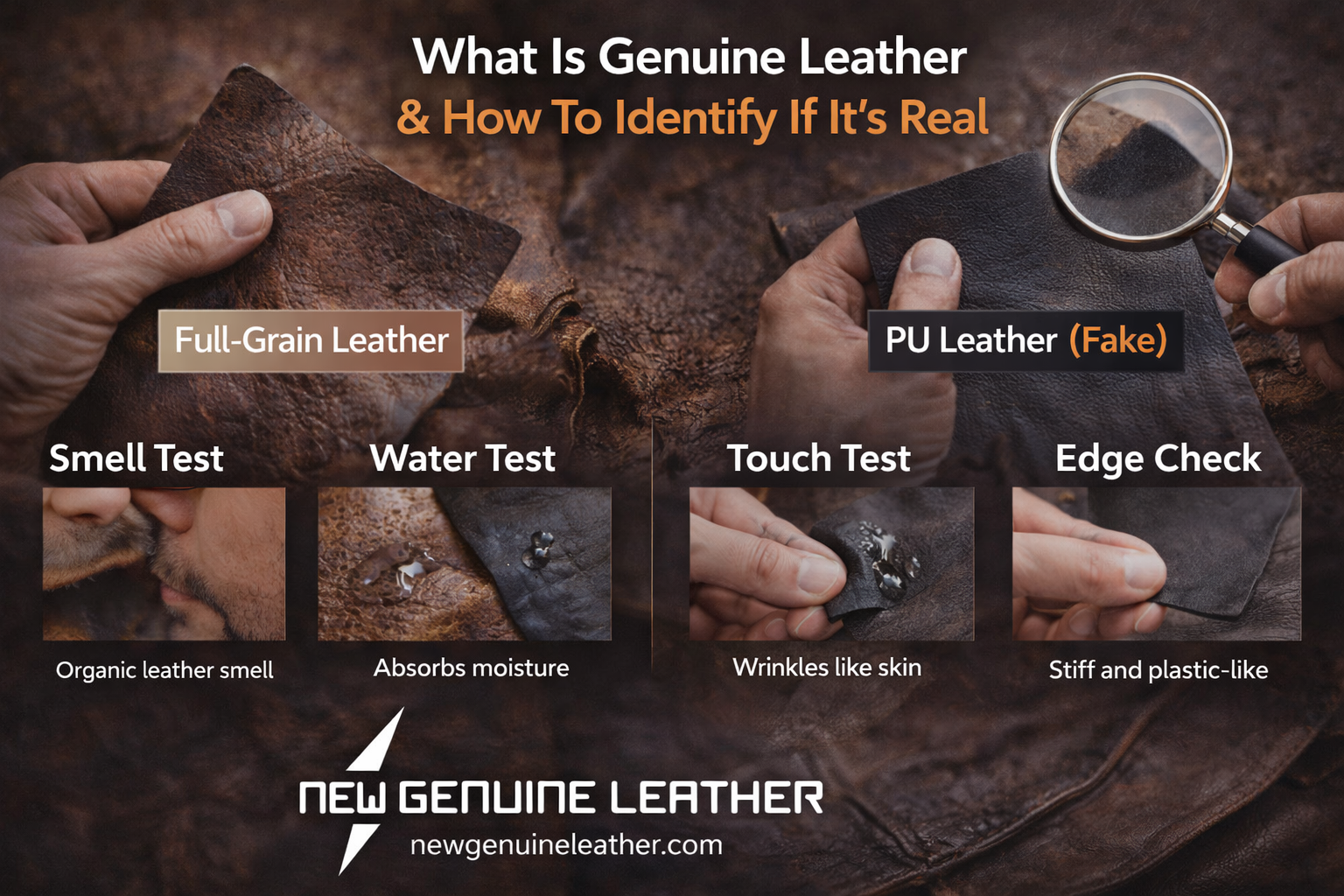
The Smell Test
- Genuine Leather: Natural, earthy, organic leather scent
- PU Leather: Chemical, plastic odor or no smell
Look at the Texture
- Genuine Leather: Natural grain with imperfections and variations
- PU Leather: Uniform, repetitive pattern that looks too perfect
Feel the Surface
- Genuine Leather: Warm, soft, breathable
- PU Leather: Cold, plastic-like, non-breathable
Examine the Edges
- Genuine Leather: Rough, fibrous, suede-like backing
- PU Leather: Smooth cut with fabric backing visible
Water Drop Test
- Genuine Leather: Absorbs water within seconds
- PU Leather: Water beads on surface, doesn’t absorb
Want to dive deeper? Read our complete guide on how to tell if leather is real.
Genuine Leather vs PU Leather: Side-by-Side Comparison Table
| Feature | Genuine Leather | PU Leather |
|---|---|---|
| Material | Natural animal hide | Synthetic polyurethane |
| Lifespan | 10-20+ years | 3-5 years |
| Durability | Excellent | Fair |
| Price | Higher ($$$) | Lower ($$) |
| Maintenance | Regular conditioning needed | Easy, low maintenance |
| Breathability | Highly breathable | Not breathable |
| Water Resistance | Absorbs water | Water-resistant |
| Aging | Develops beautiful patina | Cracks and peels |
| Comfort | Very comfortable | Less comfortable |
| Vegan | No | Yes (if 100% synthetic) |
| Eco-Friendly | Biodegradable | Non-biodegradable |
| Smell | Natural leather scent | Chemical/plastic odor |
| Texture | Unique, natural grain | Uniform, consistent |
| Repairability | Can be repaired | Difficult to repair |
| Value | Better long-term | Lower upfront cost |
Which Should You Choose: Genuine Leather or PU Leather?
The answer depends on your priorities, budget, and values. Here’s our recommendation:
Choose Genuine Leather If:
✅ You want a long-lasting investment (10-20+ years)
✅ You value quality, authenticity, and craftsmanship
✅ You appreciate natural materials that age beautifully
✅ You’re willing to invest more upfront for better long-term value
✅ You want comfort and breathability
✅ You’re buying items for heavy daily use
✅ You’re not vegan and don’t have ethical concerns about animal products
✅ You want products that can be repaired and restored
Best For: Leather wallets, leather bags, leather belts, leather jackets, furniture, shoes, accessories meant to last decades.
Choose PU Leather If:
✅ You’re on a tight budget and need affordable options
✅ You follow a vegan or animal-free lifestyle
✅ You want low-maintenance, easy-care products
✅ You need water-resistant materials
✅ You prefer consistent color and texture options
✅ You’re buying temporary or trend-based items
✅ You don’t mind replacing items every 3-5 years
✅ You need uniform appearance for commercial purposes
Best For: Fashion accessories, temporary furniture, budget-conscious purchases, vegan shoppers, items in wet environments (kitchens, bars).
The Verdict: Which is Better?
For most consumers seeking quality, longevity, and value, genuine leather is the better choice. Here’s why:
Long-Term Value
While PU leather costs less upfront, genuine leather’s 10-20+ year lifespan versus PU leather’s 3-5 years makes it more economical over time.
Superior Quality
Genuine leather offers unmatched comfort, breathability, and durability that PU leather simply cannot replicate.
Environmental Impact
Despite production concerns, genuine leather’s biodegradability and longevity make it more sustainable than petroleum-based PU leather that ends up in landfills every few years.
Aging & Character
Genuine leather can develop a patina over time, which can enhance its appearance and make it more resistant to damage, while PU leather only deteriorates.
Investment Piece
Quality genuine leather products become family heirlooms, while PU leather items are disposable.
However, PU leather has its place for vegans, budget shoppers, and low-maintenance needs. It’s not “bad” – it’s just different with different use cases.
Common Myths About Genuine Leather vs PU Leather
Myth 1: “PU Leather is Just as Durable as Real Leather”
Truth: PU leather lasts 3-5 years while genuine leather lasts 10-20+ years. The durability isn’t comparable.
Myth 2: “You Can’t Tell the Difference”
Truth: With a few simple tests (smell, touch, water test), the differences are obvious. Read our guide on identifying real leather.
Myth 3: “PU Leather is More Eco-Friendly”
Truth: While it’s animal-free, PU leather is made from petroleum, is non-biodegradable, and has a short lifespan requiring frequent replacement.
Myth 4: “Genuine Leather Requires Too Much Maintenance”
Truth: Genuine leather needs conditioning every 6-12 months – a small investment for decades of use.
Myth 5: “All PU Leather is Vegan”
Truth: Only 100% synthetic PU leather is vegan. Semi-synthetic (split leather) contains animal products with PU coating.
Care Tips for Both Materials
Caring for Genuine Leather:
- Clean regularly with a damp cloth
- Condition every 6-12 months with leather conditioner
- Avoid excessive water and moisture
- Store properly in cool, dry places
- Protect from direct sunlight to prevent fading
- Use leather-specific products for cleaning and care
- Address stains immediately for best results
Learn more with our comprehensive leather care guide.
Caring for PU Leather:
- Wipe with damp cloth and mild soap
- Avoid harsh chemicals and alcohol-based cleaners
- Keep away from heat (radiators, direct sunlight)
- Don’t over-wet the material
- Store in cool, dry places
- Avoid sharp objects that can puncture the surface
- Don’t use leather conditioners (they can damage PU coating)
Price Comparison: Is Genuine Leather Worth It?
Let’s break down the real cost over 20 years:
PU Leather Scenario:
- Initial purchase: $100
- Replacement every 4 years: 5 replacements
- Total cost: $500
- Cost per year: $25
Genuine Leather Scenario:
- Initial purchase: $300
- Lasts 20 years with proper care
- Total cost: $300
- Cost per year: $15
Genuine leather saves you $200 over 20 years while providing superior quality throughout.
Frequently Asked Questions
Is PU leather real leather?
No. PU leather is synthetic and made from polyurethane (plastic). It contains no animal hide unless it’s semi-synthetic split leather.
Does PU leather peel?
Yes. PU leather commonly peels, cracks, and flakes after 2-3 years, especially in high-use areas.
Can you repair PU leather?
PU leather is very difficult to repair. Once it starts peeling or cracking, replacement is usually the only option.
Is genuine leather worth the extra cost?
Yes, for long-term value. Genuine leather lasts 4-7 times longer than PU leather, making it more economical over time.
Which leather is best for bags?
Genuine leather, specifically full-grain or top-grain, is best for bags due to superior durability and longevity.
Can PU leather be as good as real leather?
No. While PU leather serves a purpose, it cannot match genuine leather’s durability, comfort, breathability, or aging characteristics.
Shop Authentic Genuine Leather at New Genuine Leather
At New Genuine Leather, we believe in transparency, quality, and honest value. We exclusively sell authentic genuine leather products – never PU leather or synthetic substitutes disguised as “real” leather.
Browse Our Collections:
- Premium Leather Wallets
- Luxury Leather Bags
- Durable Leather Belts
- Classic Leather Jackets
- Fine Leather Accessories
- Timeless Leather Gifts
Every product is clearly labeled with its leather grade (Full-Grain, Top-Grain, or Genuine), so you know exactly what you’re buying.
Final Thoughts
When comparing genuine leather vs PU leather, the choice ultimately comes down to your priorities:
- Want quality that lasts decades? Choose genuine leather
- Need an affordable, vegan option? PU leather works
- Seeking the best long-term value? Genuine leather wins
- Prefer low maintenance? PU leather is easier
- Care aboutHome comfort and breathability? Genuine leather excels
For most consumers, genuine leather offers superior quality, durability, comfort, and value. While the upfront cost is higher, the investment pays off through decades of reliable use and timeless style.
Ready to invest in quality genuine leather? Explore our full collection and discover why authentic leather is worth every penny.
Have Questions About Leather Types?
Still unsure which leather is right for you? Contact our leather experts for personalized advice on choosing the perfect product for your needs.
Subscribe to our newsletter for exclusive leather care tips, product launches, and special offers!